
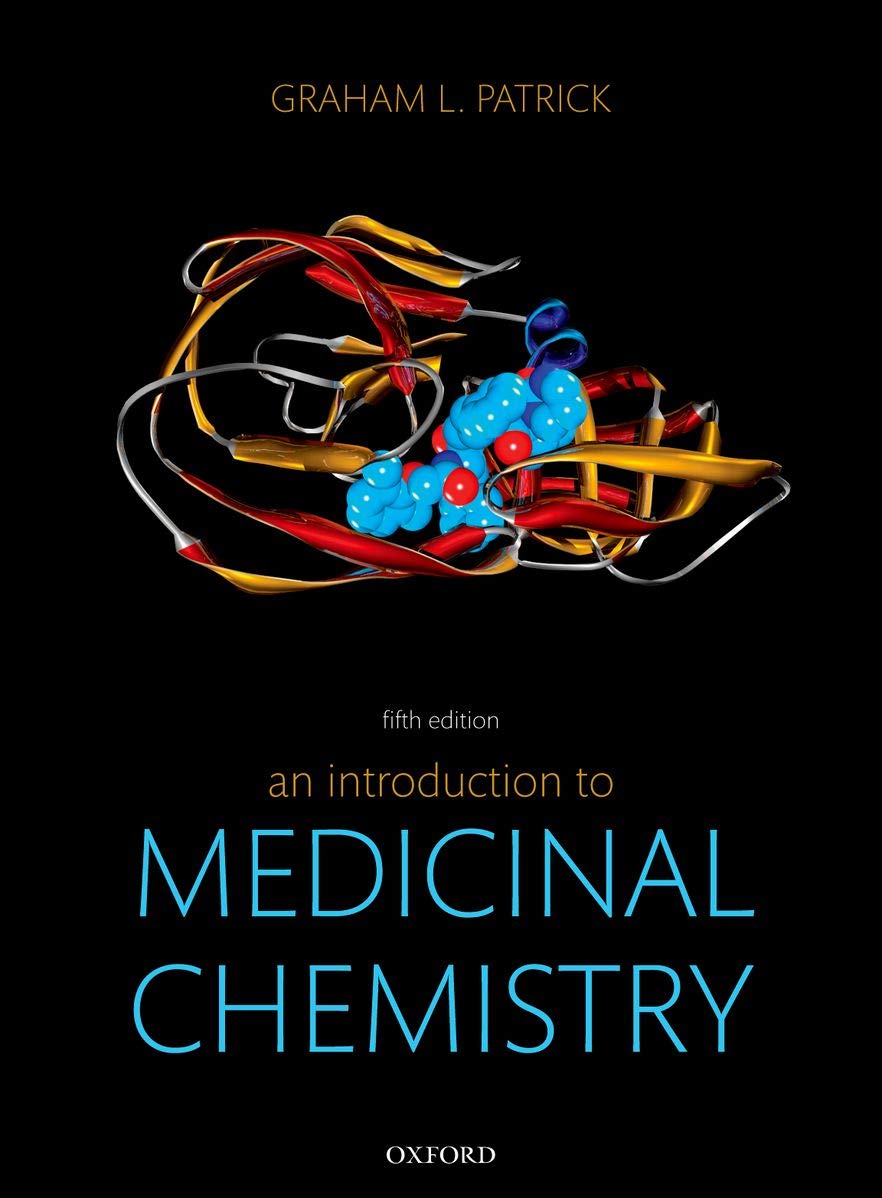
Title


An Introduction To Medicinal Chemistry
Sold by Ergodebooks, an authorized reseller.
Returns accepted within 30 days | support@ergodebooks.com
Shipping Information
- Free Standard Shipping — United States only
- Processing Time: 3–5 business days
- Estimated Delivery: 6–10 business days after dispatch
- Double-boxed, fully insured & discreetly packaged
- Tracking number sent via email once dispatched
Returns & Refund
Returns accepted within 30 days of delivery.
Damaged or Defective Item
Free return shipping + replacement or full refund
Wrong Item Received
Free return shipping + replacement or full refund
Change of Mind
Return shipping at customer's expense · 25% restocking fee applies
Payment Option

An Introduction To Medicinal Chemistry Is The Leading Text For University Courses On This Subject. Renowned For Being A Textbook Loved Equally By Both Students And Lecturers, It Presents Complete Coverage In An Accessible And Engaging Style.The Text Begins With The Essential Biochemistry On Which An Understanding Of Medicinal Chemistry Is Built, Introducing The Structure And Function Of Important Drug Targets. It Then Explores How Drugs Interact With The Body And The Consequences Of Those Reactions. There Is A Section On General Principles And Strategies Involved In Discovering And Designing New Drugs, And Another On Useful 'Tools Of The Trade'. The Text Ends With A Contemporary Look At Specific Topics Within Medicinal Chemistry, For Example, Antiviral And Anticancer Agents; Cholinergics And Anticholinesterases; And Antiulcer Agents.Learning Features Throughout An Introduction To Medicinal Chemistry Help To Unlock This Fascinating Subject. A Glossary Helps To Familiarise The Language Of Medicinal Chemistry. Boxes Present Indepth Material And Explore How Concepts Are Applied In Practice. Key Points Summarise Sections Within Chapters, Providing A Basis For Revision, And Questions At The End Of Chapters And On The Accompanying Online Resource Centre Allow The Reader To Test Their Understanding And Develop Molecular Modelling Skills.Online Resource Centrethe Online Resource Centre Features:For Registered Adopters Of The Book:Dt Answers To Endofchapter Questionsdt Figures From The Bookdt Power Point Slidesdt Test Bank Questionsfor Students:Dt Multiple Choice Questionsdt Web Articlesdt Molecular Modelling Exercisesdt 3D Rotatable Structures
⚠️ WARNING (California Proposition 65):
This product may contain chemicals known to the State of California to cause cancer, birth defects, or other reproductive harm.
For more information, please visit www.P65Warnings.ca.gov.
- Q: How many pages does 'An Introduction to Medicinal Chemistry' have? A: The book contains eight hundred sixteen pages. This extensive coverage provides thorough insights into medicinal chemistry.
- Q: What is the size of this book? A: The dimensions of the book are ten point four inches in length, one point five inches in width, and seven point seven two inches in height.
- Q: What type of binding does this book have? A: It features a paperback binding. This makes it lightweight and easy to handle for students.
- Q: Who is the author of 'An Introduction to Medicinal Chemistry'? A: The author is Graham L. Patrick. He is known for his expertise in the field of medicinal chemistry.
- Q: What subject does this book cover? A: It covers medicinal chemistry extensively. Topics include drug interactions, biochemistry, and drug design principles.
- Q: Is this book suitable for beginners in medicinal chemistry? A: Yes, it is suitable for beginners. The book is designed to be accessible for both students and lecturers.
- Q: Does this book include practical applications of medicinal chemistry? A: Yes, it includes practical applications. Boxes within the text explore how concepts are applied in real-world scenarios.
- Q: Are there any learning features in this book? A: Yes, it includes several learning features. Key points and end-of-chapter questions help reinforce understanding.
- Q: Can students find additional resources related to this book? A: Yes, there is an Online Resource Centre available. It offers multiple choice questions, web articles, and molecular modeling exercises.
- Q: What types of agents are discussed in the book? A: The book discusses antiviral agents, anticancer agents, and antiulcer agents. This provides a contemporary look at medicinal chemistry.
- Q: Is there a glossary in 'An Introduction to Medicinal Chemistry'? A: Yes, there is a glossary included. It helps familiarize readers with the language of medicinal chemistry.
- Q: What kind of figures are included in the Online Resource Centre? A: The Online Resource Centre includes figures from the book. These visuals aid in understanding complex concepts.
- Q: Are there test bank questions available for instructors? A: Yes, registered adopters have access to test bank questions. This resource supports teaching and assessment.
- Q: Does this book cater to both students and lecturers? A: Yes, it caters to both groups. It is well-received by both students for learning and lecturers for teaching.
- Q: How does the book help with revision? A: It includes key points that summarize sections. These summaries provide a strong basis for revision and understanding.