If you have any questions, you are always welcome to contact us. We'll get back to you as soon as possible, withing 24 hours on weekdays.
Customer service
All questions about your order, return and delivery must be sent to our customer service team by e-mail at yourstore@yourdomain.com
Sale & Press
If you are interested in selling our products, need more information about our brand or wish to make a collaboration, please contact us at press@yourdomain.com
Help
If you have any questions, you are always welcome to contact us. We'll get back to you as soon as possible, withing 24 hours on weekdays.
Customer service
All questions about your order, return and delivery must be sent to our customer service team by e-mail at yourstore@yourdomain.com
Sale & Press
If you are interested in selling our products, need more information about our brand or wish to make a collaboration, please contact us at press@yourdomain.com
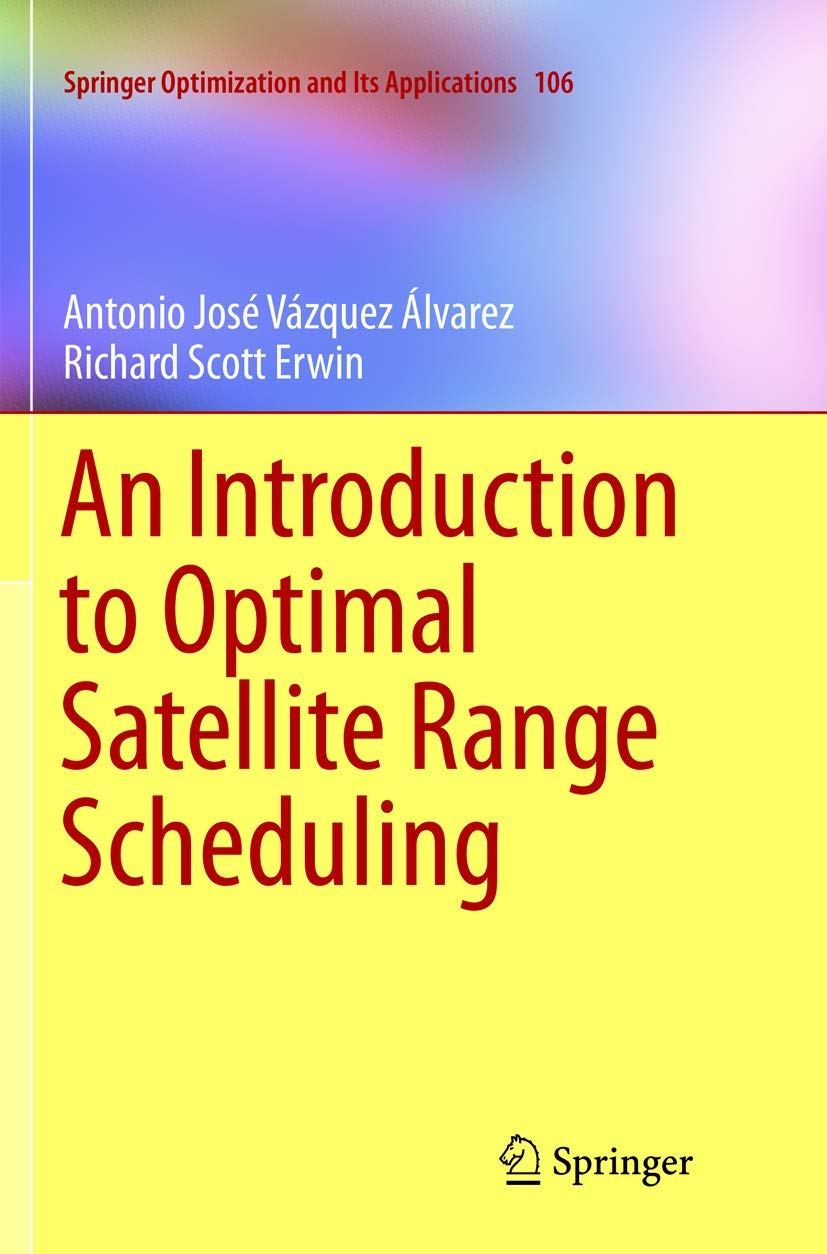
The satellite range scheduling (SRS) problem, an important operations research problem in the aerospace industry consisting of allocating tasks among satellites and Earthbound objects, is examined in this book. SRS principles and solutions are applicable to many areas, including:Satellite communications, where tasks are communication intervals between sets of satellites and ground stations Earth observation, where tasks are observations of spots on the Earth by satellites Sensor scheduling, where tasks are observations of satellites by sensors on the Earth.This selfcontained monograph begins with a structured compendium of the problem and moves on to explain the optimal approach to the solution, which includes aspects from graph theory, set theory, game theory and belief networks. This book is accessible to students, professionals and researchers in a variety of fields, including: operations research, optimization, scheduling theory, dynamic programming and game theory. Taking account of the distributed, stochastic and dynamic variants of the problem, this book presents the optimal solution to the fixed interval SRS problem and how to migrate results into more complex cases. Reference algorithms and traditional algorithms for solving the scheduling problems are provided and compared with examples and simulations in practical scenarios.
⚠️ WARNING (California Proposition 65):
This product may contain chemicals known to the State of California to cause cancer,
birth defects, or other reproductive harm.
For MAP (Minimum Advertised Price) violations and Intellectual Property (IP) or Trademark concerns, please contact:
support@ergodebooks.com
⚠️ California Proposition 65 Warning: Some products sold on this website may expose you to chemicals known to the State of California to cause cancer, birth defects, or other reproductive harm. For more information, visit www.P65Warnings.ca.gov.