If you have any questions, you are always welcome to contact us. We'll get back to you as soon as possible, withing 24 hours on weekdays.
Customer service
All questions about your order, return and delivery must be sent to our customer service team by e-mail at yourstore@yourdomain.com
Sale & Press
If you are interested in selling our products, need more information about our brand or wish to make a collaboration, please contact us at press@yourdomain.com
Help
If you have any questions, you are always welcome to contact us. We'll get back to you as soon as possible, withing 24 hours on weekdays.
Customer service
All questions about your order, return and delivery must be sent to our customer service team by e-mail at yourstore@yourdomain.com
Sale & Press
If you are interested in selling our products, need more information about our brand or wish to make a collaboration, please contact us at press@yourdomain.com
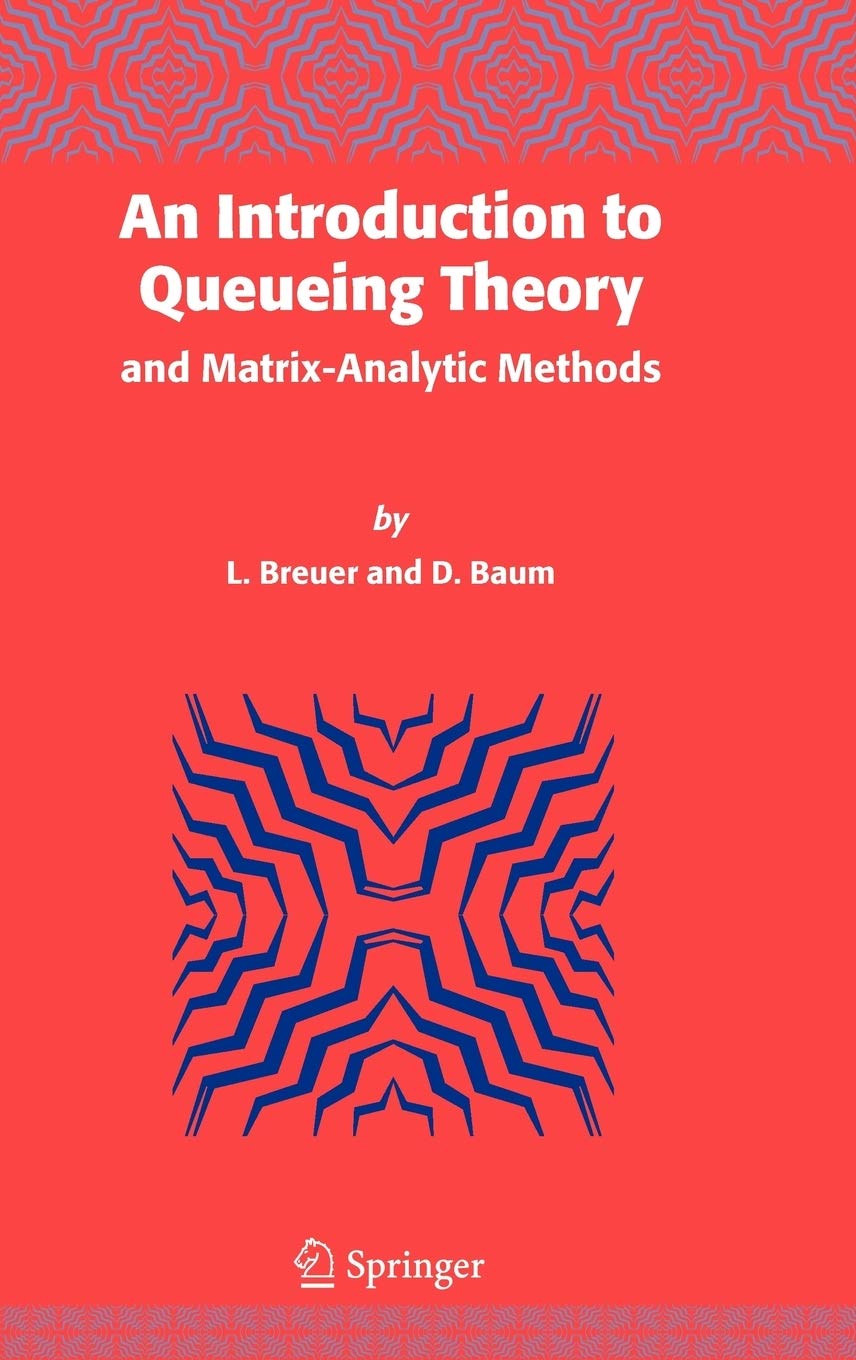
The present textbook contains the recordsof a twosemester course on que ing theory, including an introduction to matrixanalytic methods. This course comprises four hours oflectures and two hours of exercises per week andhas been taughtattheUniversity of Trier, Germany, for about ten years in quence. The course is directed to last year undergraduate and?rst year gr uate students of applied probability and computer science, who have already completed an introduction to probability theory. Its purpose is to present terial that is close enough to concrete queueing models and their applications, while providing a sound mathematical foundation for the analysis of these. Thus the goal of the present book is twofold. On the one hand, students who are mainly interested in applications easily feel bored by elaborate mathematical questions in the theory of stochastic processes. The presentation of the mathematical foundations in our courses is chosen to cover only the necessary results, which are needed for a solid foundation of the methods of queueing analysis. Further, students oriented wards applications expect to have a justi?cation for their mathematical efforts in terms of immediate use in queueing analysis. This is the main reason why we have decided to introduce new mathematical concepts only when they will be used in the immediate sequel. On the other hand, students of applied probability do not want any heur tic derivations just for the sake of yielding fast results for the model at hand.
⚠️ WARNING (California Proposition 65):
This product may contain chemicals known to the State of California to cause cancer,
birth defects, or other reproductive harm.
For MAP (Minimum Advertised Price) violations and Intellectual Property (IP) or Trademark concerns, please contact:
support@ergodebooks.com
⚠️ California Proposition 65 Warning: Some products sold on this website may expose you to chemicals known to the State of California to cause cancer, birth defects, or other reproductive harm. For more information, visit www.P65Warnings.ca.gov.