
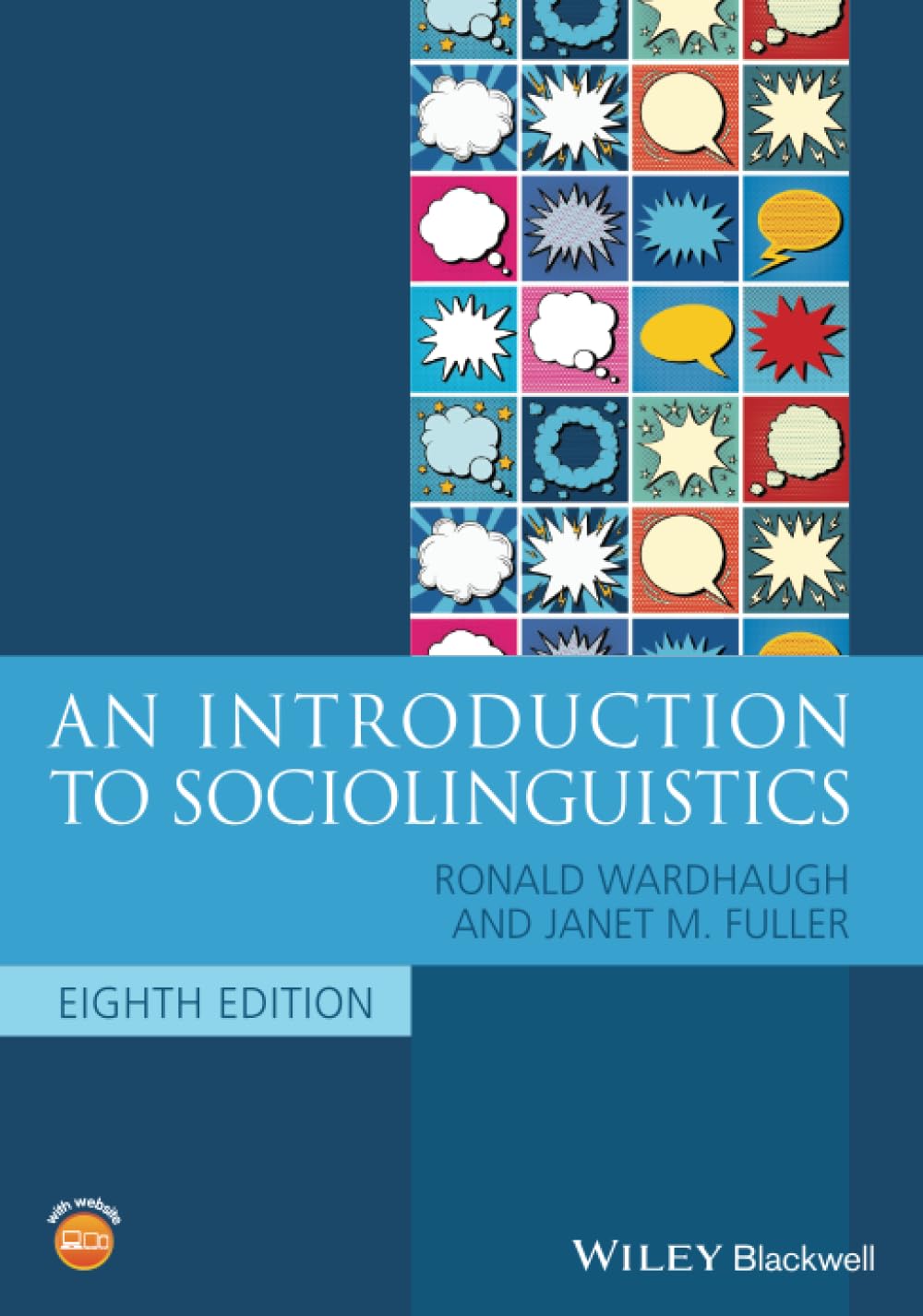
Title

An Introduction to Sociolinguistics, 8th Edition (Blackwell Textbooks in Linguistics),Used
Sold by Ergodebooks, an authorized reseller.
Returns accepted within 30 days | support@ergodebooks.com
Shipping Information
- Free Standard Shipping — United States only
- Processing Time: 3–5 business days
- Estimated Delivery: 6–10 business days after dispatch
- Double-boxed, fully insured & discreetly packaged
- Tracking number sent via email once dispatched
Returns & Refund
Returns accepted within 30 days of delivery.
Damaged or Defective Item
Free return shipping + replacement or full refund
Wrong Item Received
Free return shipping + replacement or full refund
Change of Mind
Return shipping at customer's expense · 25% restocking fee applies
Payment Option

AN INTRODUCTION TO SOCIOLINGUISTICSThe new eighth edition of An Introduction to Sociolinguistics brings this valuable, bestselling textbook up to date with the latest in sociolinguistic research and pedagogy, providing a broad overview of the study of language in social context with accessible coverage of major concepts, theories, methods, issues, and debates within the field. This leading text helps students develop a critical perspective on language in society as they explore the complex connections between societal norms and language use. The eighth edition contains new and updated coverage of such topics as the societal aspects of African American Vernacular English (AAVE), multilingual societies and discourse, gender and sexuality, ideologies and language attitudes, and the social meanings of linguistic forms.Organized in four sections, this text first covers traditional language issues such as the distinction between languages and dialects, identification of regional and social variation within languages, and the role of context in language use and interpretation. Subsequent chapters cover approaches to research in sociolinguisticsvariationist sociolinguistics, ethnography, and discourse analytic researchand address both macro and microsociolinguistic aspects of multilingualism in national, transnational, global, and digital contexts. The concluding section of the text looks at language in relation to gender and sexuality, education, and language planning and policy issues. Featuring examples from a variety of languages and cultures that illustrate topics such as social and regional dialects, multilingualism, and the linguistic construction of identity, this text provides perspectives on both new and foundational research in sociolinguistics and linguistic anthropology.An Introduction to Sociolinguistics, Eighth Edition, remains the ideal textbook for upperlevel undergraduate and graduate course in sociolinguistics, language and society, linguistic anthropology, applied and theoretical linguistics, and education. The new edition has also been updated to support classroom application with a range of effective pedagogical tools, including endofchapter written exercises and an instructor website, as well as materials to support further learning such as reading suggestions, research ideas, and an updated companion student website containing a searchable glossary, a review guide, additional exercises and examples, and links to online resources.
⚠️ WARNING (California Proposition 65):
This product may contain chemicals known to the State of California to cause cancer, birth defects, or other reproductive harm.
For more information, please visit www.P65Warnings.ca.gov.
- Q: What is the page count of this book? A: The book contains four hundred eighty pages. This comprehensive length allows for an in-depth exploration of sociolinguistic concepts and theories.
- Q: What are the dimensions of this textbook? A: The book measures six point six one inches in length, one point one inches in width, and nine point five inches in height. These dimensions make it a portable choice for students.
- Q: What is the binding type of this book? A: This textbook is paperback bound. This binding style is lightweight and flexible, making it easy to carry and handle.
- Q: How do I read this textbook effectively? A: To read this textbook effectively, start by reviewing the chapter summaries and end-of-chapter exercises. Engaging with these materials enhances comprehension of sociolinguistic themes.
- Q: Is this book suitable for graduate students? A: Yes, this book is suitable for graduate students. It provides advanced insights into sociolinguistics, making it ideal for upper-level courses.
- Q: What age group is this textbook appropriate for? A: This textbook is designed for upper-level undergraduate and graduate students. It addresses complex sociolinguistic topics suited for adults.
- Q: How should I store this book to maintain its condition? A: Store this book upright in a cool, dry place. Keeping it away from direct sunlight will help preserve the cover and pages.
- Q: Can this textbook be used for self-study? A: Yes, this textbook is suitable for self-study. It includes exercises and resources that facilitate independent learning.
- Q: What should I do if my book arrives damaged? A: If your book arrives damaged, contact the seller for a return or exchange. Most retailers offer policies to address such issues.
- Q: Are there additional resources available for this book? A: Yes, there are additional resources available. An updated companion student website provides a glossary, review guides, and online materials.
- Q: What topics are covered in this textbook? A: The textbook covers various sociolinguistic topics, including language varieties, multilingualism, and the relationship between language and identity. It offers a broad overview of the field.
- Q: Who is the author of this book? A: The author of this book is Ronald Wardhaugh. He is a noted scholar in the field of sociolinguistics.
- Q: Is this book suitable for beginners in sociolinguistics? A: While primarily aimed at upper-level students, beginners may find it useful with supplementary materials. The structured approach helps in understanding complex ideas.
- Q: What pedagogical tools are included in this edition? A: This edition includes end-of-chapter exercises and an instructor website to support learning. These tools enhance classroom application.
- Q: Does this book discuss language in relation to gender? A: Yes, it discusses language in relation to gender and sexuality. This topic is explored in the context of sociolinguistic research.