
Title
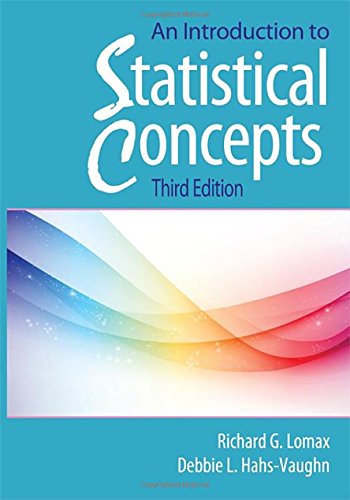
An Introduction to Statistical Concepts: Third Edition,Used
Sold by Ergodebooks, an authorized reseller.
Returns accepted within 30 days | support@ergodebooks.com
Shipping Information
- Free Standard Shipping — United States only
- Processing Time: 3–5 business days
- Estimated Delivery: 6–10 business days after dispatch
- Double-boxed, fully insured & discreetly packaged
- Tracking number sent via email once dispatched
Returns & Refund
Returns accepted within 30 days of delivery.
Damaged or Defective Item
Free return shipping + replacement or full refund
Wrong Item Received
Free return shipping + replacement or full refund
Change of Mind
Return shipping at customer's expense · 25% restocking fee applies
Payment Option

This comprehensive, flexible text is used in both one and twosemester courses to review introductory through intermediate statistics. Instructors select the topics that are most appropriate for their course. Its conceptual approach helps students more easily understand the concepts and interpret SPSS and research results. Key concepts are simply stated and occasionally reintroduced and related to one another for reinforcement. Numerous examples demonstrate their relevance. This edition features more explanation to increase understanding of the concepts. Only crucial equations are included.In addition to updating throughout, the new edition features: New coauthor, Debbie L. HahsVaughn, the 2007 recipient of the University of Central Florida's College of Education Excellence in Graduate Teaching Award. A new chapter on logistic regression models for today's more complex methodologies. More on computing confidence intervals and conducting power analyses using G*Power. Many more SPSS screenshots to assist with understanding how to navigate SPSS and annotated SPSS output to assist in the interpretation of results. Extended sections on how to writeup statistical results in APA format. New learning tools including chapteropening vignettes, outlines, and a list of key concepts, many more examples, tables, and figures, boxes, and chapter summaries. More tables of assumptions and the effects of their violation including how to test them in SPSS. 33% new conceptual, computational, and all new interpretative problems. A website that features PowerPoint slides, answers to the evennumbered problems, and test items for instructors, and for students the chapter outlines, key concepts, and datasets that can be used in SPSS and other packages, and more.Each chapter begins with an outline, a list of key concepts, and a vignette related to those concepts. Realistic examples from education and the behavioral sciences illustrate those concepts. Each example examines the procedures and assumptions and provides instructions for how to run SPSS, including annotated output, and tips to develop an APA style writeup. Useful tables of assumptions and the effects of their violation are included, along with how to test assumptions in SPSS. 'Stop and Think' boxes provide helpful tips for better understanding the concepts. Each chapter includes computational, conceptual, and interpretive problems. The data sets used in the examples and problems are provided on the web. Answers to the oddnumbered problems are given in the book.The first five chapters review descriptive statistics including ways of representing data graphically, statistical measures, the normal distribution, and probability and sampling. The remainder of the text covers inferential statistics involving means, proportions, variances, and correlations, basic and advanced analysis of variance and regression models. Topics not dealt with in other texts such as robust methods, multiple comparison and nonparametric procedures, and advanced ANOVA and multiple and logistic regression models are also reviewed.Intended for one or twosemester courses in statistics taught in education and/or the behavioral sciences at the graduate and/or advanced undergraduate level, knowledge of statistics is not a prerequisite. A rudimentary knowledge of algebra is required.
⚠️ WARNING (California Proposition 65):
This product may contain chemicals known to the State of California to cause cancer, birth defects, or other reproductive harm.
For more information, please visit www.P65Warnings.ca.gov.