
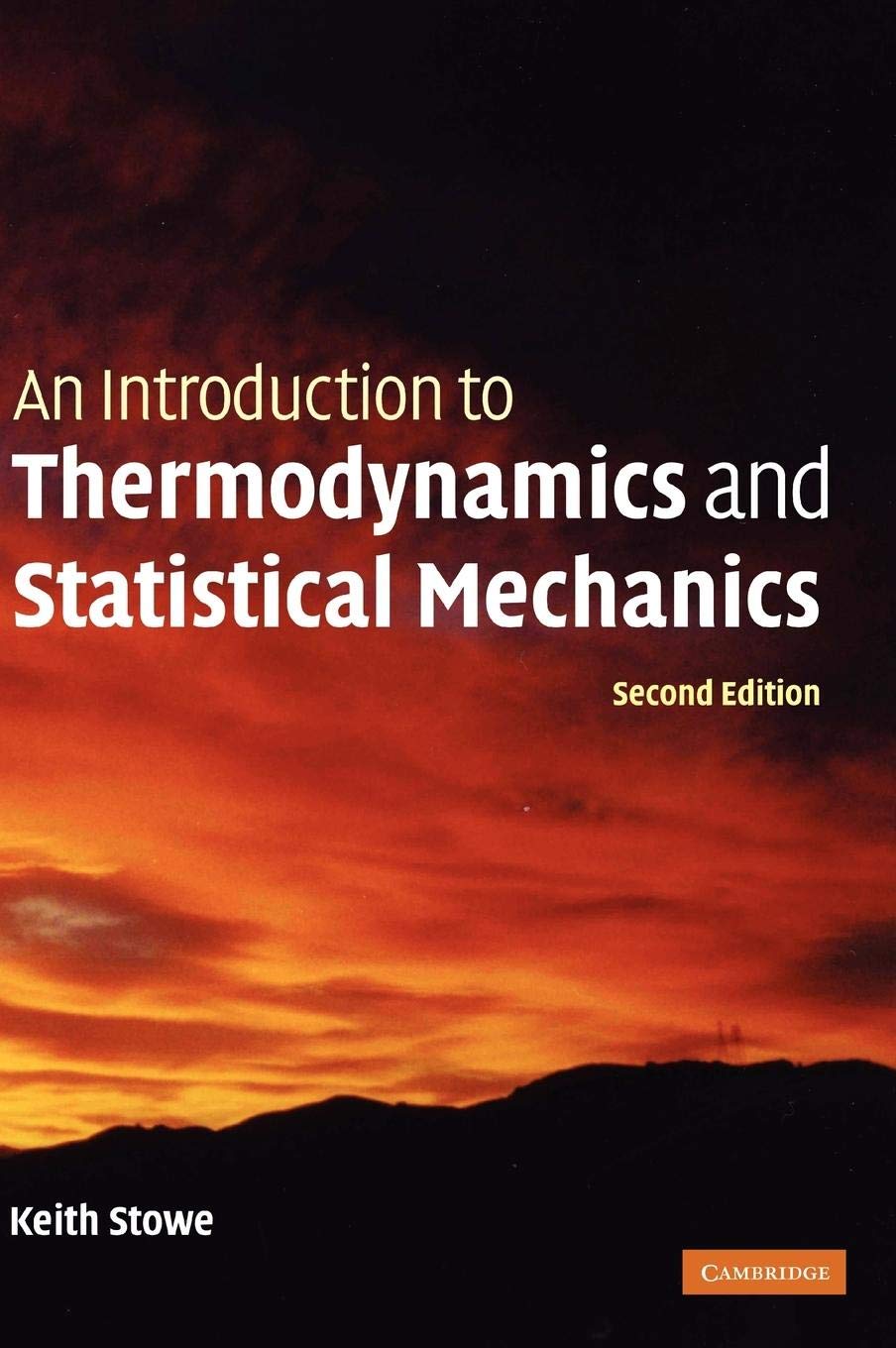
Title
An Introduction To Thermodynamics And Statistical Mechanics,Used
Sold by Ergodebooks, an authorized reseller.
Returns accepted within 30 days | support@ergodebooks.com
Shipping Information
- Free Standard Shipping — United States only
- Processing Time: 3–5 business days
- Estimated Delivery: 6–10 business days after dispatch
- Double-boxed, fully insured & discreetly packaged
- Tracking number sent via email once dispatched
Returns & Refund
Returns accepted within 30 days of delivery.
Damaged or Defective Item
Free return shipping + replacement or full refund
Wrong Item Received
Free return shipping + replacement or full refund
Change of Mind
Return shipping at customer's expense · 25% restocking fee applies
Payment Option

This Introductory Textbook For Standard Undergraduate Courses In Thermodynamics Has Been Completely Rewritten To Explore A Greater Number Of Topics, More Clearly And Concisely. Starting With An Overview Of Important Quantum Behaviours, The Book Teaches Students How To Calculate Probabilities In Order To Provide A Firm Foundation For Later Chapters. It Introduces The Ideas Of Classical Thermodynamics And Explores Them Both In General And As They Are Applied To Specific Processes And Interactions. The Remainder Of The Book Deals With Statistical Mechanics. Each Topic Ends With A Boxed Summary Of Ideas And Results, And Every Chapter Contains Numerous Homework Problems, Covering A Broad Range Of Difficulties. Answers Are Given To Oddnumbered Problems, And Solutions To Evennumbered Problems Are Available To Instructors At Www.Cambridge.Org/9781107694927.
⚠️ WARNING (California Proposition 65):
This product may contain chemicals known to the State of California to cause cancer, birth defects, or other reproductive harm.
For more information, please visit www.P65Warnings.ca.gov.
- Q: How many pages does this book have? A: The book contains five hundred seventy-two pages. This extensive length allows for a thorough exploration of thermodynamics and statistical mechanics.
- Q: What is the binding type of this textbook? A: This textbook is available in hardcover. The hardcover binding ensures durability for frequent use in academic settings.
- Q: What are the dimensions of the book? A: The book measures seven point five two inches in length, one inch in width, and nine point five inches in height. These dimensions make it a standard size for textbooks.
- Q: Who is the author of this book? A: The author of this book is Keith Stowe. He has rewritten this edition to clarify complex concepts in thermodynamics.
- Q: What topics does this textbook cover? A: The book covers thermodynamics and statistical mechanics. It begins with quantum behaviors and progresses to classical thermodynamics principles.
- Q: Is this textbook suitable for beginners? A: Yes, this textbook is suitable for beginners. It is designed for standard undergraduate courses, making it accessible for new students in the field.
- Q: How are the homework problems structured? A: Each chapter contains numerous homework problems of varying difficulties. Answers to odd-numbered problems are provided, while solutions to even-numbered problems are available for instructors.
- Q: How does this book help with understanding statistical mechanics? A: This book provides a comprehensive introduction to statistical mechanics. It includes summaries and numerous examples to enhance understanding.
- Q: What resources are available for instructors? A: Instructors can access solutions to even-numbered problems at www.cambridge.org/9781107694927. This resource facilitates teaching and grading.
- Q: Are there any illustrations in this textbook? A: Yes, the book includes illustrations. Specifically, it features one hundred seventy-five black and white illustrations to aid in visual learning.
- Q: How should I care for this hardcover book? A: To keep the book in good condition, store it in a dry place and avoid exposure to direct sunlight. Clean it gently with a soft cloth as needed.
- Q: Is the book suitable for self-study? A: Yes, this book is suitable for self-study. The structured chapters and homework problems make it ideal for independent learners.
- Q: Does the book include summaries of key concepts? A: Yes, each topic ends with a boxed summary of ideas and results. This helps reinforce the material covered in each chapter.
- Q: What is the target audience for this textbook? A: The target audience includes undergraduate students studying Earth Sciences. It is also suitable for anyone interested in thermodynamics.
- Q: Can this book be used in graduate-level courses? A: While primarily aimed at undergraduates, the book's comprehensive coverage may also benefit graduate students looking for a solid foundation.
- Q: Are there any prerequisites for reading this book? A: A basic understanding of physics and calculus is recommended. This foundation will help readers grasp the concepts introduced in the book.