
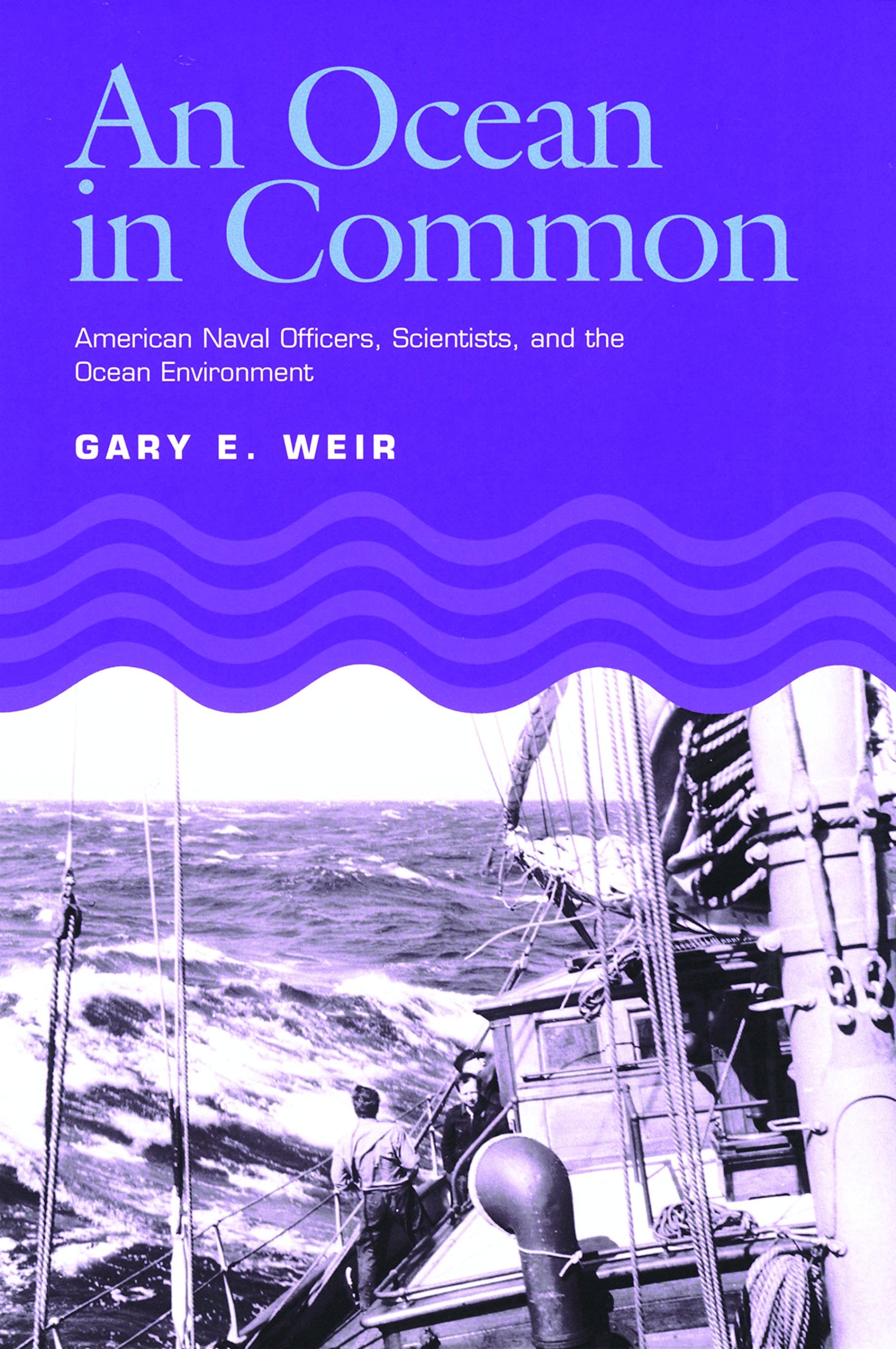
Title
An Ocean in Common: American Naval Officers, Scientists, and the Ocean Environment (Volume 72) (WilliamsFord Texas A&M Universi,Used
Sold by Ergodebooks, an authorized reseller.
Returns accepted within 30 days | support@ergodebooks.com
Shipping Information
- Free Standard Shipping — United States only
- Processing Time: 3–5 business days
- Estimated Delivery: 6–10 business days after dispatch
- Double-boxed, fully insured & discreetly packaged
- Tracking number sent via email once dispatched
Returns & Refund
Returns accepted within 30 days of delivery.
Damaged or Defective Item
Free return shipping + replacement or full refund
Wrong Item Received
Free return shipping + replacement or full refund
Change of Mind
Return shipping at customer's expense · 25% restocking fee applies
Payment Option

Through two victorious world conflicts and a Cold War, the U.S. Navy and American ocean scientists drew ever closer, converting an early marriage of necessity into a relationship of astonishing achievement. Beginning in 1919, Gary Weir's An Ocean in Common traces the first fortytwo years of their joint quest to understand each other and the deep ocean.Early in the twentieth century, American naval officers questioned the tactical and strategic significance of applied ocean science, demonstrating the gap between this kind of knowledge and that deemed critical to naval warfare. At the same time, scientists studying the ocean labored in their inadequately funded, discreet disciplines, seemingly content to keep naval warfare at arm's length. German Uboat success in World War I changed these views fundamentally, bringing ocean science insights to an increasing number of naval objectives.Driven primarily by antisubmarine priorities, the physics, chemistry, and geology of the ocean, more than its biology, became the early focus of American ocean studies. The World War II experience solidified the Navy's relationship with ocean scientists, and the years after 1945 found the American military investing heavily in both applied and basic research. Today, oceanography is a permanent resident on the bridge of American fighting ships and the Navy continues to provide much of theimpetus and funding for fundamental research, in both naval and civilian laboratories.In An Ocean in Common Gary Weir focuses on the compelling motives and carefully engineered course that brought scientists and naval officers together, across a considerable cultural divide, to achieve a more comprehensive understanding of one another and the world ocean. Weir details how this alliance laid the powerful multidisciplinary foundation for longrange ocean communication and surveillance, modern submarine warfare, deep submergence, and the emergence of oceanography and ocean engineering as independent and vital fields of study.
⚠️ WARNING (California Proposition 65):
This product may contain chemicals known to the State of California to cause cancer, birth defects, or other reproductive harm.
For more information, please visit www.P65Warnings.ca.gov.
- Q: What is the main focus of 'An Ocean in Common'? A: The book primarily focuses on the collaboration between U.S. Navy officers and ocean scientists from 1919 to the post-World War II era, highlighting their efforts to understand the ocean environment and its significance to naval operations.
- Q: Who is the author of 'An Ocean in Common'? A: The author of the book is Gary E. Weir.
- Q: What is the publication date of this book? A: The book was published on May 1, 2001.
- Q: What condition is the book in? A: The book is described as 'Used Book in Good Condition'.
- Q: How many pages does 'An Ocean in Common' have? A: The book contains 424 pages.
- Q: What binding type does the book have? A: The book is available in hardcover binding.
- Q: What are some key themes discussed in the book? A: Key themes include the evolution of the relationship between naval officers and ocean scientists, the impact of World War I and World War II on naval strategies, and the development of oceanography as a critical field for military and civilian applications.
- Q: Is this book part of a series? A: Yes, it is part of the Williams-Ford Texas A&M University Military History Series.
- Q: What topics related to ocean science does the book cover? A: The book covers topics such as the physics, chemistry, and geology of the ocean, as well as the military applications of oceanographic research.
- Q: Who would benefit from reading 'An Ocean in Common'? A: This book would benefit historians, military personnel, oceanographers, and anyone interested in the intersection of military history and ocean science.