
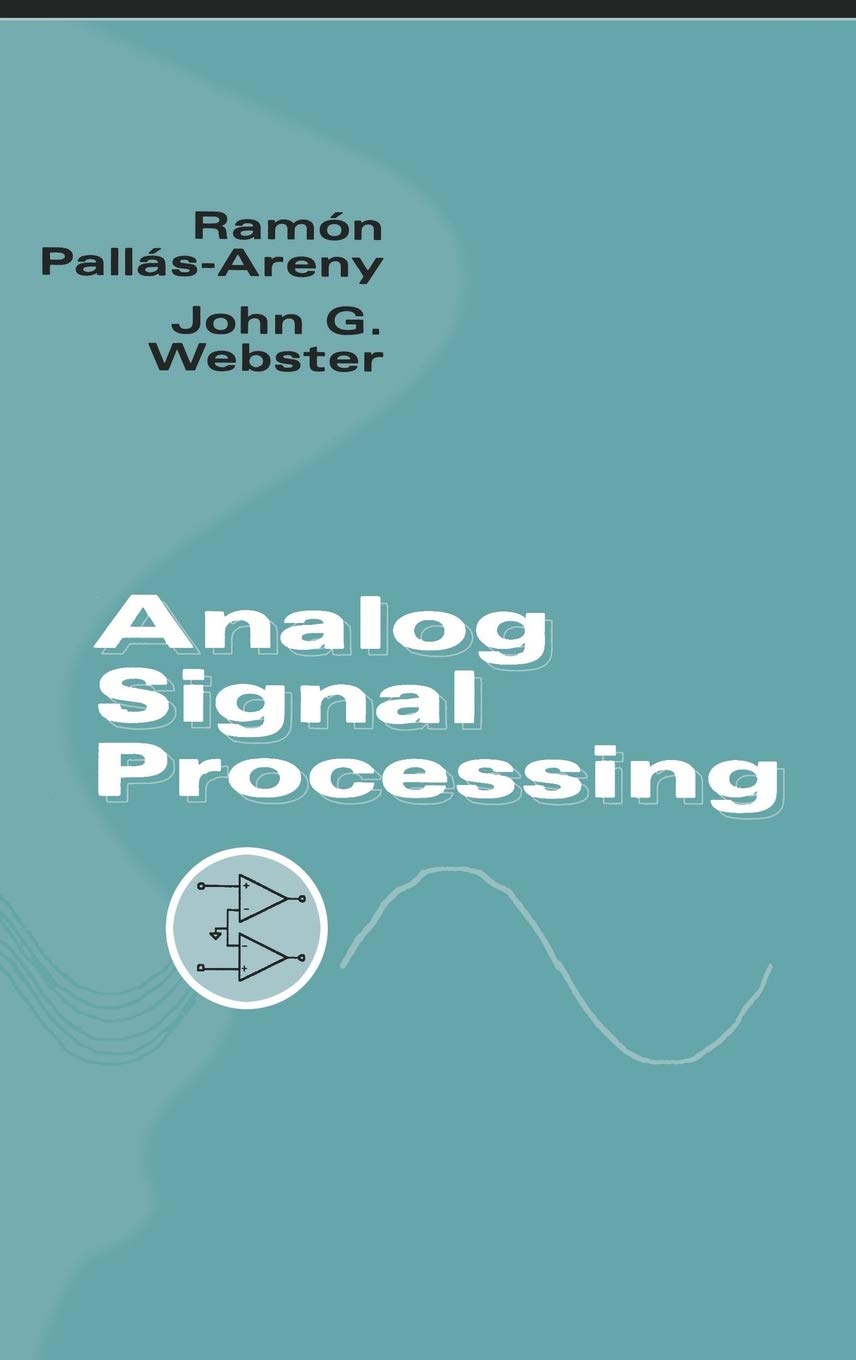
Title
Analog Signal Processing
Sold by Ergodebooks, an authorized reseller.
Returns accepted within 30 days | support@ergodebooks.com
Shipping Information
- Free Standard Shipping — United States only
- Processing Time: 3–5 business days
- Estimated Delivery: 6–10 business days after dispatch
- Double-boxed, fully insured & discreetly packaged
- Tracking number sent via email once dispatched
Returns & Refund
Returns accepted within 30 days of delivery.
Damaged or Defective Item
Free return shipping + replacement or full refund
Wrong Item Received
Free return shipping + replacement or full refund
Change of Mind
Return shipping at customer's expense · 25% restocking fee applies
Payment Option

A Proven, Costeffective Approach To Solving Analog Signal Processing Design Problemsmost Design Problems Involving Analog Circuits Require A Great Deal Of Creativity To Solve. But, As The Authors Of This Groundbreaking Guide Demonstrate, Finding Solutions To Most Analog Signal Processing Problems Does Not Have To Be That Difficult.Analog Signal Processing Presents An Original, Fivestep, Designoriented Approach To Solving Analog Signal Processing Problems Using Standard Ics As Building Blocks. Unlike Most Authors Who Prescribe A Bottomup Approach, Professors Pallsareny And Webster Cast Design Problems First In Functional Terms And Then Develop Possible Solutions Using Available Ics, Focusing On Circuit Performance Rather Than Internal Structure. The Five Steps Of Their Approach Move From Signal Classification, Definition Of Desired Functions, And Description Of Analog Domain Conversions To Error Classification And Error Analysis.Featuring 90 Worked Examplesmany Of Them Drawn From Actual Implementationsand More Than 130 Skillbuilding Chapterend Problems, Analog Signal Processing Is Both A Valuable Working Resource For Practicing Design Engineers And A Textbook For Advanced Courses In Electronic Instrumentation Design.
⚠️ WARNING (California Proposition 65):
This product may contain chemicals known to the State of California to cause cancer, birth defects, or other reproductive harm.
For more information, please visit www.P65Warnings.ca.gov.
- Q: How many pages does this book have? A: This book contains six hundred eight pages. It covers various aspects of analog signal processing in detail.
- Q: What is the binding type of 'Analog Signal Processing'? A: The book is a hardcover edition. This provides durability and a professional appearance for both personal and academic use.
- Q: What are the dimensions of this book? A: The book measures six point three inches in length, one point thirty-eight inches in width, and nine point thirty-nine inches in height. These dimensions make it easy to handle and store.
- Q: How should I read and utilize this book? A: To best use this book, follow the five-step design-oriented approach outlined by the authors. It is suitable for both self-study and as a textbook in advanced courses.
- Q: Is this book suitable for beginners in signal processing? A: While it is designed for advanced courses, beginners may benefit from it if they are willing to engage with the material. The book contains numerous worked examples that can aid understanding.
- Q: Can this book be used for professional reference? A: Yes, it serves as a valuable working resource for practicing design engineers. The practical examples make it a useful reference tool in professional settings.
- Q: How should I care for this hardcover book? A: To keep it in good condition, store it upright on a shelf and avoid exposing it to moisture. Clean the cover with a dry cloth to remove dust.
- Q: Is this book safe for all readers? A: Yes, there are no adult themes in this book. It is focused on technical content suitable for a wide audience interested in electronics.
- Q: What should I do if the book arrives damaged? A: If the book arrives damaged, contact the seller for a return or replacement. Most sellers have policies in place to handle such situations.
- Q: What if I have questions while reading the book? A: You can refer to the worked examples and chapter-end problems for clarification. Additionally, online forums and study groups may provide further assistance.
- Q: How do the authors approach analog signal processing problems? A: The authors present a five-step design-oriented approach. This method emphasizes functional definitions before exploring solutions using standard integrated circuits.
- Q: Are there practice problems in this book? A: Yes, there are over one hundred thirty skill-building chapter-end problems. These are designed to reinforce learning and application of concepts.
- Q: Who are the authors of 'Analog Signal Processing'? A: The authors are Professors Ramón Pallás-Areny and Webster. They are renowned for their expertise in electronics and instrumentation design.
- Q: Is this book appropriate for engineering students? A: Yes, it is particularly suitable for engineering students studying electronic instrumentation design. The content aligns well with advanced academic curricula.
- Q: What kind of topics does this book cover? A: The book covers various aspects of analog signal processing, including signal classification, function definition, and error analysis. It is comprehensive in its approach.