
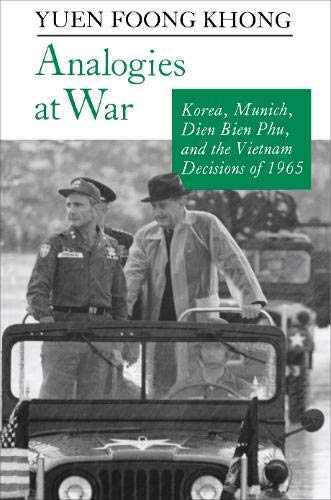
Title
Analogies At War: Korea, Munich, Dien Bien Phu, And The Vietnam Decisions Of 1965,Used
Sold by Ergodebooks, an authorized reseller.
Returns accepted within 30 days | support@ergodebooks.com
Shipping Information
- Free Standard Shipping — United States only
- Processing Time: 3–5 business days
- Estimated Delivery: 6–10 business days after dispatch
- Double-boxed, fully insured & discreetly packaged
- Tracking number sent via email once dispatched
Returns & Refund
Returns accepted within 30 days of delivery.
Damaged or Defective Item
Free return shipping + replacement or full refund
Wrong Item Received
Free return shipping + replacement or full refund
Change of Mind
Return shipping at customer's expense · 25% restocking fee applies
Payment Option

From World War I To Operation Desert Storm, American Policymakers Have Repeatedly Invoked The 'Lessons Of History' As They Contemplated Taking Their Nation To War. Do These Historical Analogies Actually Shape Policy, Or Are They Primarily Tools Of Political Justification? Yuen Foong Khong Argues That Leaders Use Analogies Not Merely To Justify Policies But Also To Perform Specific Cognitive And Informationprocessing Tasks Essential To Political Decisionmaking. Khong Identifies What These Tasks Are And Shows How They Can Be Used To Explain The U.S. Decision To Intervene In Vietnam. Relying On Interviews With Senior Officials And On Recently Declassified Documents, The Author Demonstrates With A Precision Not Attained By Previous Studies That The Three Most Important Analogies Of The Vietnam Erakorea, Munich, And Dien Bien Phucan Account For America'S Vietnam Choices. A Special Contribution Is The Author'S Use Of Cognitive Social Psychology To Support His Argument About How Humans Analogize And To Explain Why Policymakers Often Use Analogies Poorly.
⚠️ WARNING (California Proposition 65):
This product may contain chemicals known to the State of California to cause cancer, birth defects, or other reproductive harm.
For more information, please visit www.P65Warnings.ca.gov.
- Q: What is the page count of the book? A: The book has three hundred four pages. This length provides ample content for a thorough exploration of the subject matter.
- Q: What are the dimensions of this book? A: The book measures six and a half inches in length, one inch in width, and nine and a half inches in height. These dimensions make it a standard size for hardcover books.
- Q: What type of binding does this book have? A: This book features a hardcover binding. This type of binding offers durability and a premium feel compared to paperback editions.
- Q: Who is the author of this book? A: The author is Yuen Foong Khong. He is recognized for his insights into international relations and historical analogies.
- Q: What is the genre of this book? A: This book falls under the category of 'Korean War'. It explores historical events and their implications on U.S. foreign policy.
- Q: Is this book suitable for academic use? A: Yes, this book is suitable for academic use. It provides in-depth analysis and references that can support research in political science and history.
- Q: How does this book analyze historical analogies? A: The book analyzes historical analogies by examining how policymakers reference past events to inform their decisions. It offers a cognitive perspective on decision-making.
- Q: Is this book appropriate for high school students? A: Yes, this book is appropriate for high school students. It discusses complex topics but is accessible with guidance from teachers or mentors.
- Q: What themes are explored in this book? A: The book explores themes of historical analogies, decision-making processes, and U.S. intervention in foreign conflicts. It provides insights into cognitive psychology.
- Q: How should I care for this hardcover book? A: To care for this hardcover book, store it in a cool, dry place and avoid exposing it to direct sunlight. This will help preserve its condition.
- Q: Can I return this book if I don't like it? A: Yes, you can return the book if you're not satisfied with it. Check the retailer's return policy for specific conditions and time frames.
- Q: What if the book arrives damaged? A: If the book arrives damaged, contact the seller immediately. Most retailers have a process for returns or exchanges for damaged items.
- Q: Is there a warranty for this book? A: No, books typically do not come with a warranty. However, you can inquire about return policies from the seller.
- Q: How do I store this book to keep it in good condition? A: Store this book upright on a shelf with similar-sized books. Avoid stacking heavy items on top to prevent damage.
- Q: Is this book a good resource for understanding U.S. foreign policy? A: Yes, this book is a valuable resource for understanding U.S. foreign policy. It provides historical context and analysis of critical decisions.