
Title
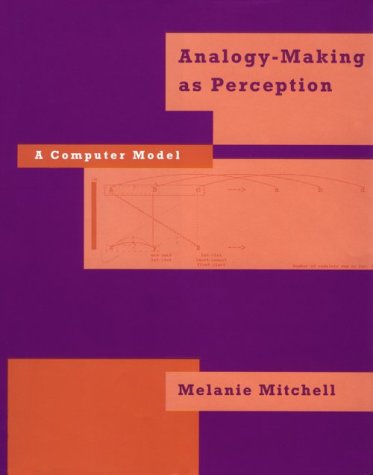
AnalogyMaking as Perception: A Computer Model,Used
Sold by Ergodebooks, an authorized reseller.
Returns accepted within 30 days | support@ergodebooks.com
Shipping Information
- Free Standard Shipping — United States only
- Processing Time: 3–5 business days
- Estimated Delivery: 6–10 business days after dispatch
- Double-boxed, fully insured & discreetly packaged
- Tracking number sent via email once dispatched
Returns & Refund
Returns accepted within 30 days of delivery.
Damaged or Defective Item
Free return shipping + replacement or full refund
Wrong Item Received
Free return shipping + replacement or full refund
Change of Mind
Return shipping at customer's expense · 25% restocking fee applies
Payment Option

The psychologist William James observed that 'a native talent for perceiving analogies is ... the leading fact in genius of every order.' The centrality and the ubiquity of analogy in creative thought have been noted again and again by scientists, artists, and writers, and understanding and modeling analogical thought have emerged as two of the most important challenges for cognitive science.AnalogyMaking as Perception is based on the premise that analogymaking is fundamentally a highlevel perceptual process in which the interaction of perception and concepts gives rise to 'conceptual slippages' which allow analogies to be made. It describes Copycat a computer model of analogymaking, developed by the author with Douglas Hofstadter, that models the complex, subconscious interaction between perception and concepts that underlies the creation of analogies.In Copycat, both concepts and highlevel perception are emergent phenomena, arising from large numbers of lowlevel, parallel, nondeterministic activities. In the spectrum of cognitive modeling approaches, Copycat occupies a unique intermediate position between symbolic systems and connectionist systems a position that is at present the most useful one for understanding the fluidity of concepts and highlevel perception.On one level the work described here is about analogymaking, but on another level it is about cognition in general. It explores such issues as the nature of concepts and perception and the emergence of highly flexible concepts from a lowerlevel 'subcognitive' substrate.Melanie Mitchell, Assistant Professor in the Department of Electrical Engineering and Computer Science at the University of Michigan, is a Fellow of the Michigan Society of Fellows. She is also Director of the Adaptive Computation Program at the Santa Fe Institute.
⚠️ WARNING (California Proposition 65):
This product may contain chemicals known to the State of California to cause cancer, birth defects, or other reproductive harm.
For more information, please visit www.P65Warnings.ca.gov.