
Title
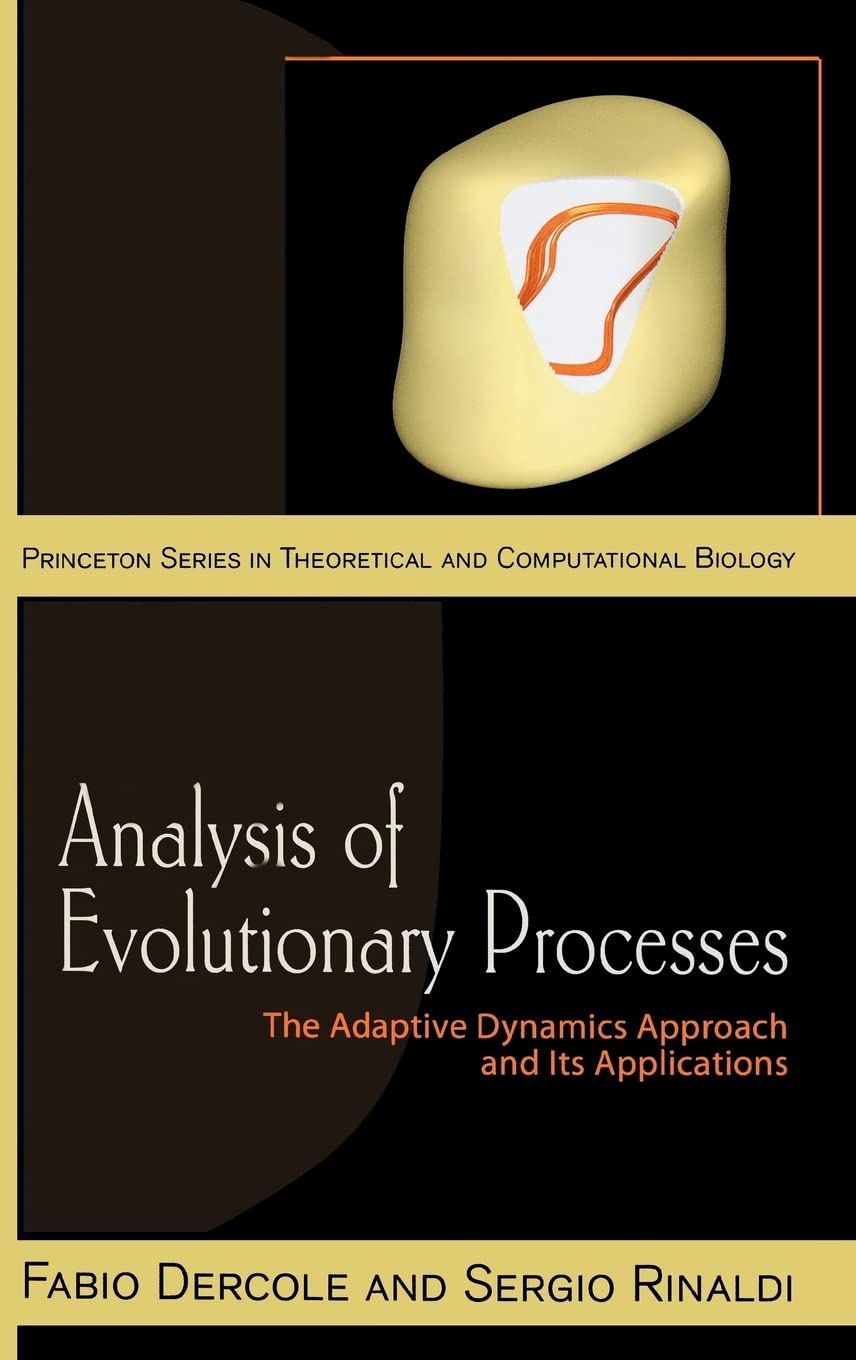
Analysis Of Evolutionary Processes: The Adaptive Dynamics Approach And Its Applications (Princeton Series In Theoretical And Com,Used
Sold by Ergodebooks, an authorized reseller.
Returns accepted within 30 days | support@ergodebooks.com
Shipping Information
- Free Standard Shipping — United States only
- Processing Time: 3–5 business days
- Estimated Delivery: 6–10 business days after dispatch
- Double-boxed, fully insured & discreetly packaged
- Tracking number sent via email once dispatched
Returns & Refund
Returns accepted within 30 days of delivery.
Damaged or Defective Item
Free return shipping + replacement or full refund
Wrong Item Received
Free return shipping + replacement or full refund
Change of Mind
Return shipping at customer's expense · 25% restocking fee applies
Payment Option

Quantitative approaches to evolutionary biology traditionally consider evolutionary change in isolation from an important pressure in natural selection: the demography of coevolving populations. In Analysis of Evolutionary Processes, Fabio Dercole and Sergio Rinaldi have written the first comprehensive book on Adaptive Dynamics (AD), a quantitative modeling approach that explicitly links evolutionary changes to demographic ones. The book shows how the socalled AD canonical equation can answer questions of paramount interest in biology, engineering, and the social sciences, especially economics.After introducing the basics of evolutionary processes and classifying available modeling approaches, Dercole and Rinaldi give a detailed presentation of the derivation of the AD canonical equation, an ordinary differential equation that focuses on evolutionary processes driven by rare and small innovations. The authors then look at important features of evolutionary dynamics as viewed through the lens of AD. They present their discovery of the first chaotic evolutionary attractor, which calls into question the common view that coevolution produces exquisitely harmonious adaptations between species. And, opening up potential new lines of research by providing the first application of AD to economics, they show how AD can explain the emergence of technological variety.Analysis of Evolutionary Processes will interest anyone looking for a selfcontained treatment of AD for selfstudy or teaching, including graduate students and researchers in mathematical and theoretical biology, applied mathematics, and theoretical economics.
⚠️ WARNING (California Proposition 65):
This product may contain chemicals known to the State of California to cause cancer, birth defects, or other reproductive harm.
For more information, please visit www.P65Warnings.ca.gov.