
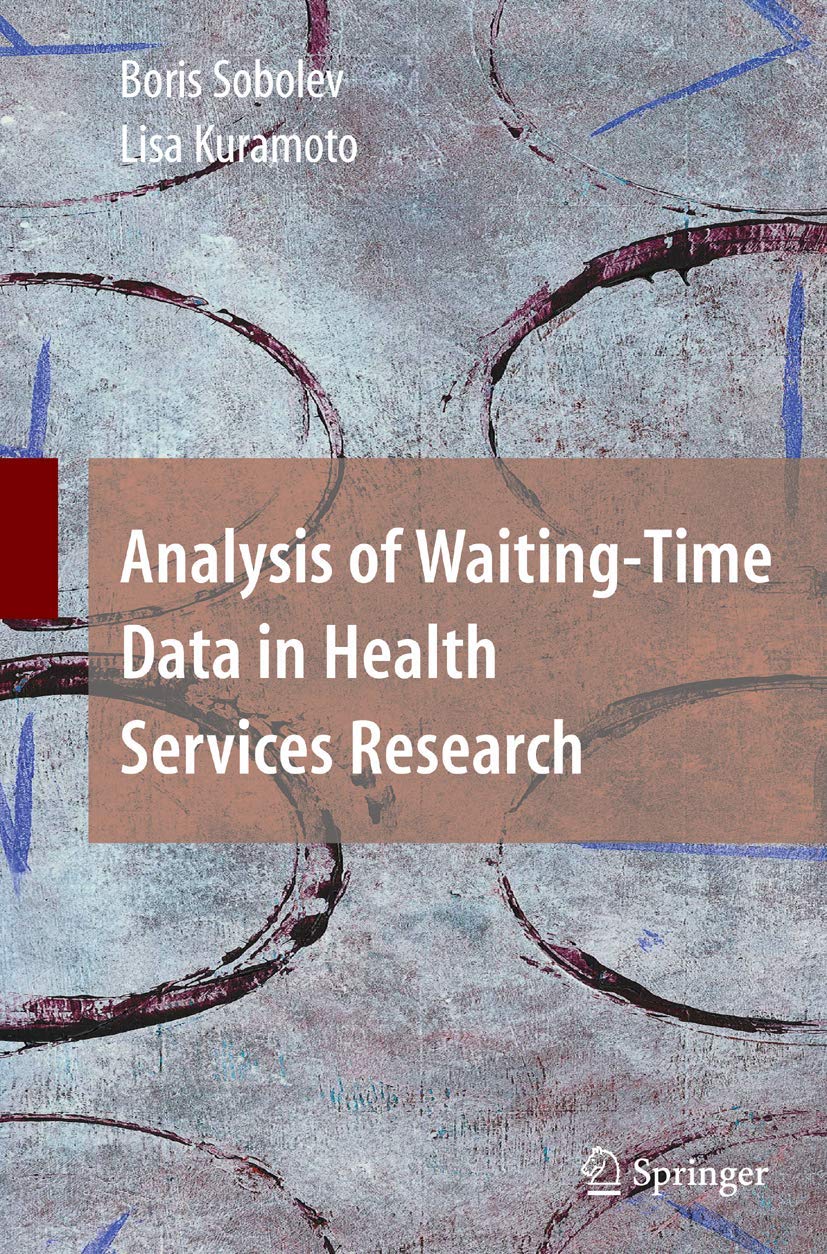
Title
Analysis of WaitingTime Data in Health Services Research,Used
Sold by Ergodebooks, an authorized reseller.
Returns accepted within 30 days | support@ergodebooks.com
Shipping Information
- Free Standard Shipping — United States only
- Processing Time: 3–5 business days
- Estimated Delivery: 6–10 business days after dispatch
- Double-boxed, fully insured & discreetly packaged
- Tracking number sent via email once dispatched
Returns & Refund
Returns accepted within 30 days of delivery.
Damaged or Defective Item
Free return shipping + replacement or full refund
Wrong Item Received
Free return shipping + replacement or full refund
Change of Mind
Return shipping at customer's expense · 25% restocking fee applies
Payment Option

In health care systems that provide universal access to care, efforts to contain costs for standby hospital capacity usually result in wait lists for surgical procedures. When access to health care is rationed by such wait lists, the length of time that patients are required to wait is usually uncertain. This uncertainty is a natural product of stochastic variation in service time and in the percentage of urgent cases in any queuing system. However, in a queue for elective (nonemergency) procedures, waitingtime uncertainty has many additionalcauses. Forinstance,decisionsofbothpatientsandcareprovidersmayoverrideaqueuediscipline. Alternatively, the lack of a hospital resource, such as beds in the intensive care unit, may change queuing practices in favor of services that would not require the resource. Waiting time is often compared between regions, hospitals, periods, or surgical services to evaluate p icy and performance. However, surprisingly little attention has been given to the variation in times spent in a single queue. Why some patients wait longer than others remains an important question in health services search. Itisunclear,forexample, whether timetoservicevariesmorethanwouldbeexpected throughchance alone after differences in clinical condition are taken into account. Another important issue is preferential allocation of hospital resources. It also remains unclear whether patients of low priority are admitted directly as a way to circumvent long wait lists or to substitute for cancellations on the operating room schedule.
⚠️ WARNING (California Proposition 65):
This product may contain chemicals known to the State of California to cause cancer, birth defects, or other reproductive harm.
For more information, please visit www.P65Warnings.ca.gov.
- Q: How many pages does this book have? A: This book has two hundred thirty-four pages. It provides an in-depth analysis of waiting-time data in health services research.
- Q: What is the binding type of the book? A: The book is hardcover. This durable binding ensures longevity and protection for the pages.
- Q: What are the dimensions of the book? A: The book measures seven point zero one inches in length, zero point five six inches in width, and ten inches in height.
- Q: Who is the author of this book? A: The author is Boris Sobolev. He specializes in health services research and provides valuable insights in this publication.
- Q: What genre does this book belong to? A: This book is categorized under Biographies and Memoirs. It discusses the complexities of waiting times in healthcare.
- Q: Is this book suitable for professionals in healthcare? A: Yes, this book is suitable for healthcare professionals. It offers analytical insights into waiting-time data that can inform policy and practice.
- Q: Can I read this book if I am not a healthcare professional? A: Yes, you can read this book even if you are not a healthcare professional. It provides accessible insights into an important healthcare issue.
- Q: How can I use this book for my research? A: You can use this book to analyze waiting-time data in your research. It offers a comprehensive exploration of factors affecting surgical wait times.
- Q: What themes are explored in this book? A: The book explores themes such as waiting-time uncertainty and resource allocation in healthcare. It highlights significant issues in health services research.
- Q: How should I store this book to keep it in good condition? A: Store this book upright in a cool, dry place. Avoid direct sunlight to prevent damage to the cover and pages.
- Q: Is this book safe to read for young adults? A: Yes, the book is safe for young adults. It presents factual information relevant to health services without graphic content.
- Q: What if my book arrives damaged? A: If your book arrives damaged, contact the seller for a return or replacement. Most sellers have a policy for returns on damaged items.
- Q: Are there any specific care instructions for this book? A: No specific care instructions are required. Just handle it carefully and keep it away from moisture.
- Q: Can this book help in understanding health policy decisions? A: Yes, this book can help understand health policy decisions. It evaluates waiting times to inform policy and performance evaluation.
- Q: Is this book appropriate for academic use? A: Yes, this book is appropriate for academic use. It serves as a valuable resource for students and researchers in health services.
- Q: What should I do if I need assistance with my order? A: If you need assistance with your order, contact customer support for help with any inquiries or issues related to your purchase.