
Title
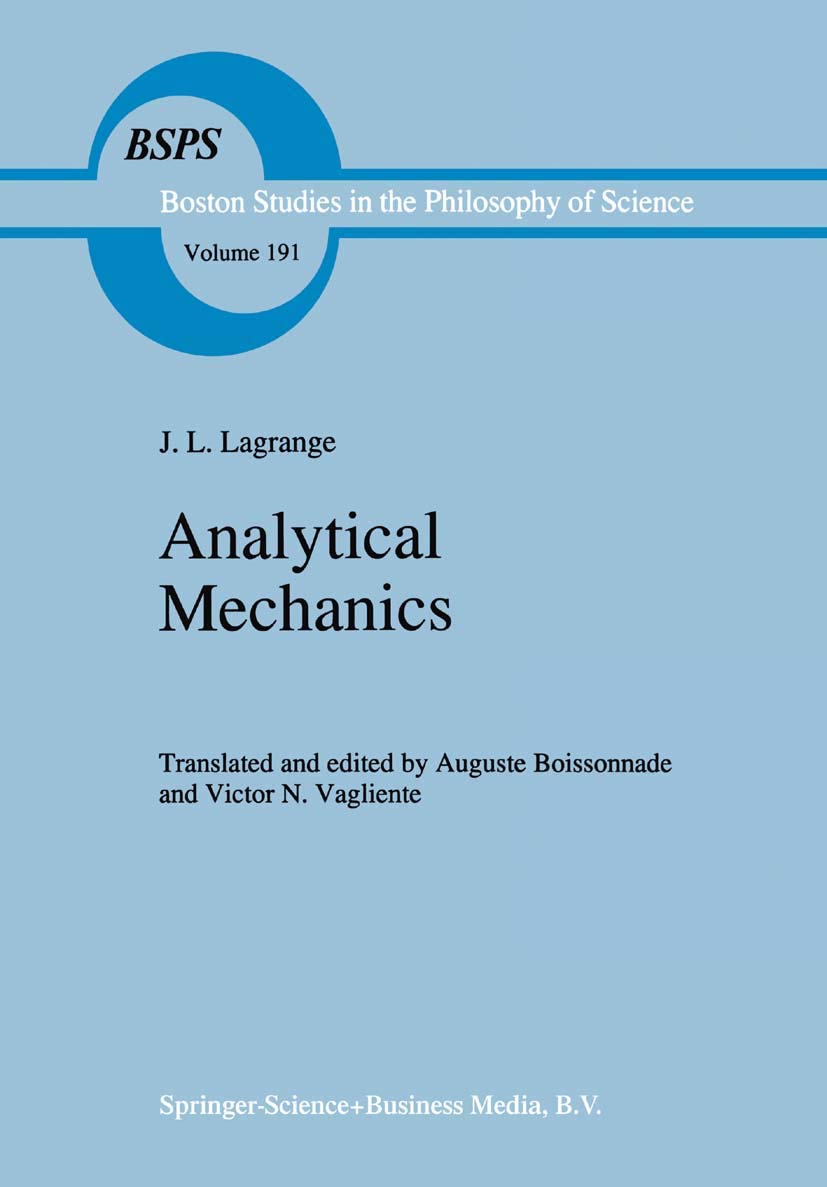
Analytical Mechanics (Boston Studies in the Philosophy and History of Science, 191),Used
Sold by Ergodebooks, an authorized reseller.
Returns accepted within 30 days | support@ergodebooks.com
Shipping Information
- Free Standard Shipping — United States only
- Processing Time: 3–5 business days
- Estimated Delivery: 6–10 business days after dispatch
- Double-boxed, fully insured & discreetly packaged
- Tracking number sent via email once dispatched
Returns & Refund
Returns accepted within 30 days of delivery.
Damaged or Defective Item
Free return shipping + replacement or full refund
Wrong Item Received
Free return shipping + replacement or full refund
Change of Mind
Return shipping at customer's expense · 25% restocking fee applies
Payment Option

to the English translation of Lagrange's Mecanique Analytique Lagrange's Mecanique Analytique appeared early in 1788 almost exactly one cen tury after the publication of Newton's Principia Mathematica. It marked the culmination of a line of research devoted to recasting Newton's synthetic, geomet ric methods in the analytic style of the Leibnizian calculus. Its sources extended well beyond the physics of central forces set forth in the Principia. Continental au thors such as Jakob Bernoulli, Daniel Bernoulli, Leonhard Euler, Alexis Clairaut and Jean d'Alembert had developed new concepts and methods to investigate problems in constrained interaction, fluid flow, elasticity, strength of materials and the operation of machines. The Mecanique Analytique was a remarkable work of compilation that became a fundamental reference for subsequent research in exact science. During the eighteenth century there was a considerable emphasis on extending the domain of analysis and algorithmic calculation, on reducing the dependence of advanced mathematics on geometrical intuition and diagrammatic aids. The analytical style that characterizes the Mecanique Analytique was evident in La grange's original derivation in 1755 of the 8algorithm in the calculus of variations. It was expressed in his consistent attempts during the 1770s to prove theorems of mathematics and mechanics that had previously been obtained synthetically. The scope and distinctiveness of his 1788 treatise are evident if one compares it with an earlier work of similar outlook, Euler's Mechanica sive Motus Scientia Analyt 1 ice Exposita of 1736.
⚠️ WARNING (California Proposition 65):
This product may contain chemicals known to the State of California to cause cancer, birth defects, or other reproductive harm.
For more information, please visit www.P65Warnings.ca.gov.