
Title
Ancient Arms Race: Antiquity's Largest Fortresses and Sasanian Military Networks of Northern Iran: A joint fieldwork project by ,Used
Sold by Ergodebooks, an authorized reseller.
Returns accepted within 30 days | support@ergodebooks.com
Shipping Information
- Free Standard Shipping — United States only
- Processing Time: 3–5 business days
- Estimated Delivery: 6–10 business days after dispatch
- Double-boxed, fully insured & discreetly packaged
- Tracking number sent via email once dispatched
Returns & Refund
Returns accepted within 30 days of delivery.
Damaged or Defective Item
Free return shipping + replacement or full refund
Wrong Item Received
Free return shipping + replacement or full refund
Change of Mind
Return shipping at customer's expense · 25% restocking fee applies
Payment Option

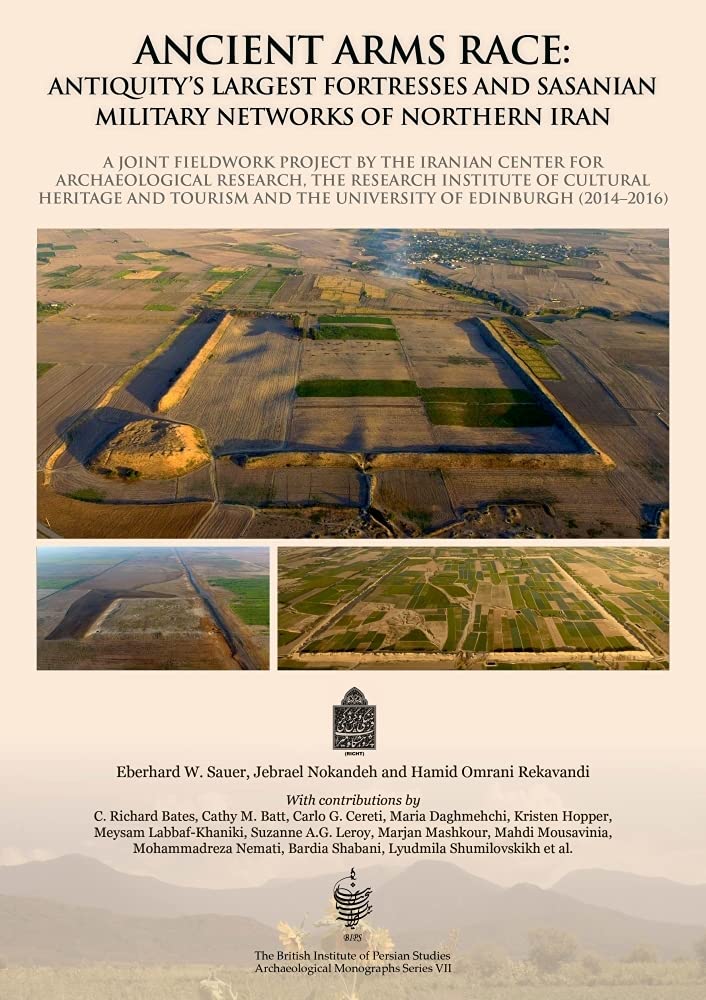
Which ancient army boasted the largest fortifications, and how did the competitive buildup of military capabilities shape world history? Few realise that imperial Rome had a serious competitor in Late Antiquity. Late Roman legionary bases, normally no larger than 5ha, were dwarfed by Sasanian fortresses, often covering 40ha, sometimes even 125175ha. The latter did not necessarily house permanent garrisons but sheltered large armies temporarily perhaps numbering 1050,000 men each. Even Roman camps and fortresses of the Early and High Empire did not reach the dimensions of their later Persian counterparts. The longest fortlined wall of the late antique world was also Persian. Persia built up, between the fourth and sixth centuries AD, the most massive military infrastructure of any ancient or medieval Near Eastern empire if not the ancient and medieval world. Much of the known defensive network was directed against Persias powerful neighbours in the north rather than the west. This may reflect differences in archaeological visibility more than troop numbers. Urban garrisons in the RomanoPersian frontier zone are much harder to identify than vast geometric compounds in marginal northern lands. Recent excavations in Iran have enabled us to precisiondate two of the largest fortresses of Southwest Asia, both larger than any in the Roman world. Excavations in a Gorgan Wall fort have shed much new light on frontier life, and we have unearthed a massive bridge nearby. A sonar survey has traced the terminal of the Tammisheh Wall, now submerged under the waters of the Caspian Sea. Further work has focused on a vast city and settlements in the hinterland. Persias Imperial Power, our previous project, had already shed much light on the Great Wall of Gorgan, but it was our recent fieldwork that has thrown the sheer magnitude of Sasanian military infrastructure into sharp relief.
⚠️ WARNING (California Proposition 65):
This product may contain chemicals known to the State of California to cause cancer, birth defects, or other reproductive harm.
For more information, please visit www.P65Warnings.ca.gov.