
Title
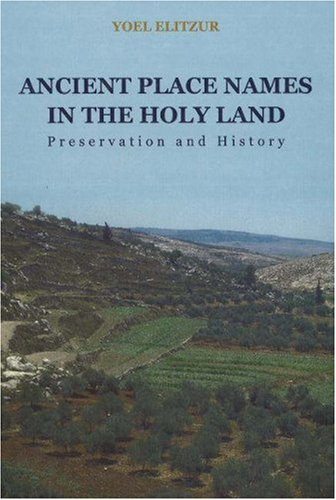
Ancient Place Names in the Holy Land: Preservation and History,Used
Sold by Ergodebooks, an authorized reseller.
Returns accepted within 30 days | support@ergodebooks.com
Shipping Information
- Free Standard Shipping — United States only
- Processing Time: 3–5 business days
- Estimated Delivery: 6–10 business days after dispatch
- Double-boxed, fully insured & discreetly packaged
- Tracking number sent via email once dispatched
Returns & Refund
Returns accepted within 30 days of delivery.
Damaged or Defective Item
Free return shipping + replacement or full refund
Wrong Item Received
Free return shipping + replacement or full refund
Change of Mind
Return shipping at customer's expense · 25% restocking fee applies
Payment Option

That many ancient toponyms in the Holy Land have survived for thousands of years, right up to modern times, is a remarkable and unique phenomenon, unparalleled in neighboring countries, such as Egypt, Mesopotamia, or Asia Minor. Preserved toponymy provides a basis for research in the historical geography of the country and is also of major importance for studies in the history of Hebrew and Aramaic, being a kind of ancient recording of an archaic linguistic inventory. In addition, it has many implications for a wide variety of other scholarly fields, such as Bible studies, Rabbinics, Qumran and Samaritan studies, early Christianity, Arabic and Islam. This reserve of preserved placenames is therefore frequently consulted and used by scholars for their purposes. Surprisingly, however, despite the importance of this subject, there have been very few attempts to put things in order, and for many years there have been no rules that would help to understand the changes that occur in toponyms. Accordingly, the prevailing situation in the field of historical geography is one of nearanarchy; lacking hard and fast rules, scholars could find support for their identification of an ancient toponym in any somewhat similar Arabic name. In order to break this vicious circle of conjectures founded on dubious linguistic assumptions, producing preservation laws themselves provide an alleged basis for historical identification, and so on, Elitzur has tried, first and foremost, to lay down objective criteria for the selection of positive identifications. On this basis, he has built up a corpus of 177 toponyms representing positive or almostpositive identifications, upon which this study is based. Sixty of these toponyms are then reviewed in depth, tracing their documentation in all languages, throughout recorded history; in the process, the author has tried to locate and analyze whatever changes occurred and when. The linguistic conclusions from the material follow, arranged according to the standard layout of grammar books. Innovative conclusions and ideas in the context of historical geography emerged in the course of the study are listed alphabetically in the last part of the volume.
⚠️ WARNING (California Proposition 65):
This product may contain chemicals known to the State of California to cause cancer, birth defects, or other reproductive harm.
For more information, please visit www.P65Warnings.ca.gov.
- Q: How many pages does this book have? A: This book contains four hundred sixty-four pages. It provides a comprehensive exploration of ancient place names in the Holy Land.
- Q: What is the binding type of this book? A: The book is hardcover. This binding type ensures durability and makes it suitable for long-term use.
- Q: What are the dimensions of this book? A: The book measures seven point zero one inches in length, one point five four inches in width, and nine point zero two inches in height. These dimensions make it easy to handle and store.
- Q: Who is the author of this book? A: The author of this book is Yoel Elitzur. He provides valuable insights into the historical geography of the Holy Land.
- Q: What category does this book belong to? A: This book belongs to the Ancient Civilizations category. It focuses on the historical significance of ancient toponyms.
- Q: How do I use this book for research? A: You can use this book to study ancient place names and their historical contexts. It is particularly useful for scholars in various fields including Bible studies and historical geography.
- Q: Is this book suitable for beginners? A: Yes, this book can be suitable for beginners interested in ancient history. It provides a structured approach to understanding place names in the Holy Land.
- Q: Can this book be used for educational purposes? A: Yes, this book is ideal for educational purposes. It serves as a resource for students and scholars in understanding historical geography.
- Q: How should I care for this hardcover book? A: To care for this hardcover book, keep it in a dry, cool place and avoid exposing it to direct sunlight. This will help maintain its condition.
- Q: Is this book safe for all ages? A: Yes, this book is generally safe for all ages. However, it is recommended for those with an interest in ancient history.
- Q: What if the book arrives damaged? A: If the book arrives damaged, you should contact the seller immediately for return or exchange options. Most sellers offer a satisfaction guarantee.
- Q: Can I return this book if I'm not satisfied? A: Yes, you can typically return this book if you're not satisfied. Be sure to check the return policy provided by the seller.
- Q: Are there any specific storage instructions for this book? A: Store this book upright on a shelf away from moisture. This helps prevent warping and keeps the pages in good condition.
- Q: Does this book include illustrations or maps? A: No, this book does not typically include illustrations or maps. It focuses primarily on textual analysis of place names.
- Q: What makes this book unique compared to others? A: This book is unique due to its focus on the preservation of ancient place names in the Holy Land, which is not commonly explored in other texts.
- Q: Is there a glossary or index in this book? A: Yes, this book includes an index that helps you locate specific topics or toponyms easily. This feature is beneficial for research purposes.