
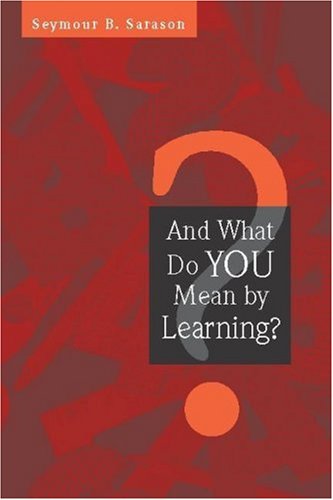
Title
And What Do You Mean By Learning?
Sold by Ergodebooks, an authorized reseller.
Returns accepted within 30 days | support@ergodebooks.com
Shipping Information
- Free Standard Shipping — United States only
- Processing Time: 3–5 business days
- Estimated Delivery: 6–10 business days after dispatch
- Double-boxed, fully insured & discreetly packaged
- Tracking number sent via email once dispatched
Returns & Refund
Returns accepted within 30 days of delivery.
Damaged or Defective Item
Free return shipping + replacement or full refund
Wrong Item Received
Free return shipping + replacement or full refund
Change of Mind
Return shipping at customer's expense · 25% restocking fee applies
Payment Option

One Of America'S Original Thinkers About Public Education, Seymour Sarason Poses The Crucial Question For All EducatorsWhat Do You Mean By Learning? Learning Is The Word Most Used In Educational Literature And Yet Educators Have Great Difficulty In Defining It. Sarason Demonstrates That The Lack Of Clarity About The Concept Of Learning Is At The Root Of The Disappointments Of Educational Reform, The Inadequacies Of Preparatory Programs, And Proclamations Of Policy. He Takes A Good Look At Another Question As Well: Why Are The Principles Of Learning Implied By What Parents Of Preschoolers Say And Do So Different From The Principles Educators Employ? And He Goes A Step Further When He Asks: Why Is It That No One, Educators Or Otherwise, Has Ever Said That Schools Are Places Where Teachers Learn?Central To Sarason'S Questions On All Fronts Is The Distinction Between The Contexts Of Productive And Unproductive Learning, The Latter Being Far More Frequent Than The Former. Unlike The Words Sticks And Stones, Learning Is Not Concrete, Visible, Palpable. Learning Is A Process That Takes Place In A Social Context Involving And Intertwining Motivation And Attitudes, Cognitive And Emotional Responses, No One Of Which Is Ever Zero In Strength. Recognizing This Has Enormous Implications For Pedagogy, School Administration, And Educational Policy. Sarason Discusses These Implications By Use Of Concrete Examples Familiar To Any Reader.And What Do You Mean By Learning? Is Not About Theoryit'S A Warning. It Alerts Readers To How Glossing Over What They Mean By Learning Effectively Stymies Any Educational Reform. Educators' Stockintrade Is Learning. Only When They Become Aware Of What Learning Encompasses And The Contexts In Which It Occurs Can We Have A Starting Point For Real Education.
⚠️ WARNING (California Proposition 65):
This product may contain chemicals known to the State of California to cause cancer, birth defects, or other reproductive harm.
For more information, please visit www.P65Warnings.ca.gov.
- Q: How many pages does 'And What Do You Mean by Learning?' have? A: This book has two hundred sixteen pages. It provides a comprehensive exploration of the concept of learning in education.
- Q: What are the dimensions of this book? A: The book measures six point nine three inches in length, zero point four three inches in width, and eight point nine inches in height.
- Q: What type of binding does this book have? A: The book is available in paperback binding. This makes it lightweight and easy to handle.
- Q: What is the author's background? A: The author is Seymour Sarason, a notable thinker in public education. His insights are informed by years of experience and research.
- Q: Is this book suitable for educators? A: Yes, this book is highly suitable for educators. It addresses fundamental questions about learning that are relevant to teaching.
- Q: What age group is this book appropriate for? A: The book is appropriate for adult readers, particularly those involved in education or pedagogy. It discusses complex educational concepts.
- Q: How should I care for this book? A: To care for this book, keep it in a dry place and avoid exposure to direct sunlight. This will help maintain its condition.
- Q: Can this book be used as a textbook? A: Yes, it can be used as a textbook in educational courses. It provides valuable insights and discussions on learning.
- Q: Is there a warranty for this book? A: Books typically do not come with a warranty. However, you can check with the retailer for their return policy.
- Q: What if the book arrives damaged? A: If the book arrives damaged, contact the seller for a return or exchange. Most retailers have policies in place for such situations.
- Q: How does this book compare to other educational psychology texts? A: This book stands out by focusing on the meaning of learning. It offers a unique perspective compared to traditional educational psychology texts.
- Q: Are there any specific themes covered in this book? A: Yes, it covers themes such as the social context of learning, motivation, and the distinction between productive and unproductive learning.
- Q: Is this book recommended for parents as well? A: Yes, parents can benefit from this book. It addresses the differences in perceptions of learning between parents and educators.
- Q: What makes this book a warning for educators? A: The book warns educators about the dangers of not clarifying what they mean by learning, which can hinder educational reform.
- Q: How does this book address educational reform? A: It discusses how misconceptions about learning contribute to the failures of educational reform efforts, advocating for clarity and understanding.