If you have any questions, you are always welcome to contact us. We'll get back to you as soon as possible, withing 24 hours on weekdays.
Customer service
All questions about your order, return and delivery must be sent to our customer service team by e-mail at yourstore@yourdomain.com
Sale & Press
If you are interested in selling our products, need more information about our brand or wish to make a collaboration, please contact us at press@yourdomain.com
Help
If you have any questions, you are always welcome to contact us. We'll get back to you as soon as possible, withing 24 hours on weekdays.
Customer service
All questions about your order, return and delivery must be sent to our customer service team by e-mail at yourstore@yourdomain.com
Sale & Press
If you are interested in selling our products, need more information about our brand or wish to make a collaboration, please contact us at press@yourdomain.com
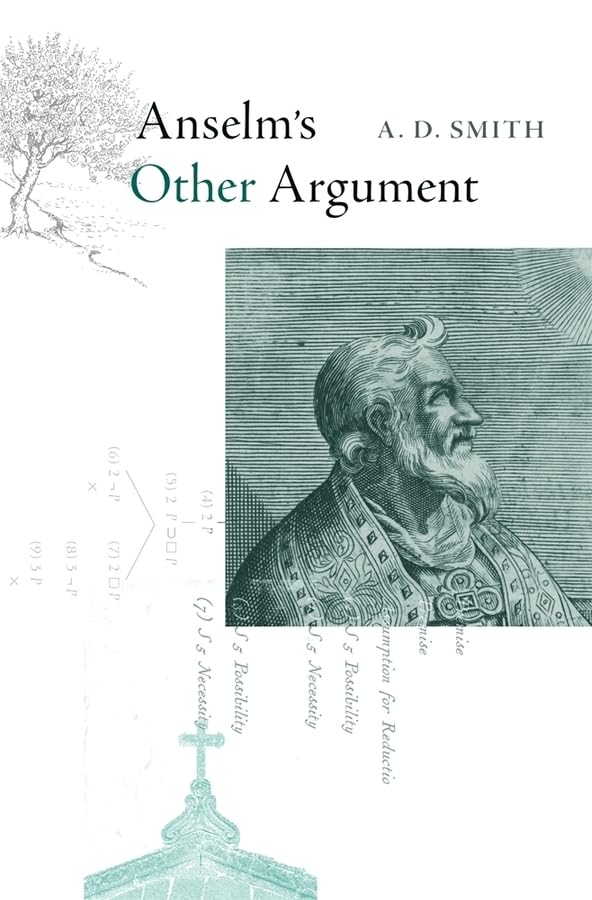
Anselm of Canterbury (10331109 CE), in his work Proslogion, originated the ontological argument for Gods existence, famously arguing that something than which nothing greater can be conceived, which he identifies with God, must actually exist, for otherwise something greater could indeed be conceived. Some commentators have claimed that although Anselm may not have been conscious of the fact, the Proslogion as well as his Reply to Gaunilo contains passages that constitute a second independent proof: a modal ontological argument that concerns the supposed logical necessity of Gods existence. Other commentators disagree, countering that the alleged second argument does not stand on its own but presupposes the conclusion of the first.Anselms Other Argument stakes an original claim in this debate, and takes it further. There is a second a priori argument in Anselm (specifically in the Reply), A. D. Smith contends, but it is not the modal argument past scholars have identified. This second argument surfaces in a number of forms, though always turning on certain deep, interrelated metaphysical issues. It is this form of argument that in fact underlies several of the passages which have been misconstrued as statements of the modal argument. In a book that combines historical research with rigorous philosophical analysis, Smith discusses this argument in detail, finally defending a modification of it that is implicit in Anselm. This other argument bears a striking resemblance to one that Duns Scotus would later employ.
⚠️ WARNING (California Proposition 65):
This product may contain chemicals known to the State of California to cause cancer,
birth defects, or other reproductive harm.
For MAP (Minimum Advertised Price) violations and Intellectual Property (IP) or Trademark concerns, please contact:
support@ergodebooks.com
⚠️ California Proposition 65 Warning: Some products sold on this website may expose you to chemicals known to the State of California to cause cancer, birth defects, or other reproductive harm. For more information, visit www.P65Warnings.ca.gov.