If you have any questions, you are always welcome to contact us. We'll get back to you as soon as possible, withing 24 hours on weekdays.
Customer service
All questions about your order, return and delivery must be sent to our customer service team by e-mail at yourstore@yourdomain.com
Sale & Press
If you are interested in selling our products, need more information about our brand or wish to make a collaboration, please contact us at press@yourdomain.com
Help
If you have any questions, you are always welcome to contact us. We'll get back to you as soon as possible, withing 24 hours on weekdays.
Customer service
All questions about your order, return and delivery must be sent to our customer service team by e-mail at yourstore@yourdomain.com
Sale & Press
If you are interested in selling our products, need more information about our brand or wish to make a collaboration, please contact us at press@yourdomain.com
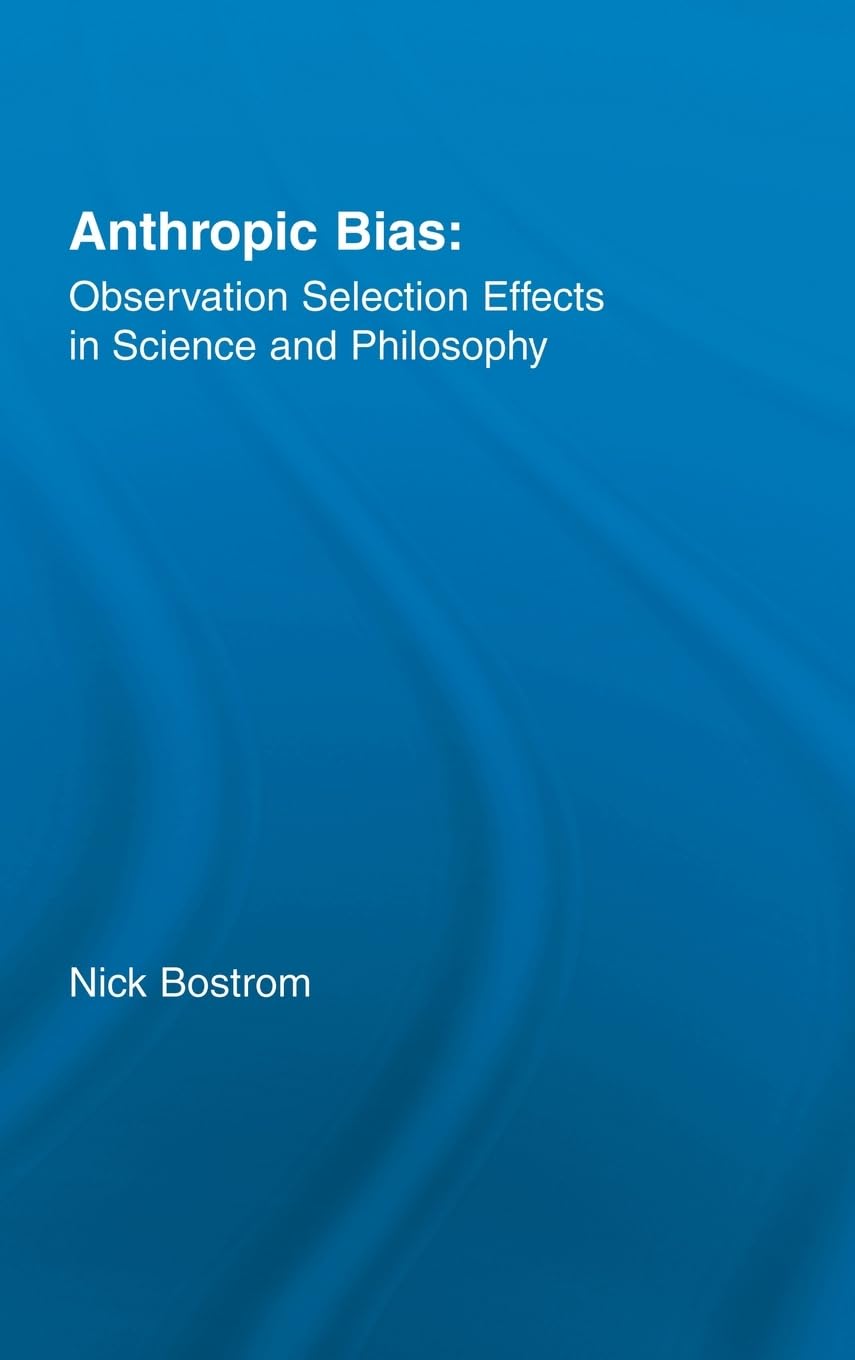
Anthropic Bias explores how to reason when you suspect that your evidence is biased by "observation selection effects"that is, evidence that has been filtered by the precondition that there be some suitably positioned observer to "have" the evidence. This conundrumsometimes alluded to as "the anthropic principle," "selflocating belief," or "indexical information"turns out to be a surprisingly perplexing and intellectually stimulating challenge, one abounding with important implications for many areas in science and philosophy.There are the philosophical thought experiments and paradoxes: the Doomsday Argument; Sleeping Beauty; the Presumptuous Philosopher; Adam & Eve; the AbsentMinded Driver; the Shooting Room.And there are the applications in contemporary science: cosmology ("How many universes are there?", "Why does the universe appear finetuned for life?"); evolutionary theory ("How improbable was the evolution of intelligent life on our planet?"); the problem of time's arrow ("Can it be given a thermodynamic explanation?"); quantum physics ("How can the manyworlds theory be tested?"); gametheory problems with imperfect recall ("How to model them?"); even traffic analysis ("Why is the 'next lane' faster?").Anthropic Bias argues that the same principles are at work across all these domains. And it offers a synthesis: a mathematically explicit theory of observation selection effects that attempts to meet scientific needs while steering clear of philosophical paradox.
⚠️ WARNING (California Proposition 65):
This product may contain chemicals known to the State of California to cause cancer,
birth defects, or other reproductive harm.
For MAP (Minimum Advertised Price) violations and Intellectual Property (IP) or Trademark concerns, please contact:
support@ergodebooks.com
⚠️ California Proposition 65 Warning: Some products sold on this website may expose you to chemicals known to the State of California to cause cancer, birth defects, or other reproductive harm. For more information, visit www.P65Warnings.ca.gov.