
Title
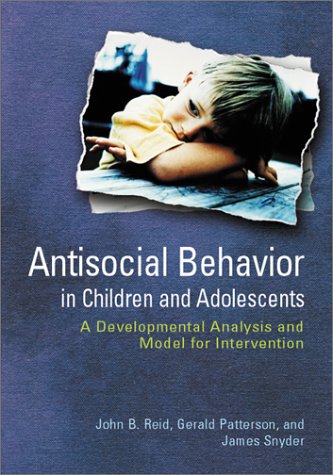
Antisocial Behavior In Children And Adolescents: A Developmental Analysis And Model For Intervention
Sold by Ergodebooks, an authorized reseller.
Returns accepted within 30 days | support@ergodebooks.com
Shipping Information
- Free Standard Shipping — United States only
- Processing Time: 3–5 business days
- Estimated Delivery: 6–10 business days after dispatch
- Double-boxed, fully insured & discreetly packaged
- Tracking number sent via email once dispatched
Returns & Refund
Returns accepted within 30 days of delivery.
Damaged or Defective Item
Free return shipping + replacement or full refund
Wrong Item Received
Free return shipping + replacement or full refund
Change of Mind
Return shipping at customer's expense · 25% restocking fee applies
Payment Option

Summarizes The Ongoing Work At The Oregon Social Learning Center. Provides Approaches To Reducing The Occurrence Of Antisocial Behavior Beginning In The Earliest Years In Childhood. Uses The Coercion Theory As An Organizing Framework, Distilling More Than 30 Years Of Research. Written For Researchers And Clinicians.
⚠️ WARNING (California Proposition 65):
This product may contain chemicals known to the State of California to cause cancer, birth defects, or other reproductive harm.
For more information, please visit www.P65Warnings.ca.gov.
- Q: What is the page count of the book? A: The book has four hundred eighty-eight pages. It provides extensive insights into antisocial behavior in children and adolescents.
- Q: What are the dimensions of the book? A: The book measures seven point twenty-five inches in length, one inch in width, and ten point twenty-five inches in height. These dimensions make it a standard hardcover size.
- Q: What type of binding does the book have? A: The book is bound in hardcover. This type of binding ensures durability for frequent use.
- Q: Who is the author of the book? A: The author is John B. Reid. He has extensive experience in developmental psychology and intervention strategies.
- Q: What is the main focus of the book? A: The book focuses on antisocial behavior in children and adolescents. It discusses developmental analysis and intervention models.
- Q: Is this book suitable for clinicians? A: Yes, the book is written for researchers and clinicians. It provides valuable insights for professionals working with children and adolescents.
- Q: How can the information in this book be applied? A: The information can be applied in clinical settings to reduce antisocial behavior. It offers strategies based on coercion theory.
- Q: Is this book appropriate for parents? A: Yes, parents may find the strategies helpful. The book discusses approaches to managing antisocial behavior from early childhood.
- Q: What age group does this book target? A: The book targets children and adolescents. It discusses developmental stages relevant to antisocial behavior.
- Q: How should I store this book? A: Store the book in a dry, cool place. Keeping it away from direct sunlight will help preserve the hardcover.
- Q: Can this book be used as a textbook? A: Yes, this book can be used as a textbook. It includes research and models suitable for academic study.
- Q: How should I clean the book if it gets dirty? A: Clean the book by gently wiping it with a dry cloth. Avoid using liquids that could damage the cover or pages.
- Q: What if the book arrives damaged? A: If the book arrives damaged, contact customer support for a replacement. Ensure to keep the original packaging for returns.
- Q: Is there a warranty for this book? A: No, books typically do not come with a warranty. However, check the return policy for any issues upon delivery.
- Q: How does this book compare to other psychology texts? A: This book offers a unique focus on antisocial behavior and intervention. It is based on over thirty years of research.
- Q: What is the coercion theory mentioned in the book? A: Coercion theory explains how certain behaviors are learned through interactions. The book uses this framework for intervention strategies.