
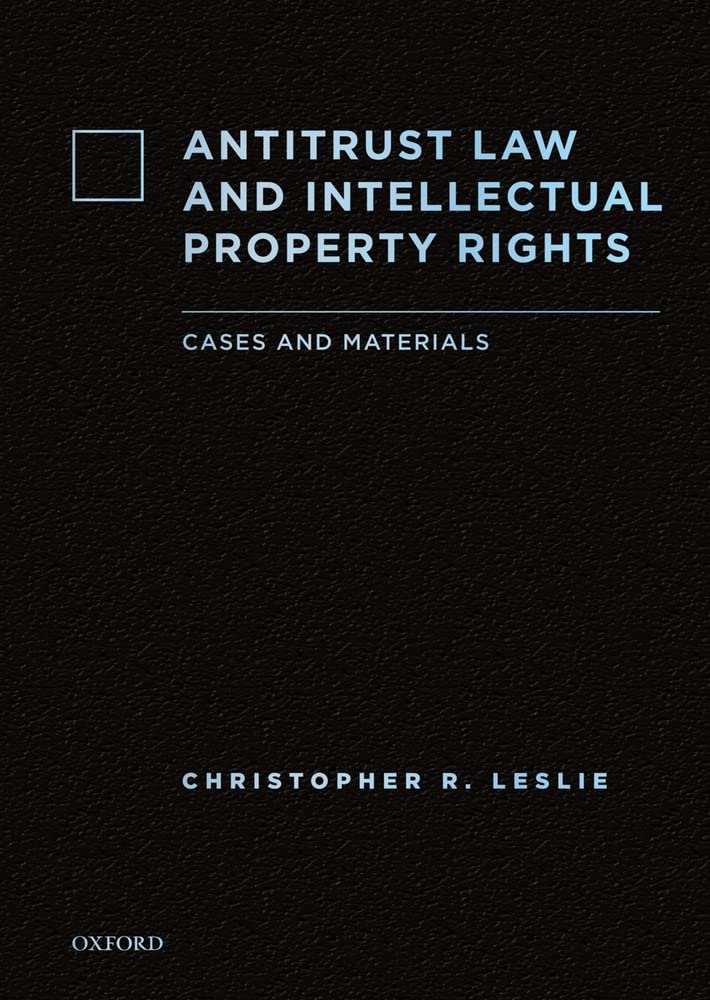
Title
Antitrust Law And Intellectual Property Rights: Cases And Materials,Used
Sold by Ergodebooks, an authorized reseller.
Returns accepted within 30 days | support@ergodebooks.com
Shipping Information
- Free Standard Shipping — United States only
- Processing Time: 3–5 business days
- Estimated Delivery: 6–10 business days after dispatch
- Double-boxed, fully insured & discreetly packaged
- Tracking number sent via email once dispatched
Returns & Refund
Returns accepted within 30 days of delivery.
Damaged or Defective Item
Free return shipping + replacement or full refund
Wrong Item Received
Free return shipping + replacement or full refund
Change of Mind
Return shipping at customer's expense · 25% restocking fee applies
Payment Option

In Antitrust Law And Intellectual Property Rights: Cases And Materials, Christopher R. Leslie Describes How Patents, Copyrights, And Trademarks Confer Exclusionary Rights On Their Owners, And How Firms Sometimes Exercise This Exclusionary Power In Ways That Exceed The Legitimate Bounds Of Their Intellectual Property Rights. Leslie Explains That While Substantive Intellectual Property Law Defines The Scope Of The Exclusionary Rights, Antitrust Law Often Provides The Most Important Consequences When Owners Of Intellectual Property Misuse Their Rights In A Way That Harms Consumers Or Illegitimately Excludes Competitors. Antitrust Law Defines The Limits Of What Intellectual Property Owners Can Do With Their Ip Rights. In This Book, Leslie Explores What Conduct Firms Can And Cannot Engage In While Acquiring And Exploiting Their Intellectual Property Rights, And Surveys Those Aspects Of Antitrust Law That Are Necessary For Both Antitrust Practitioners And Intellectual Property Attorneys To Understand. This Book Is Ideal For An Advanced Antitrust Course In A Jd Program. In Addition To Building On Basic Antitrust Concepts, It Fills In A Gap That Is Often Missing In Basic Antitrust Courses Yet Critical For An Intellectual Property Lawyer: The Intersection Of Intellectual Property And Antitrust Law. The Relationship Between Intellectual Property And Antitrust Is Particularly Valuable As An Increasing Number Of Law Schools Offer Specializations And Llms In Intellectual Property. This Book Also Provides Meaningful Material For Both Undergraduate And Graduate Business Schools Programs Because It Explains How Antitrust Law Limits The Marshalling Of Intellectual Property Rights.
⚠️ WARNING (California Proposition 65):
This product may contain chemicals known to the State of California to cause cancer, birth defects, or other reproductive harm.
For more information, please visit www.P65Warnings.ca.gov.
- Q: How many pages does this book have? A: This book has six hundred eighty-one pages. It provides a comprehensive exploration of antitrust law and intellectual property rights.
- Q: What is the binding type of this book? A: This book is bound in hardcover. Hardcover bindings offer durability and a professional appearance, making it suitable for academic use.
- Q: What are the dimensions of the book? A: The book measures nine point nine inches in length, seven point two inches in width, and one point four two inches in height. These dimensions make it easy to handle and store.
- Q: Who is the author of this book? A: The author of this book is Christopher R. Leslie. He is known for his expertise in antitrust law and intellectual property rights.
- Q: What category does this book fall under? A: This book falls under the Antitrust category. It addresses the intersection of antitrust law and intellectual property rights.
- Q: Is this book suitable for law students? A: Yes, this book is ideal for advanced law students, particularly those in JD programs. It covers essential concepts relevant to antitrust practitioners and intellectual property attorneys.
- Q: How can this book benefit business students? A: This book provides valuable insights for undergraduate and graduate business students. It explains how antitrust law limits the use of intellectual property rights in business.
- Q: What topics are covered in this book? A: The book covers topics such as exclusionary rights, misuse of intellectual property, and the relationship between antitrust law and intellectual property rights. It provides a thorough understanding of these critical areas.
- Q: Does this book include case studies? A: Yes, the book includes cases and materials that illustrate the application of antitrust law to intellectual property. These examples enhance comprehension of complex legal principles.
- Q: Can this book help with preparing for the bar exam? A: Yes, this book can be a useful resource for bar exam preparation. It covers essential topics in antitrust law that are relevant for aspiring lawyers.
- Q: What should I do if the book arrives damaged? A: If the book arrives damaged, you should contact the seller for a return or replacement. Most sellers have policies in place for handling damaged items.
- Q: Is there a warranty for this book? A: No, books typically do not come with a warranty. However, you can check the seller's return policy for any issues.
- Q: How should I store this book? A: You should store this book upright on a shelf, away from direct sunlight and moisture, to prevent damage. Proper storage will help maintain its condition.
- Q: What if I have questions about the content of the book? A: If you have questions about the content, you can refer to the book's index or glossary, or consult legal professionals for further clarification.
- Q: Is this book suitable for beginners in law? A: No, this book is not designed for beginners. It is intended for advanced students who have a foundational understanding of antitrust and intellectual property law.
- Q: How can I find additional resources related to this book? A: You can find additional resources by checking references in the book, visiting legal education websites, or consulting academic libraries.