
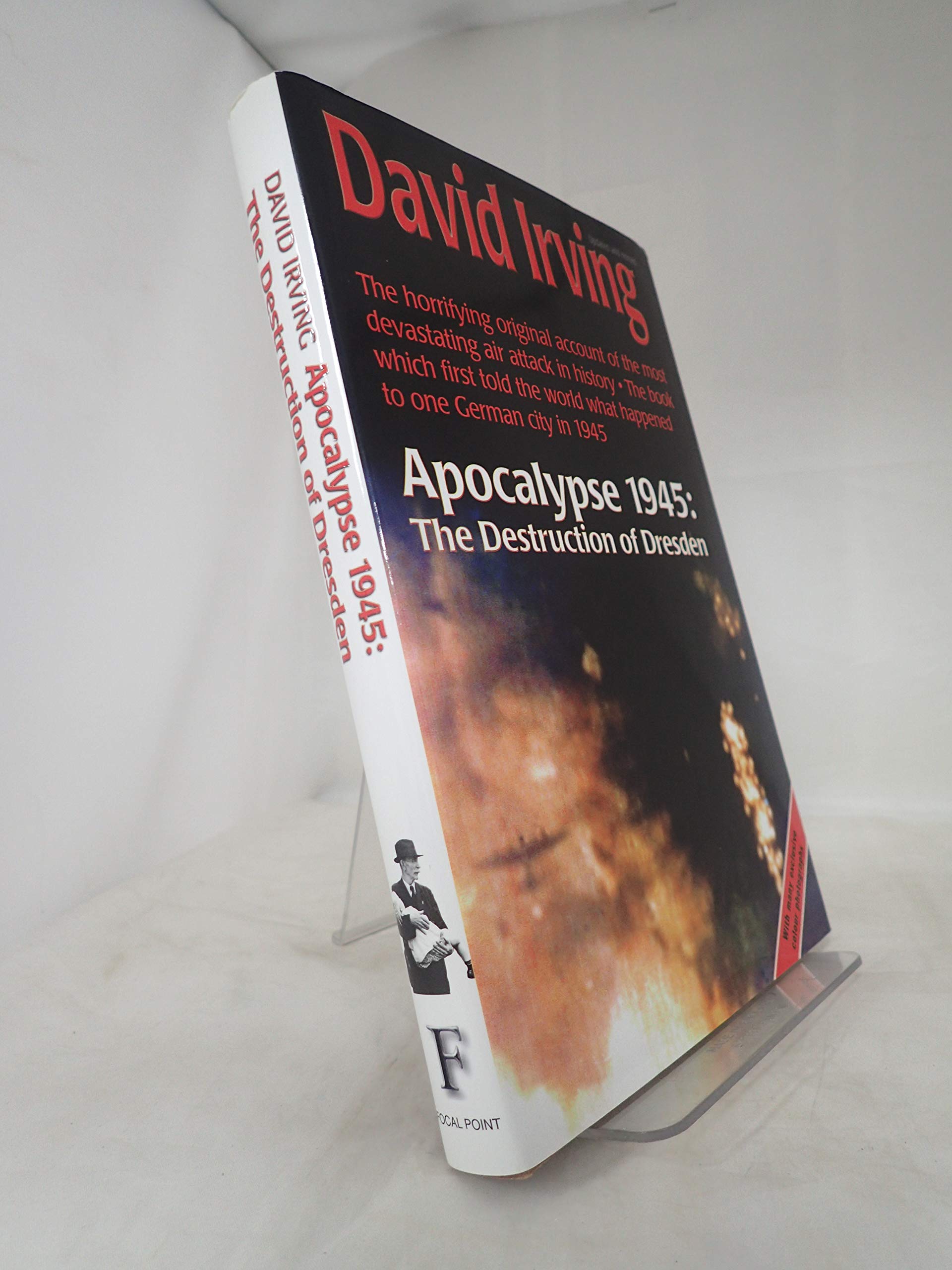
Title
Apocalypse 1945: The Destruction of Dresden,New
Sold by Ergodebooks, an authorized reseller.
Returns accepted within 30 days | support@ergodebooks.com
Shipping Information
- Free Standard Shipping — United States only
- Processing Time: 3–5 business days
- Estimated Delivery: 6–10 business days after dispatch
- Double-boxed, fully insured & discreetly packaged
- Tracking number sent via email once dispatched
Returns & Refund
Returns accepted within 30 days of delivery.
Damaged or Defective Item
Free return shipping + replacement or full refund
Wrong Item Received
Free return shipping + replacement or full refund
Change of Mind
Return shipping at customer's expense · 25% restocking fee applies
Payment Option

AT 10.10 P.M. ON THE NIGHT of February 1314, 1945 the R.A.F. Master Bomber broadcast the cryptic order: 'Controller to PlateRack Force: Come in and bomb glow of red T.I.s as planned.' The illfamed attack on Dresden had begun. The target city was among Germany's largest, but it alone had developed no single major war industry. The German authorities had made it a centre for the evacuation of wounded servicemen, and by February 1945 most schools, restaurants, and public buildings had been converted into military hospitals. In selecting Dresden for this purpose, the German government probably hoped that this, one of the most beautiful cities in Europe, often compared with Florence for its graceful Baroque architectural style, would be spared the attentions of the allied bombers. By 1945, the legend was deeply entrenched in the population's mind that Dresden was a city that would never be bombed. It was not to be. In February 1945, with the Soviet armies making striking advances in their invasion of Silesia and East Prussia, and when the war's political and military directors were meeting at Yalta, Mr Winston Churchill was urgently in need of some display both of his offensive strength and of his willingness to assist the Russians in their drive westwards. Dresden, the 'virgin target' just seven miles behind the eastern Front, became the victim of Mr Churchill's desire for a spectacular blow. By a combination of delays and poor weather, the raid, the climax of the strategic air offensive against Germany, and the most crushing airraid of the war, was not delivered until the day that Mr Churchill was departing from Yalta. The city was undefended it had no guns, and even the German nightfighter force was grounded by Bomber Command's brilliant tactics of deception and trickery. It had no proper airraid shelters. On the night of the attack, Dresden was housing hundreds of thousands of refugees from Silesia, East Prussia, and from western Germany in addition to its own population of 630,000. Up to 100,000 people, perhaps more, were killed in two to three hours, burned alive, that night. Yet until the author's first book on it appeared in 1963 the raid on Dresden scarcely figured in any official indices of the war. A veil had been drawn across this tragedy. Why was there this official silence about the Dresden tragedy? Certainly little discredit reflected on the officers and men of the bomber forces; equally the two commanders, Sir Arthur Harris and General Carl Spaatz, were not acting out of hand. The directives and orders confronting them were painfully clear. Stung by foreign revulsion at this new St. Valentine's Day Massacre, the British Prime Minister who had ordered it penned an angry minute to his Chief of Staff, even before the war ended, rasping that, 'The Destruction of Dresden remains a query against the conduct of Allied Bombing.' It is from this remarkably forgetful minute that the subtitle of this documentary account is taken. For the first time, the full story, ommitting nothing, of the historical background to this cruel blow and of its unexpected political consequences, is told. First three, and now forty years' research in England, Germany, and the U.S.A., and the active cooperation of the military authorities in London, Washington, and Moscow, produce a detailed account of this tragedy.
⚠️ WARNING (California Proposition 65):
This product may contain chemicals known to the State of California to cause cancer, birth defects, or other reproductive harm.
For more information, please visit www.P65Warnings.ca.gov.
- Q: How many pages does 'Apocalypse 1945: The Destruction of Dresden' have? A: This book has three hundred twenty pages. It offers a detailed account of the events surrounding the bombing of Dresden.
- Q: What type of binding does this book have? A: The book is available in hardcover binding. This type of binding typically provides durability and a premium feel.
- Q: Who is the author of 'Apocalypse 1945: The Destruction of Dresden'? A: The author is David Irving. He is known for his historical research and controversial perspectives.
- Q: What genre does this book belong to? A: This book belongs to the military genre. It focuses on a significant event in World War II.
- Q: Is 'Apocalypse 1945' suitable for young readers? A: No, this book is not recommended for young readers. It contains complex themes and graphic descriptions of war.
- Q: What age group is this book appropriate for? A: This book is suitable for adult readers and mature teens. It delves into historical events that require a mature understanding.
- Q: How should I care for my hardcover copy of 'Apocalypse 1945'? A: Keep it in a dry place away from direct sunlight. This will help preserve the cover and pages over time.
- Q: Can I easily clean the book's cover? A: Yes, you can clean the hardcover cover with a damp cloth. Avoid using harsh chemicals that may damage the material.
- Q: Is there any recommended storage for this book? A: Store this book upright on a shelf. This prevents warping and keeps it in good condition.
- Q: How does 'Apocalypse 1945' compare to other military history books? A: This book offers a unique perspective on the bombing of Dresden compared to others in the genre. It focuses on the political and moral implications.
- Q: Is this book a good choice for history buffs? A: Yes, it is an excellent choice for history buffs. The detailed account and research make it a valuable addition to any collection.
- Q: What makes this book different from other World War II accounts? A: It focuses specifically on the bombing of Dresden, highlighting the untold tragedy and its aftermath. This specificity sets it apart from broader accounts.
- Q: What should I do if my copy of the book arrives damaged? A: Contact the seller for a return or exchange. Most retailers will have policies to address damaged items.
- Q: Is there a warranty for 'Apocalypse 1945'? A: Typically, books do not come with a warranty. However, check with the retailer for their return policy.
- Q: How can I find support if I have issues with my order? A: Reach out to customer service of the retailer where you purchased the book. They can assist with any issues or concerns.