If you have any questions, you are always welcome to contact us. We'll get back to you as soon as possible, withing 24 hours on weekdays.
Customer service
All questions about your order, return and delivery must be sent to our customer service team by e-mail at yourstore@yourdomain.com
Sale & Press
If you are interested in selling our products, need more information about our brand or wish to make a collaboration, please contact us at press@yourdomain.com
Help
If you have any questions, you are always welcome to contact us. We'll get back to you as soon as possible, withing 24 hours on weekdays.
Customer service
All questions about your order, return and delivery must be sent to our customer service team by e-mail at yourstore@yourdomain.com
Sale & Press
If you are interested in selling our products, need more information about our brand or wish to make a collaboration, please contact us at press@yourdomain.com
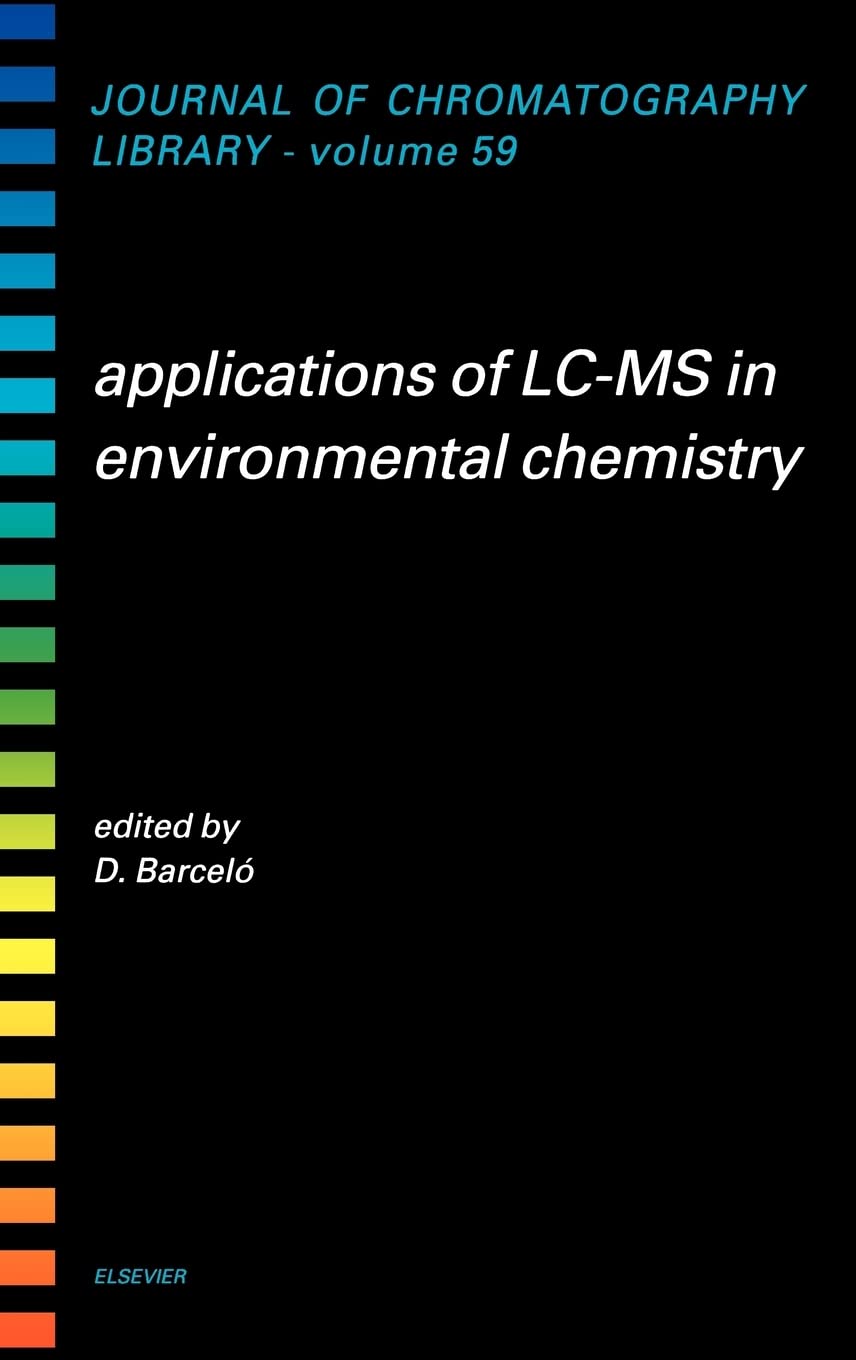
Looking at the literature available, it is clear that there is a need for a book on LCMS applications in environmental analysis. This book endeavours to answer the following questions: What interface to use to solve "my detection problem"? Can I obtain enough sensitivity for the confirmation of my compound in realworld environmental samples? Is there enough structural information?The present book aims to provide a critical evaluation of LCMS in environmental chemistry and it is structured in different areas. Apart from an introductory section with fundamental aspects, application areas using the most relevant interfacing systems (PB, TSP, ES) for the characterization of environmental compounds are included. In this sense, applications are discussed on the characterization of the most relevant compounds of environmental interest such as pesticides, detergents, dyes, polar metabolites, waste streams, organotin compounds and marine toxins with comparison between different interfacing systems. Finally, new methods and strategies in LCMS, e.g. the use of capillary electrophoresis, MS together with online postcolumn systems in LCMS are also shown.By the nature of its content and written as it is by experienced practitioners, the book is intended to serve as a practical reference for analytical chemists who need to use LCMS in environmental studies. Each chapter includes sufficient references to the literature to serve as a valuable starting point and also contains detailed investigations. The broad spectrum of the book and its application to environmental priority compounds makes it unique in many ways.
⚠️ WARNING (California Proposition 65):
This product may contain chemicals known to the State of California to cause cancer,
birth defects, or other reproductive harm.
For MAP (Minimum Advertised Price) violations and Intellectual Property (IP) or Trademark concerns, please contact:
support@ergodebooks.com
⚠️ California Proposition 65 Warning: Some products sold on this website may expose you to chemicals known to the State of California to cause cancer, birth defects, or other reproductive harm. For more information, visit www.P65Warnings.ca.gov.