If you have any questions, you are always welcome to contact us. We'll get back to you as soon as possible, withing 24 hours on weekdays.
Customer service
All questions about your order, return and delivery must be sent to our customer service team by e-mail at yourstore@yourdomain.com
Sale & Press
If you are interested in selling our products, need more information about our brand or wish to make a collaboration, please contact us at press@yourdomain.com
Help
If you have any questions, you are always welcome to contact us. We'll get back to you as soon as possible, withing 24 hours on weekdays.
Customer service
All questions about your order, return and delivery must be sent to our customer service team by e-mail at yourstore@yourdomain.com
Sale & Press
If you are interested in selling our products, need more information about our brand or wish to make a collaboration, please contact us at press@yourdomain.com
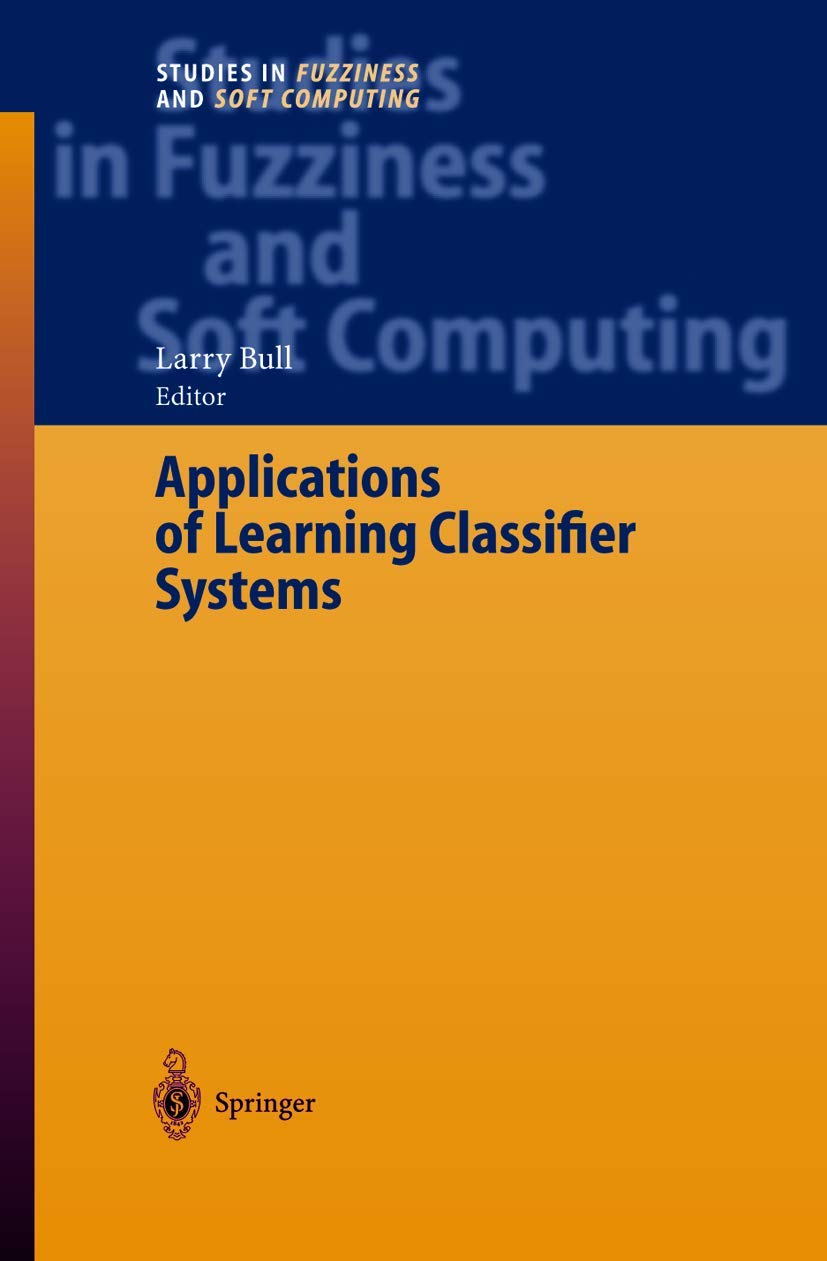
The field called Learning Classifier Systems is populated with romantics. Why shouldn't it be possible for computer programs to adapt, learn, and develop while interacting with their environments? In particular, why not systems that, like organic populations, contain competing, perhaps cooperating, entities evolving together? John Holland was one of the earliest scientists with this vision, at a time when socalled artificial intelligence was in its infancy and mainly concerned with preprogrammed systems that didn't learn. that, like organisms, had sensors, took Instead, Holland envisaged systems actions, and had rich selfgenerated internal structure and processing. In so doing he foresaw and his work prefigured such present day domains as reinforcement learning and embedded agents that are now displacing the older "standard Af' . One focus was what Holland called "classifier systems": sets of competing rule like "classifiers", each a hypothesis as to how best to react to some aspect of the environmentor to another rule. The system embracing such a rule "popu lation" would explore its available actions and responses, rewarding and rating the active rules accordingly. Then "good" classifiers would be selected and re produced, mutated and even crossed, a la Darwin and genetics, steadily and reliably increasing the system's ability to cope.
⚠️ WARNING (California Proposition 65):
This product may contain chemicals known to the State of California to cause cancer,
birth defects, or other reproductive harm.
For MAP (Minimum Advertised Price) violations and Intellectual Property (IP) or Trademark concerns, please contact:
support@ergodebooks.com
⚠️ California Proposition 65 Warning: Some products sold on this website may expose you to chemicals known to the State of California to cause cancer, birth defects, or other reproductive harm. For more information, visit www.P65Warnings.ca.gov.