If you have any questions, you are always welcome to contact us. We'll get back to you as soon as possible, withing 24 hours on weekdays.
Customer service
All questions about your order, return and delivery must be sent to our customer service team by e-mail at yourstore@yourdomain.com
Sale & Press
If you are interested in selling our products, need more information about our brand or wish to make a collaboration, please contact us at press@yourdomain.com
Help
If you have any questions, you are always welcome to contact us. We'll get back to you as soon as possible, withing 24 hours on weekdays.
Customer service
All questions about your order, return and delivery must be sent to our customer service team by e-mail at yourstore@yourdomain.com
Sale & Press
If you are interested in selling our products, need more information about our brand or wish to make a collaboration, please contact us at press@yourdomain.com
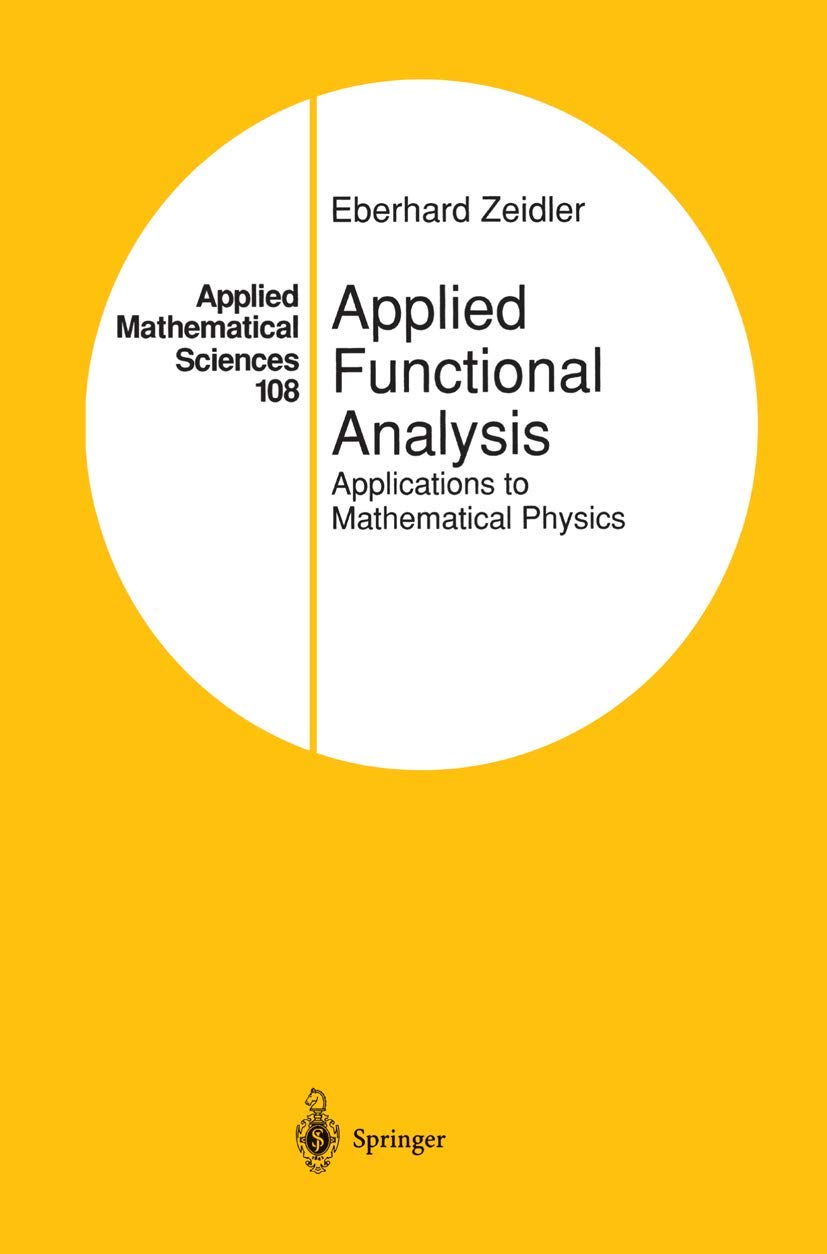
A theory is the more impressive, the simpler are its premises, the more distinct are the things it connects, and the broader is its range of applicability. Albert Einstein There are two different ways of teaching mathematics, namely, (i) the systematic way, and (ii) the applicationoriented way. More precisely, by (i), I mean a systematic presentation of the material governed by the desire for mathematical perfection and completeness of the results. In contrast to (i), approach (ii) starts out from the question 'What are the most important applications?' and then tries to answer this question as quickly as possible. Here, one walks directly on the main road and does not wander into all the nice and interesting side roads. The present book is based on the second approach. It is addressed to undergraduate and beginning graduate students of mathematics, physics, and engineering who want to learn how functional analysis elegantly solves mathematical problems that are related to our real world and that have played an important role in the history of mathematics. The reader should sense that the theory is being developed, not simply for its own sake, but for the effective solution of concrete problems. viii Preface This introduction to functional analysis is divided into the following two parts: Part I: Applications to mathematical physics (the present AMS Vol. 108); Part II: Main principles and their applications (AMS Vol. 109).
⚠️ WARNING (California Proposition 65):
This product may contain chemicals known to the State of California to cause cancer,
birth defects, or other reproductive harm.
For MAP (Minimum Advertised Price) violations and Intellectual Property (IP) or Trademark concerns, please contact:
support@ergodebooks.com
⚠️ California Proposition 65 Warning: Some products sold on this website may expose you to chemicals known to the State of California to cause cancer, birth defects, or other reproductive harm. For more information, visit www.P65Warnings.ca.gov.