
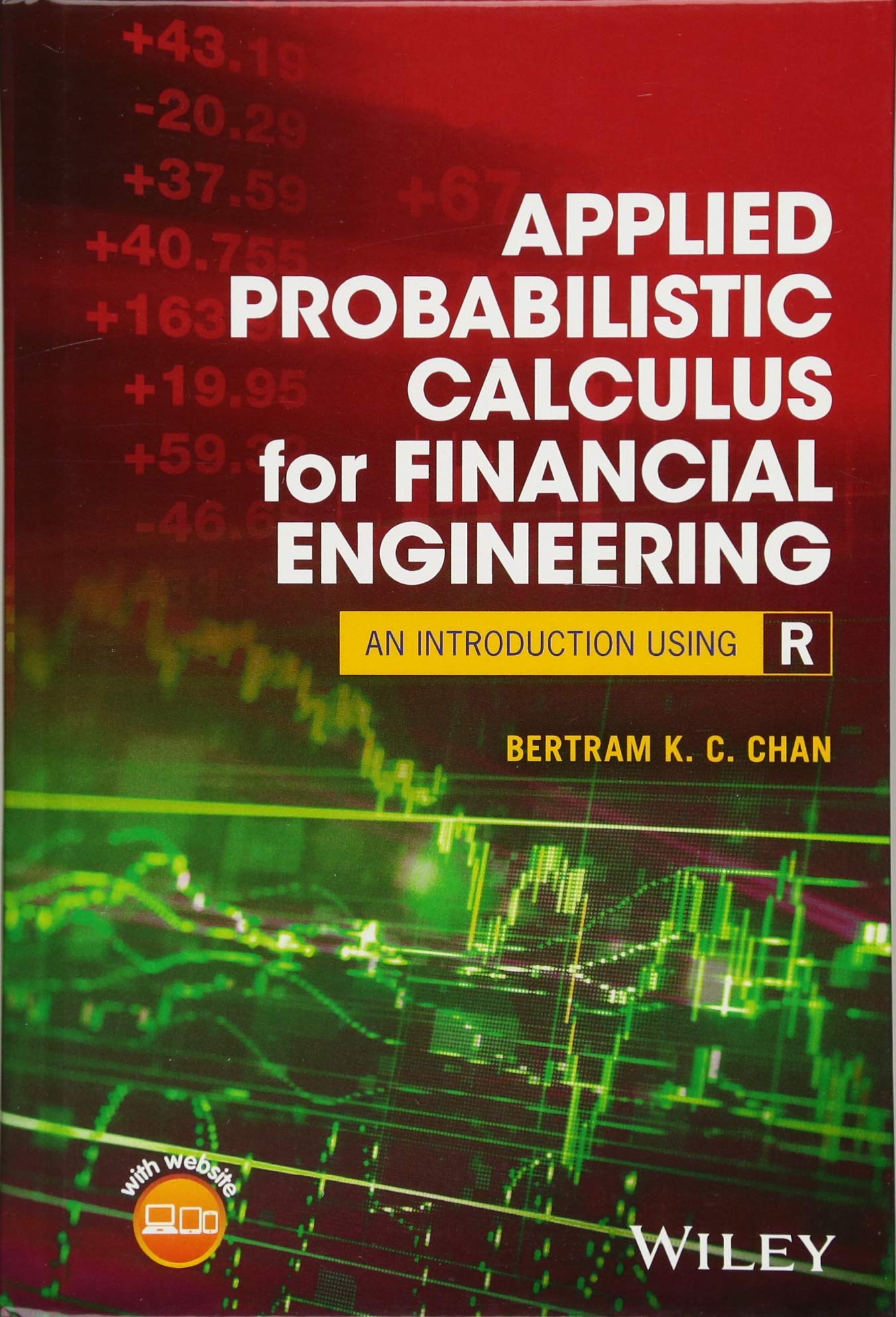
Title
Applied Probabilistic Calculus for Financial Engineering: An Introduction Using R,Used
Sold by Ergodebooks, an authorized reseller.
Returns accepted within 30 days | support@ergodebooks.com
Shipping Information
- Free Standard Shipping — United States only
- Processing Time: 3–5 business days
- Estimated Delivery: 6–10 business days after dispatch
- Double-boxed, fully insured & discreetly packaged
- Tracking number sent via email once dispatched
Returns & Refund
Returns accepted within 30 days of delivery.
Damaged or Defective Item
Free return shipping + replacement or full refund
Wrong Item Received
Free return shipping + replacement or full refund
Change of Mind
Return shipping at customer's expense · 25% restocking fee applies
Payment Option

Illustrates how R may be used successfully to solve problems in quantitative financeApplied Probabilistic Calculus for Financial Engineering: An Introduction Using R provides R recipes for asset allocation and portfolio optimization problems. It begins by introducing all the necessary probabilistic and statistical foundations, before moving on to topics related to asset allocation and portfolio optimization with R codes illustrated for various examples. This clear and concise book covers financial engineering, using R in data analysis, and univariate, bivariate, and multivariate data analysis. It examines probabilistic calculus for modeling financial engineeringwalking the reader through building an effective financial model from the Geometric Brownian Motion (GBM) Model via probabilistic calculus, while also covering Ito Calculus. Classical mathematical models in financial engineering and modern portfolio theory are discussedalong with the Two Mutual Fund Theorem and The Sharpe Ratio. The book also looks at R as a calculator and using R in data analysis in financial engineering. Additionally, it covers asset allocation using R, financial risk modeling and portfolio optimization using R, global and local optimal values, locating functional maxima and minima, and portfolio optimization by performance analytics in CRAN. Covers optimization methodologies in probabilistic calculus for financial engineering Answers the question: What does a "Random Walk" Financial Theory look like? Covers the GBM Model and the Random Walk Model Examines modern theories of portfolio optimization, including The Markowitz Model of Modern Portfolio Theory (MPT), The BlackLitterman Model, and The BlackScholes Option Pricing ModelApplied Probabilistic Calculus for Financial Engineering: An Introduction Using R s an ideal reference for professionals and students in economics, econometrics, and finance, as well as for financial investment quants and financial engineers.
⚠️ WARNING (California Proposition 65):
This product may contain chemicals known to the State of California to cause cancer, birth defects, or other reproductive harm.
For more information, please visit www.P65Warnings.ca.gov.