
Title
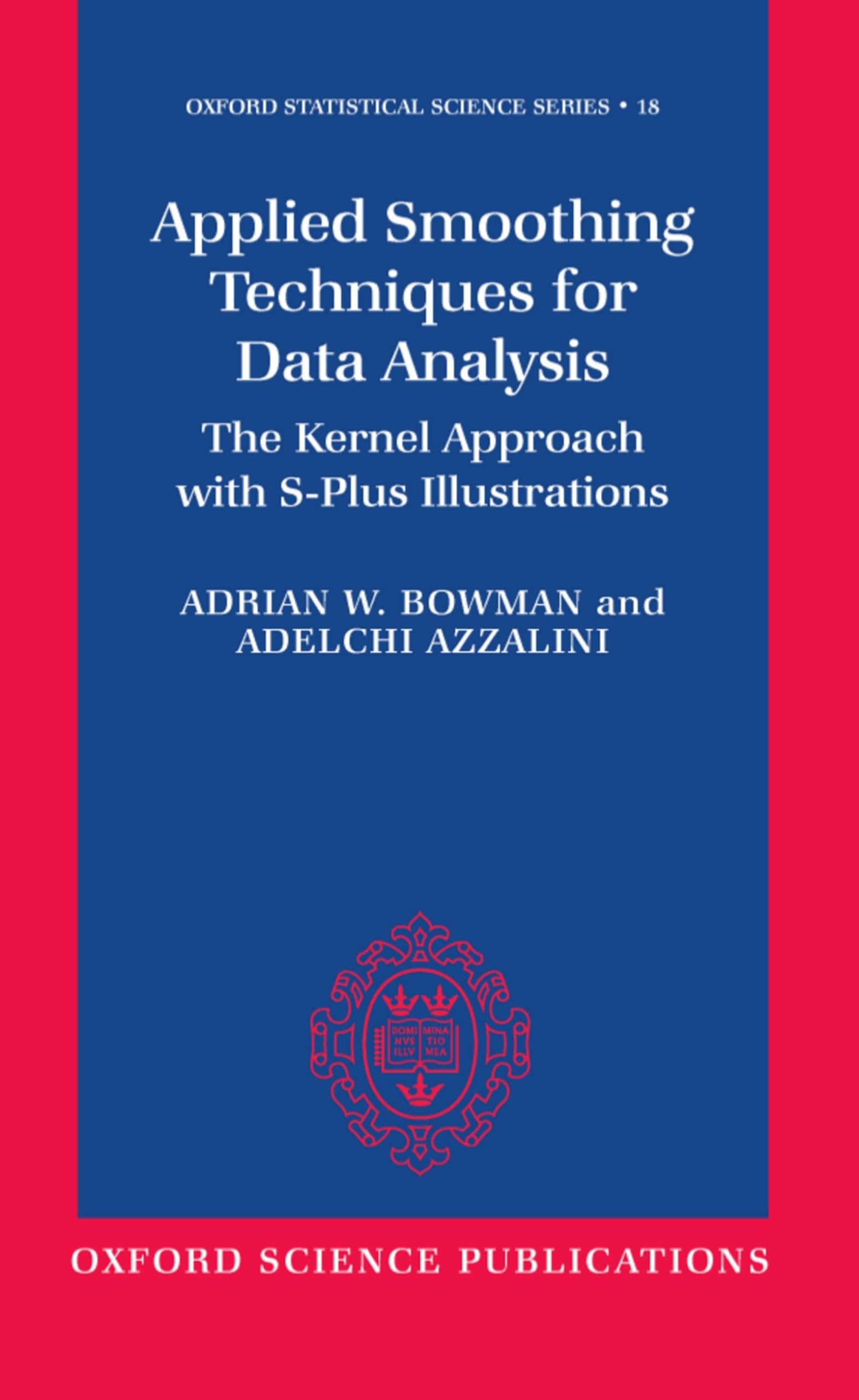
Applied Smoothing Techniques For Data Analysis: The Kernel Approach With Splus Illustrations (Oxford Statistical Science Series
Processing time: 1-3 days
US Orders Ships in: 3-5 days
International Orders Ships in: 8-12 days
Return Policy: 15-days return on defective items
Payment Option

This Book Describes The Use Of Smoothing Techniques In Statistics And Includes Both Density Estimation And Nonparametric Regression. Incorporating Recent Advances, It Describes A Variety Of Ways To Apply These Methods To Practical Problems. Although The Emphasis Is On Using Smoothing Techniques To Explore Data Graphically, The Discussion Also Covers Data Analysis With Nonparametric Curves, As An Extension Of More Standard Parametric Models. Intended As An Introduction, With A Focus On Applications Rather Than On Detailed Theory, The Book Will Be Equally Valuable For Undergraduate And Graduate Students In Statistics And For A Wide Range Of Scientists Interested In Statistical Techniques.The Text Makes Extensive Reference To Splus, A Powerful Computing Environment For Exploring Data, And Provides Many Splus Functions And Example Scripts. This Material, However, Is Independent Of The Main Body Of Text And May Be Skipped By Readers Not Interested In Splus.
⚠️ WARNING (California Proposition 65):
This product may contain chemicals known to the State of California to cause cancer, birth defects, or other reproductive harm.
For more information, please visit www.P65Warnings.ca.gov.
- Q: How many pages does the book have? A: The book contains two hundred four pages. This length provides a comprehensive overview of smoothing techniques in statistics.
- Q: What are the dimensions of this book? A: The book measures nine point twenty-one inches in length, nine point forty-one inches in width, and six point three inches in height. These dimensions make it a suitable size for both reading and reference.
- Q: What type of binding does this book have? A: This book is hardcover bound. A hardcover provides durability and protection for the pages.
- Q: Who is the author of this book? A: The author is Adrian W. Bowman. He is recognized for his contributions to statistics and data analysis.
- Q: What is the main focus of the book? A: The book focuses on applying smoothing techniques to practical statistical problems. It emphasizes graphical exploration of data over detailed theoretical discussions.
- Q: What statistical techniques are covered in this book? A: The book covers density estimation and nonparametric regression techniques. These are crucial for analyzing complex data sets effectively.
- Q: Is this book suitable for beginners? A: Yes, the book is intended as an introduction. It is suitable for both undergraduate and graduate students in statistics.
- Q: Does the book provide examples using S-Plus? A: Yes, the book includes many S-Plus functions and example scripts. This material is useful for readers interested in practical applications of smoothing techniques.
- Q: Can I skip the S-Plus sections if I'm not interested? A: Yes, the S-Plus material is independent of the main text. Readers can easily focus on the core statistical techniques without it.
- Q: Is this book recommended for scientists? A: Yes, it is valuable for a wide range of scientists interested in statistical techniques. The practical focus makes it applicable across various fields.
- Q: What category does this book belong to? A: This book falls under the category of Linguistics. It specifically relates to statistical methods in data analysis.
- Q: What is the publisher of this book? A: The book is published by Oxford University Press, USA. This publisher is known for its reputable academic publications.
- Q: Are there any prerequisites for understanding this book? A: A basic understanding of statistical concepts is helpful. However, the book is designed to be accessible to beginners.
- Q: What type of audience is this book aimed at? A: The book is aimed at both undergraduate and graduate students as well as professionals in scientific fields. It serves as a practical guide to statistical techniques.
- Q: What is the main teaching method used in the book? A: The book emphasizes graphical exploration of data. This method aids in understanding complex statistical concepts through visual representation.