
Title
Applied Stochastic System Modeling,Used
Sold by Ergodebooks, an authorized reseller.
Returns accepted within 30 days | support@ergodebooks.com
Shipping Information
- Free Standard Shipping — United States only
- Processing Time: 3–5 business days
- Estimated Delivery: 6–10 business days after dispatch
- Double-boxed, fully insured & discreetly packaged
- Tracking number sent via email once dispatched
Returns & Refund
Returns accepted within 30 days of delivery.
Damaged or Defective Item
Free return shipping + replacement or full refund
Wrong Item Received
Free return shipping + replacement or full refund
Change of Mind
Return shipping at customer's expense · 25% restocking fee applies
Payment Option

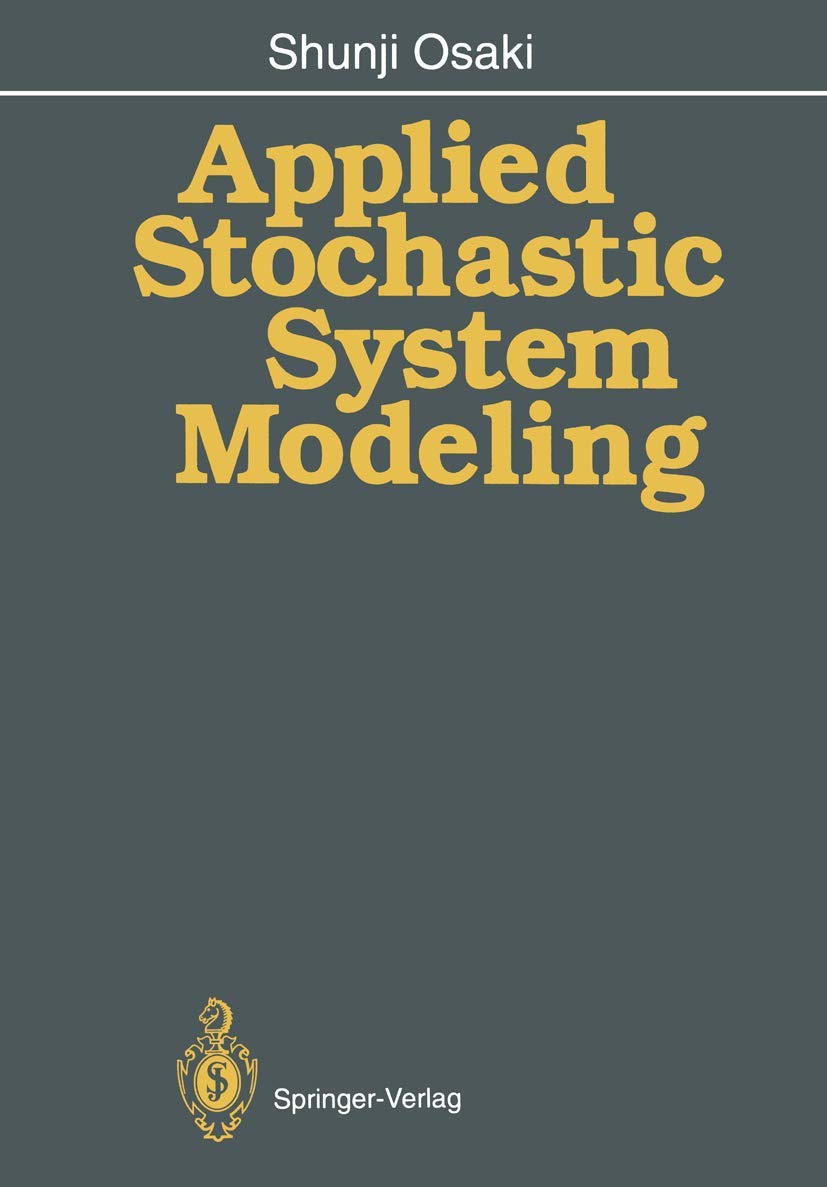
This book was written for an introductory onesemester or twoquarter course in stochastic processes and their applications. The reader is assumed to have a basic knowledge of analysis and linear algebra at an undergraduate level. Stochastic models are applied in many fields such as engineering systems, physics, biology, operations research, business, economics, psychology, and linguistics. Stochastic modeling is one of the promising kinds of modeling in applied probability theory. This book is intended to introduce basic stochastic processes: Poisson pro cesses, renewal processes, discretetime Markov chains, continuoustime Markov chains, and Markovrenewal processes. These basic processes are introduced from the viewpoint of elementary mathematics without going into rigorous treatments. This book also introduces applied stochastic system modeling such as reliability and queueing modeling. Chapters 1 and 2 deal with probability theory, which is basic and prerequisite to the following chapters. Many important concepts of probabilities, random variables, and probability distributions are introduced. Chapter 3 develops the Poisson process, which is one of the basic and im portant stochastic processes. Chapter 4 presents the renewal process. Renewal theoretic arguments are then used to analyze applied stochastic models. Chapter 5 develops discretetime Markov chains. Following Chapter 5, Chapter 6 deals with continuoustime Markov chains. Continuoustime Markov chains have im portant applications to queueing models as seen in Chapter 9. A onesemester course or twoquarter course consists of a brief review of Chapters 1 and 2, fol lowed in order by Chapters 3 through 6.
⚠️ WARNING (California Proposition 65):
This product may contain chemicals known to the State of California to cause cancer, birth defects, or other reproductive harm.
For more information, please visit www.P65Warnings.ca.gov.