
Title
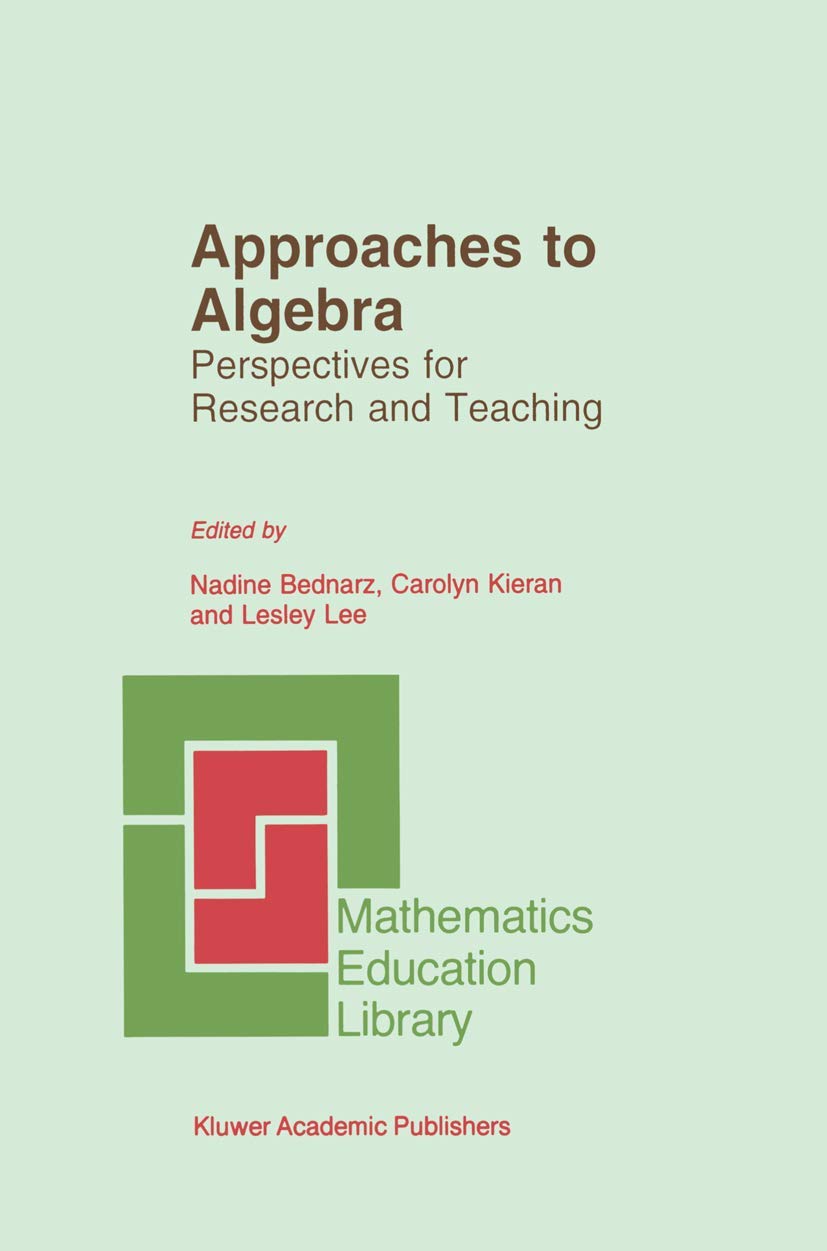
Approaches to Algebra: Perspectives for Research and Teaching (Mathematics Education Library, 18),Used
Sold by Ergodebooks, an authorized reseller.
Returns accepted within 30 days | support@ergodebooks.com
Shipping Information
- Free Standard Shipping — United States only
- Processing Time: 3–5 business days
- Estimated Delivery: 6–10 business days after dispatch
- Double-boxed, fully insured & discreetly packaged
- Tracking number sent via email once dispatched
Returns & Refund
Returns accepted within 30 days of delivery.
Damaged or Defective Item
Free return shipping + replacement or full refund
Wrong Item Received
Free return shipping + replacement or full refund
Change of Mind
Return shipping at customer's expense · 25% restocking fee applies
Payment Option

In Greek geometry, there is an arithmetic of magnitudes in which, in terms of numbers, only integers are involved. This theory of measure is limited to exact measure. Operations on magnitudes cannot be actually numerically calculated, except if those magnitudes are exactly measured by a certain unit. The theory of proportions does not have access to such operations. It cannot be seen as an "arithmetic" of ratios. Even if Euclidean geometry is done in a highly theoretical context, its axioms are essentially semantic. This is contrary to Mahoney's second characteristic. This cannot be said of the theory of proportions, which is less semantic. Only synthetic proofs are considered rigorous in Greek geometry. Arithmetic reasoning is also synthetic, going from the known to the unknown. Finally, analysis is an approach to geometrical problems that has some algebraic characteristics and involves a method for solving problems that is different from the arithmetical approach. 3. GEOMETRIC PROOFS OF ALGEBRAIC RULES Until the second half of the 19th century, Euclid's Elements was considered a model of a mathematical theory. This may be one reason why geometry was used by algebraists as a tool to demonstrate the accuracy of rules otherwise given as numerical algorithms. It may also be that geometry was one way to represent general reasoning without involving specific magnitudes. To go a bit deeper into this, here are three geometric proofs of algebraic rules, the frrst by AlKhwarizmi, the other two by Cardano.
⚠️ WARNING (California Proposition 65):
This product may contain chemicals known to the State of California to cause cancer, birth defects, or other reproductive harm.
For more information, please visit www.P65Warnings.ca.gov.