If you have any questions, you are always welcome to contact us. We'll get back to you as soon as possible, withing 24 hours on weekdays.
Customer service
All questions about your order, return and delivery must be sent to our customer service team by e-mail at yourstore@yourdomain.com
Sale & Press
If you are interested in selling our products, need more information about our brand or wish to make a collaboration, please contact us at press@yourdomain.com
Help
If you have any questions, you are always welcome to contact us. We'll get back to you as soon as possible, withing 24 hours on weekdays.
Customer service
All questions about your order, return and delivery must be sent to our customer service team by e-mail at yourstore@yourdomain.com
Sale & Press
If you are interested in selling our products, need more information about our brand or wish to make a collaboration, please contact us at press@yourdomain.com
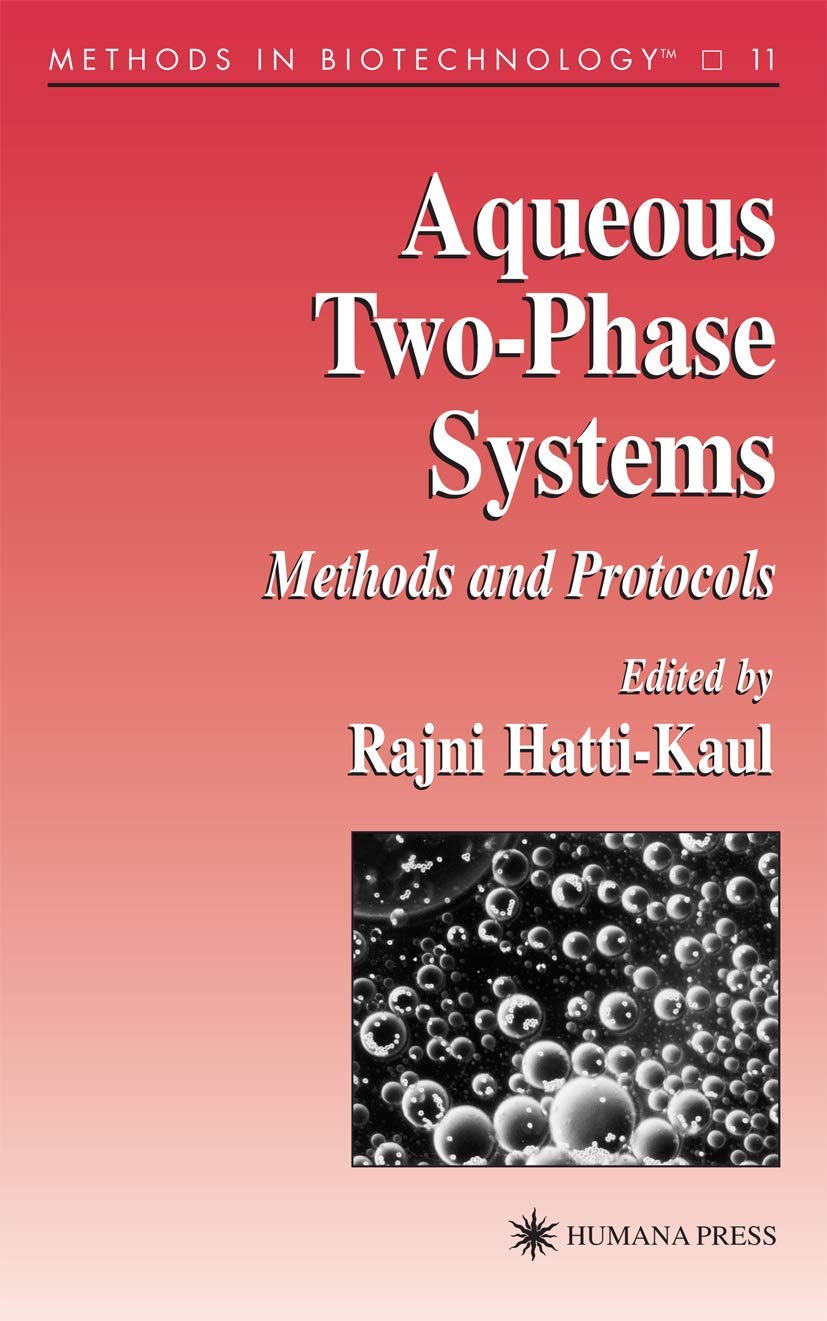
A mixture of two polymers, or one polymer and a salt, in an aqueous medium separates into two phases: this phenomenon is useful in biotechn ogy for product separations. Separation of biological molecules and particles in these aqueous twophase systems (ATPS) was initiated over 40 years ago by P.. Albertsson, and later proved to be of immense utility in biochemical and cell biological research. A boost in the application of ATPS was seen when problems of separations in biotechnology processes were encountered. Its simplicity, biocompatibility, and amenability to easy scaleup operations make the use of ATPS very attractive for largescale bioseparations. Despite the advantages ATPS enjoys over other separation techniques, the application of twophase systems has for a long time been confined to selected labora ries. Recent years have, however, shown a trend in which increasing numbers of researchers employ twophase partitioning techniques in both basic and applied research.
⚠️ WARNING (California Proposition 65):
This product may contain chemicals known to the State of California to cause cancer,
birth defects, or other reproductive harm.
For MAP (Minimum Advertised Price) violations and Intellectual Property (IP) or Trademark concerns, please contact:
support@ergodebooks.com
⚠️ California Proposition 65 Warning: Some products sold on this website may expose you to chemicals known to the State of California to cause cancer, birth defects, or other reproductive harm. For more information, visit www.P65Warnings.ca.gov.