
Title
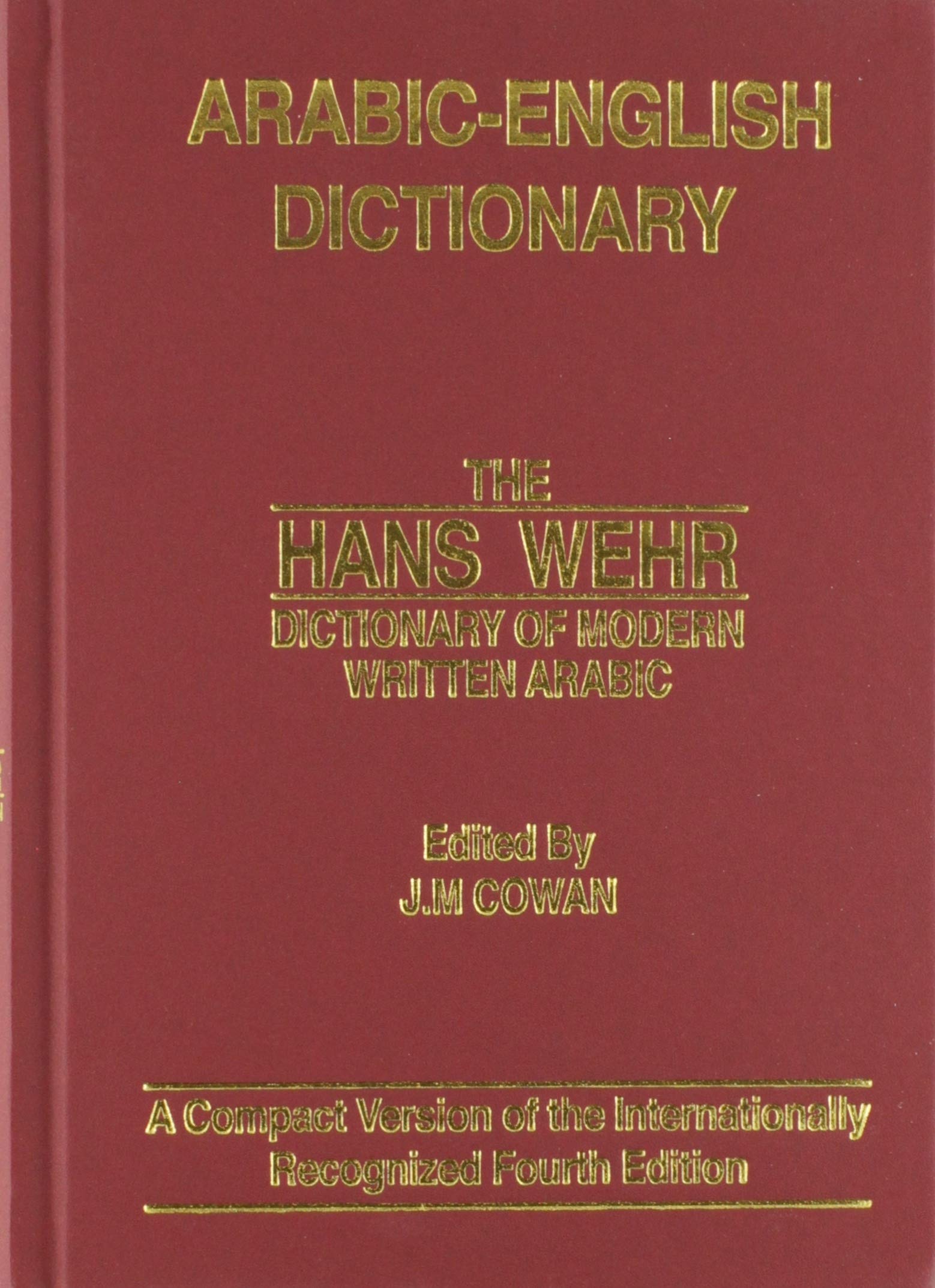
ArabicEnglish Dictionary: The Hans Wehr Dictionary of Modern Written Arabic,New
Sold by Ergodebooks, an authorized reseller.
Returns accepted within 30 days | support@ergodebooks.com
Shipping Information
- Free Standard Shipping — United States only
- Processing Time: 3–5 business days
- Estimated Delivery: 6–10 business days after dispatch
- Double-boxed, fully insured & discreetly packaged
- Tracking number sent via email once dispatched
Returns & Refund
Returns accepted within 30 days of delivery.
Damaged or Defective Item
Free return shipping + replacement or full refund
Wrong Item Received
Free return shipping + replacement or full refund
Change of Mind
Return shipping at customer's expense · 25% restocking fee applies
Payment Option

This Dictionary of Modern Written Arabic (fourth edition) has been enlarged and amended with 13,000 new entries. It is the only authorized hardcover edition of the famous Hans Wehr ArabicEnglish Dictionary, edited by J. Milton Cowan. This new edition has thousands of new entries include numerous additions and corrections to the material and presents the results in a single handsome volume.The author provides a useful introduction in which he discusses, clearly and precisely, the present state of the Arabic language. He points out the situations in which written and spoken varieties of Arabic are used, and remarks on the forces that influenced the development of the lexicon of Modern Arabic. He discusses both the purist movement with its normative tradition, and what might be called the laissezfaire actual usage of writers and journalists under the influence of Western modes of expression, of their everyday colloquial, or both.He then moves on to the problem of local terminology, especially for public institutions, offices, administrative matters, titles, and foods. Although such terms are included for most of the Arab countries, the list is not complete, as indeed the author recognizes (viii); readers of Arabic material characterized by a distinct regional coloring are advised to refer to dialect dictionaries and glossaries. In addition to admitting dialectal forms attested in written Arabic, Wehr's dictionary makes room for older forms of Classical Arabic used for artistic and stylistic effect in presentday writing. After discussing the evolution of a relatively standardized journalistic, style, used in the press and over the radio, the author turns to the problem of scientific and technical terminology, which is still far from standardized. He decides to exclude, and rightly so, academic coinages and individual creations that are not attested in actual usage.Terms that are attested, but not considered to be generally accepted are marked with special symbols. The dictionary entries are arranged according to the traditional Arabic root order. Foreign words are listed in alphabetical order by first letter (in the Arabic script).Arabicized loanwords, if they can clearly fit under some roots, are entered both ways, often with the root entry giving reference to the alphabetical listing. Under a given root, lexical data is present whenever it exists and arranged in the following sequence:The perfect of the basic stem (stem I)Vowels of the imperfect of stem IMasdars (verbal nouns) of stem IFinite derived stem verb forms, indicated by Roman numeralsNominal forms then follow according to their length, including those verbal nouns and participles which merit separate listings.This ordering means that forms derived from the same verb stem (i.e. closelyrelated finite verb forms, verbal nouns, and participles) are not always grouped together, as is done in some other Arabic dictionaries. The dictionary does not usually give concrete example forms of finite derived stem verbs, so that the user must memorize the meaning of the stem numbers ('II' through 'X') and reconstruct such verb forms based solely on the stem number and the abstract consonantal root.
⚠️ WARNING (California Proposition 65):
This product may contain chemicals known to the State of California to cause cancer, birth defects, or other reproductive harm.
For more information, please visit www.P65Warnings.ca.gov.