
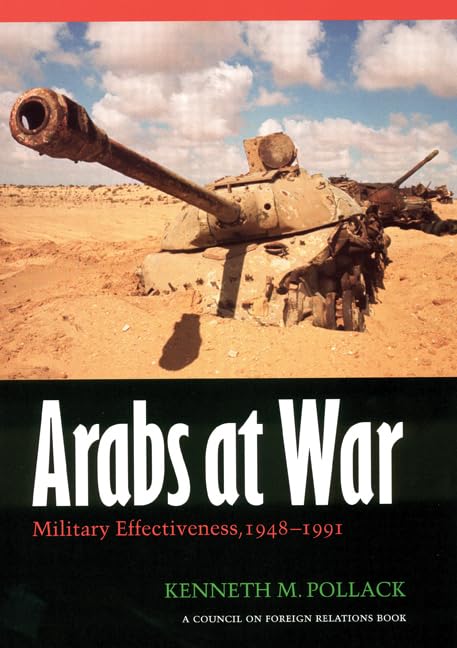
Title
Arabs At War: Military Effectiveness, 19481991 (Studies In War, Society, And The Military)
Sold by Ergodebooks, an authorized reseller.
Returns accepted within 30 days | support@ergodebooks.com
Shipping Information
- Free Standard Shipping — United States only
- Processing Time: 3–5 business days
- Estimated Delivery: 6–10 business days after dispatch
- Double-boxed, fully insured & discreetly packaged
- Tracking number sent via email once dispatched
Returns & Refund
Returns accepted within 30 days of delivery.
Damaged or Defective Item
Free return shipping + replacement or full refund
Wrong Item Received
Free return shipping + replacement or full refund
Change of Mind
Return shipping at customer's expense · 25% restocking fee applies
Payment Option

Kenneth M. Pollack, Formerly A Persian Gulf Military Analyst At The Cia And Director For Persian Gulf Affairs At The National Security Council, Describes And Analyzes The Military History Of The Six Key Arab Statesegypt, Iraq, Jordan, Libya, Saudi Arabia, And Syriaduring The Postworld War Ii Era. He Shows In Detail How Each Arab Military Grew And Learned From Its Own Experiences In Response To The Specific Objectives Set For It And Within Often Constrained Political, Economic, And Social Circumstances. This Firstever Overview Of The Modern Arab Approach To Warfare Provides A Better Understanding Of The Capabilities And Limitations Of The Arab Militaries, Some Of Which Are The United States Most Likely Adversaries, And Some Of Which Are Our Most Important Allies.
⚠️ WARNING (California Proposition 65):
This product may contain chemicals known to the State of California to cause cancer, birth defects, or other reproductive harm.
For more information, please visit www.P65Warnings.ca.gov.
- Q: How many pages does the book have? A: This book has six hundred ninety-nine pages. It provides an in-depth analysis of military effectiveness in the Arab states.
- Q: What is the binding type of this book? A: The binding of this book is hardcover. This makes it durable and suitable for long-term use.
- Q: What are the dimensions of the book? A: The dimensions of the book are six point five inches in length, two point five two inches in width, and nine point zero two inches in height. This size makes it portable and easy to handle.
- Q: Who is the author of this book? A: The author of this book is Kenneth M. Pollack. He is known for his expertise in Persian Gulf military affairs.
- Q: What is the main topic of the book? A: The main topic of the book is military effectiveness in six key Arab states from nineteen forty-eight to nineteen ninety-one. It covers their military history and strategies.
- Q: Is this book suitable for academic use? A: Yes, this book is suitable for academic use. It provides detailed insights and analyses relevant to military studies and Middle Eastern history.
- Q: How do I care for this hardcover book? A: To care for this hardcover book, store it upright in a cool, dry place. Avoid exposing it to direct sunlight to prevent fading.
- Q: What should I do if the book arrives damaged? A: If the book arrives damaged, contact the seller for a return or replacement. Most sellers offer a satisfaction guarantee for their products.
- Q: Is there a warranty for this book? A: No, there is typically no warranty for books. However, check the seller's return policy for options.
- Q: Can this book be used for personal research? A: Yes, this book can be used for personal research. It offers valuable insights into the military strategies of Arab countries.
- Q: What makes this book unique? A: This book is unique because it is the first comprehensive overview of modern Arab military approaches. It analyzes specific military experiences and responses.
- Q: Is this book suitable for beginners in military history? A: Yes, this book is suitable for beginners in military history. It presents complex topics in an accessible manner, making it easier to understand.
- Q: How should I store this book? A: Store this book in a cool, dry place, preferably on a shelf. Keep it away from humidity and extreme temperatures to preserve its condition.
- Q: What are the key themes discussed in the book? A: Key themes include military growth, learning from experience, and the interplay of political, economic, and social factors in Arab militaries.
- Q: Who is the publisher of the book? A: The publisher of the book is the University of Nebraska Press. They specialize in scholarly works on various topics.
- Q: What period does the book cover? A: The book covers the period from nineteen forty-eight to nineteen ninety-one. It focuses on the military effectiveness of Arab states during this time.