If you have any questions, you are always welcome to contact us. We'll get back to you as soon as possible, withing 24 hours on weekdays.
Customer service
All questions about your order, return and delivery must be sent to our customer service team by e-mail at yourstore@yourdomain.com
Sale & Press
If you are interested in selling our products, need more information about our brand or wish to make a collaboration, please contact us at press@yourdomain.com
Help
If you have any questions, you are always welcome to contact us. We'll get back to you as soon as possible, withing 24 hours on weekdays.
Customer service
All questions about your order, return and delivery must be sent to our customer service team by e-mail at yourstore@yourdomain.com
Sale & Press
If you are interested in selling our products, need more information about our brand or wish to make a collaboration, please contact us at press@yourdomain.com
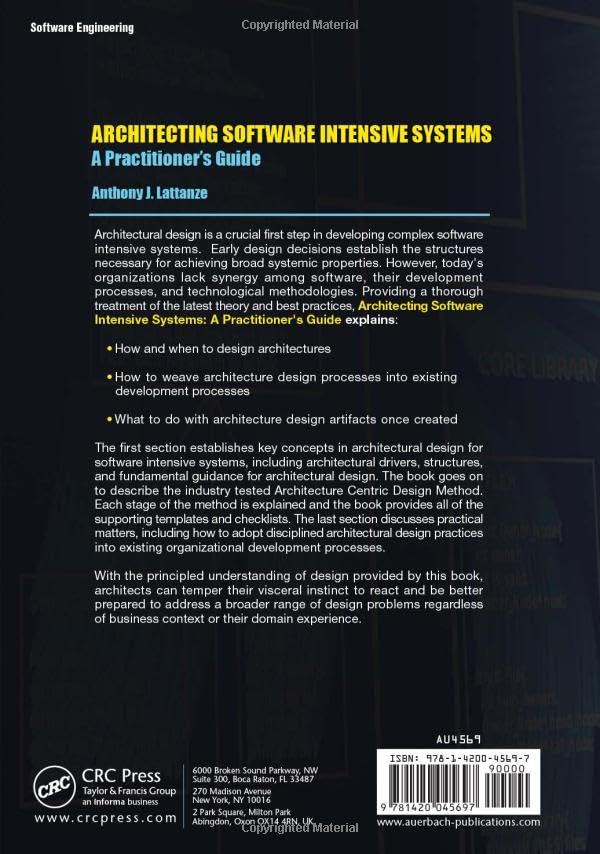
Architectural design is a crucial first step in developing complex software intensive systems. Early design decisions establish the structures necessary for achieving broad systemic properties. However, todays organizations lack synergy between software their development processes and technological methodologies. Providing a thorough treatment of the latest theory and best practices, Architecting Software Intensive Systems: A Practitioners Guide explains:How and when to design architectures How to weave architecture design processes into existing development processes What to do with architecture design artifacts once createdThe first section establishes key concepts in architectural design for software intensive systems, including architectural drivers, structures, and fundamental guidance for architectural design. The book goes on to describe the industry tested Architecture Centric Design Method. Each stage of the method is explained and the book provides all of the supporting templates and checklists. The last section discusses practical matters, including how to adopt disciplined architectural design practices into existing organizational development processes.With the principled understanding of design provided by this book, architects can temper their visceral instinct to react and be better prepared to address a broader range of design problems regardless of business context or their domain experience.
⚠️ WARNING (California Proposition 65):
This product may contain chemicals known to the State of California to cause cancer,
birth defects, or other reproductive harm.
For MAP (Minimum Advertised Price) violations and Intellectual Property (IP) or Trademark concerns, please contact:
support@ergodebooks.com
⚠️ California Proposition 65 Warning: Some products sold on this website may expose you to chemicals known to the State of California to cause cancer, birth defects, or other reproductive harm. For more information, visit www.P65Warnings.ca.gov.