If you have any questions, you are always welcome to contact us. We'll get back to you as soon as possible, withing 24 hours on weekdays.
Customer service
All questions about your order, return and delivery must be sent to our customer service team by e-mail at yourstore@yourdomain.com
Sale & Press
If you are interested in selling our products, need more information about our brand or wish to make a collaboration, please contact us at press@yourdomain.com
Help
If you have any questions, you are always welcome to contact us. We'll get back to you as soon as possible, withing 24 hours on weekdays.
Customer service
All questions about your order, return and delivery must be sent to our customer service team by e-mail at yourstore@yourdomain.com
Sale & Press
If you are interested in selling our products, need more information about our brand or wish to make a collaboration, please contact us at press@yourdomain.com
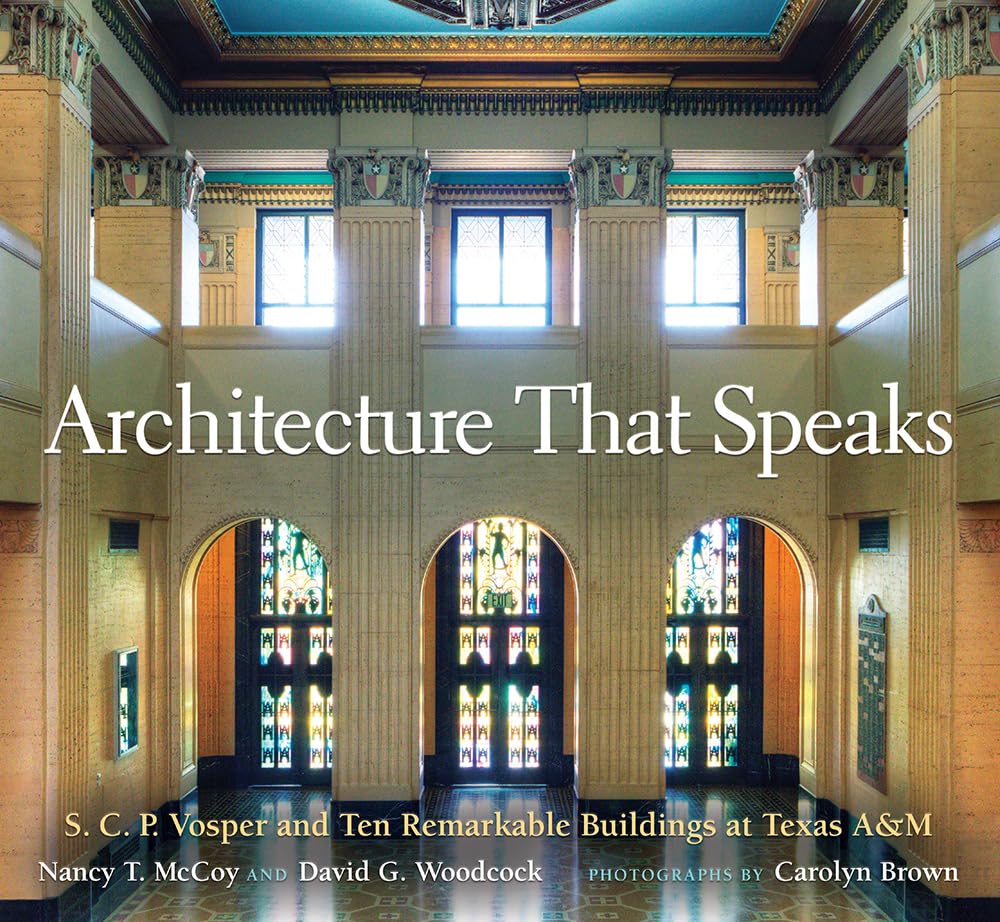
When the A&M College of Texas opened its doors in 1876, its early buildings followed a Victorian architectural style. Classical architecture came to the campus with the Academic Building, after the 1912 fire that destroyed Old Main. Subsequent buildings generally followed this neoclassical path, but the growth of the campus in the Depression era saw the addition of an extraordinary group of buildings, sited in accordance with a master plan developed by college architect F. E. Giesecke and designed by S. C. P. Vosper, each of whom also held faculty positions in the first architecture program at a state college in Texas.The buildings designed by Vosper are arguably the finest buildings on the campus, uniquely expressive of the agricultural and mechanical origins of the university; they delight the senses with color, sculpture, and wit. Nancy T. McCoy and David G. Woodcock, distinguished preservation architects and scholars, review the history of Texas A&M campus architecture and provide indepth coverage of Vosper and his legacy. Illustrated by the sumptuous photography of Carolyn Brown, Architecture That Speaks concludes with observations on recent approaches toward the reuse and rehabilitation of campus heritage architecture and a view to the future, as plans evolve for further development of the campus that maintains a respect for both strategic vision and historical heritage.
⚠️ WARNING (California Proposition 65):
This product may contain chemicals known to the State of California to cause cancer,
birth defects, or other reproductive harm.
For MAP (Minimum Advertised Price) violations and Intellectual Property (IP) or Trademark concerns, please contact:
support@ergodebooks.com
⚠️ California Proposition 65 Warning: Some products sold on this website may expose you to chemicals known to the State of California to cause cancer, birth defects, or other reproductive harm. For more information, visit www.P65Warnings.ca.gov.