
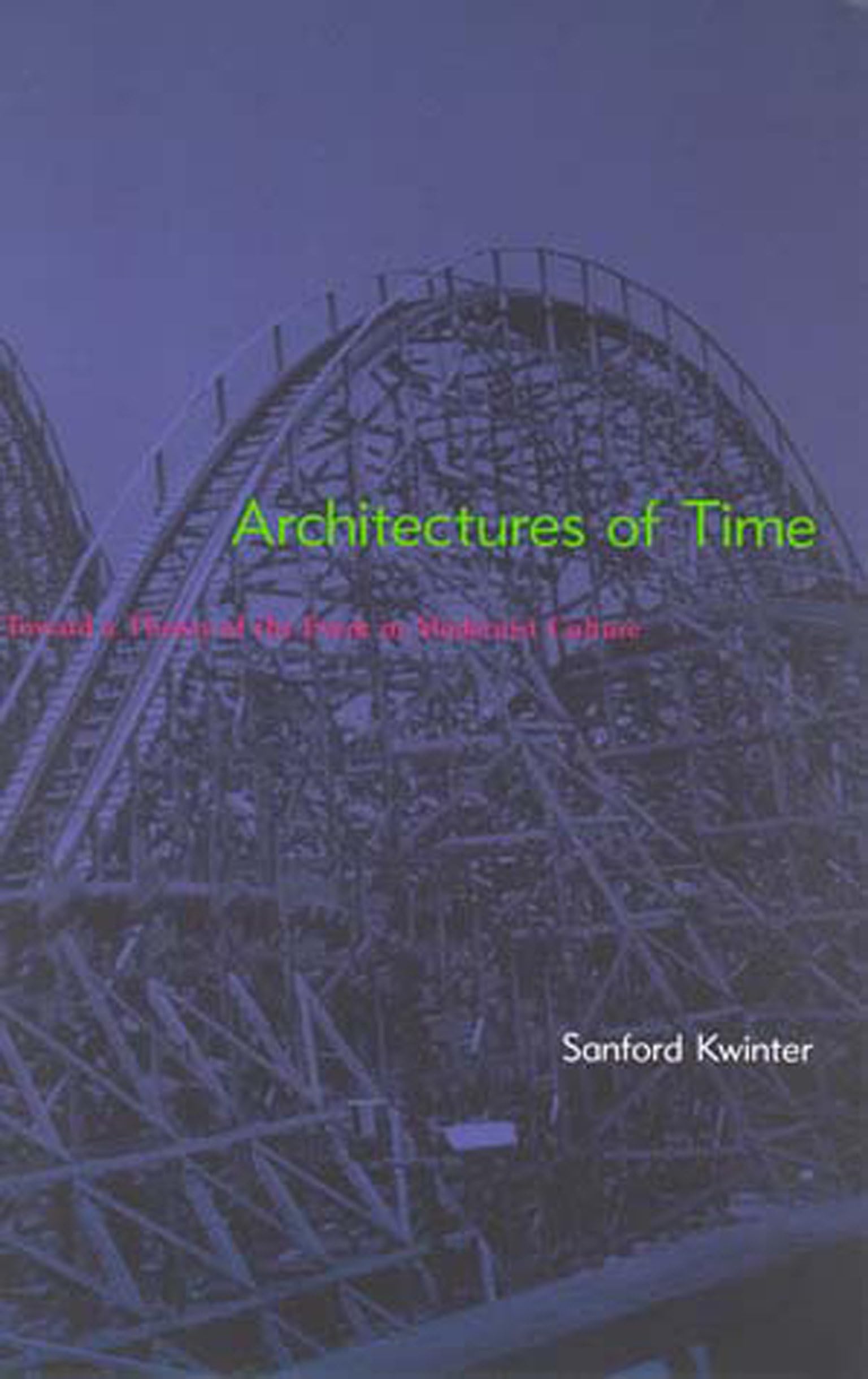
Title
Architectures Of Time: Toward A Theory Of The Event In Modernist Culture,New
Sold by Ergodebooks, an authorized reseller.
Returns accepted within 30 days | support@ergodebooks.com
Shipping Information
- Free Standard Shipping — United States only
- Processing Time: 3–5 business days
- Estimated Delivery: 6–10 business days after dispatch
- Double-boxed, fully insured & discreetly packaged
- Tracking number sent via email once dispatched
Returns & Refund
Returns accepted within 30 days of delivery.
Damaged or Defective Item
Free return shipping + replacement or full refund
Wrong Item Received
Free return shipping + replacement or full refund
Change of Mind
Return shipping at customer's expense · 25% restocking fee applies
Payment Option

An Exploration Of Twentiethcentury Conceptions Of Time And Their Relation To Artistic Form.In Architectures Of Time, Sanford Kwinter Offers A Critical Guide To The Modern History Of Time And To The Interplay Between The Physical Sciences And The Arts. Tracing The Transformation Of Twentiethcentury Epistemology To The Rise Of Thermodynamics And Statistical Mechanics, Kwinter Explains How The Demise Of The Concept Of Absolute Time, And Of The Classical Notion Of Space As A Fixed Background Against Which Things Occur, Led To Field Theory And A Physics Of The 'Event.' He Suggests That The Closed, Controlled, And Mechanical World Of Physics Gave Way To The Approximate, Active, And Qualitative World Of Biology As A Model Of Both Scientific And Metaphysical Explanation.Kwinter Examines Theory Of Time And Space In Einstein'S Theories Of Relativity And Shows How These Ideas Were Reflected In The Writings Of The Sculptor Umberto Boccioni, The Town Planning Schema Of The Futurist Architect Antonio Sant'Elia, The Philosophy Of Henri Bergson, And The Writings Of Franz Kafka. He Argues That The Writings Of Boccioni And The Visionary Architecture Of Sant'Elia Represent The Earliest And Most Profound Deployments Of The Concepts Of Field And Event. In Discussing Kafka'S Work, He Moves Away From The Thermodynamic Model In Favor Of The Closely Related One Of Bergsonian Duree, Or Virtuality. He Argues That Kafka'S Work Manifests A Coherent Cosmology That Can Be Understood Only In Relation To The Constant Temporal Flux That Underlies It.
⚠️ WARNING (California Proposition 65):
This product may contain chemicals known to the State of California to cause cancer, birth defects, or other reproductive harm.
For more information, please visit www.P65Warnings.ca.gov.
- Q: How many pages does the book have? A: The book has two hundred fifty-one pages. This length provides a comprehensive exploration of the themes discussed.
- Q: What is the binding type of the book? A: The book is paperback bound. This makes it lightweight and flexible for easy handling.
- Q: What are the dimensions of the book? A: The book measures six inches in length, zero point five seven inches in width, and nine point zero two inches in height. These dimensions make it portable and easy to store.
- Q: Who is the author of the book? A: The author is Sanford Kwinter. He is known for his insightful exploration of modernist culture and concepts of time.
- Q: What genre does this book belong to? A: The book belongs to the criticism genre. It delves into artistic and philosophical interpretations of time.
- Q: What is the main theme of the book? A: The main theme explores twentieth-century conceptions of time in relation to artistic form. It investigates how these ideas have shaped modernist culture.
- Q: Is this book suitable for beginners in philosophy? A: Yes, this book is suitable for beginners. The author presents complex ideas in an accessible manner.
- Q: What audience is this book intended for? A: The book is intended for readers interested in modernist culture, philosophy, and criticism. It appeals to both scholars and general readers.
- Q: Can I use this book for academic research? A: Yes, the book is suitable for academic research. It provides critical insights and references important figures in modernist culture.
- Q: How should I care for this book? A: To care for the book, store it in a cool, dry place. Avoid exposure to direct sunlight to preserve the cover and pages.
- Q: What is the recommended storage for this book? A: The recommended storage is upright on a shelf. This helps prevent warping and keeps the pages flat.
- Q: Is this book safe for young readers? A: The book is not specifically targeted at young readers. It discusses complex themes that may be better suited for older teens and adults.
- Q: What if I receive a damaged copy? A: If you receive a damaged copy, contact customer support for a replacement. Ensure you have your order details handy for a smooth process.
- Q: Is there a return policy for this book? A: Yes, there is a return policy in place. You can return the book within a specified period if it is in new condition.
- Q: What issues can I encounter with this book? A: Common issues include printing errors or damage during shipping. If you encounter any issues, reach out to customer service for assistance.
- Q: How does this book compare to other criticisms of modernist culture? A: This book offers a unique perspective by intertwining physics and philosophy. It contrasts with other criticisms by focusing on the concept of time.