
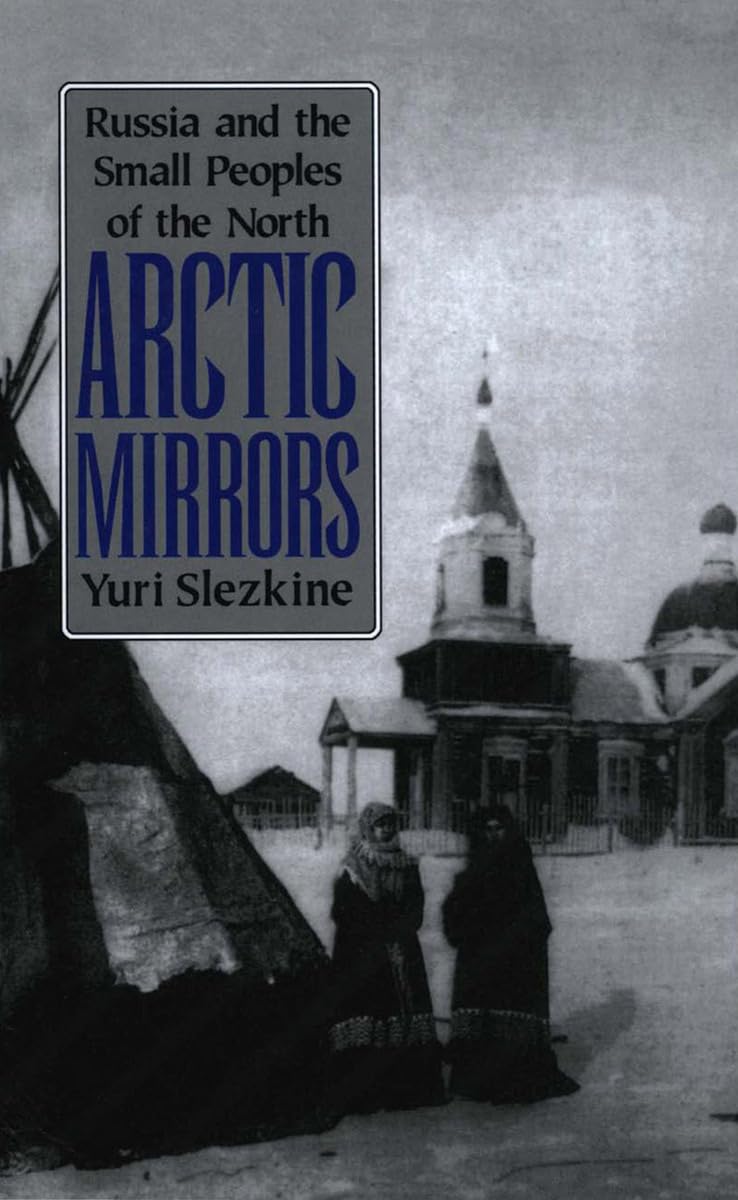
Title
Arctic Mirrors: Russia And The Small Peoples Of The North
Sold by Ergodebooks, an authorized reseller.
Returns accepted within 30 days | support@ergodebooks.com
Shipping Information
- Free Standard Shipping — United States only
- Processing Time: 3–5 business days
- Estimated Delivery: 6–10 business days after dispatch
- Double-boxed, fully insured & discreetly packaged
- Tracking number sent via email once dispatched
Returns & Refund
Returns accepted within 30 days of delivery.
Damaged or Defective Item
Free return shipping + replacement or full refund
Wrong Item Received
Free return shipping + replacement or full refund
Change of Mind
Return shipping at customer's expense · 25% restocking fee applies
Payment Option

For Over Five Hundred Years The Russians Wondered What Kind Of People Their Arctic And Subarctic Subjects Were. They Have Mouths Between Their Shoulders And Eyes In Their Chests, Reported A Fifteenthcentury Tale. They Rove Around, Live Of Their Own Free Will, And Beat The Russian People, Complained A Seventeenthcentury Cossack. Their Actions Are Exceedingly Rude. They Do Not Take Off Their Hats And Do Not Bow To Each Other, Huffed An Eighteenthcentury Scholar. They Are Children Of Nature And Guardians Of Ecological Balance, Rhapsodized Early Nineteenthcentury And Late Twentiethcentury Romantics. Even The Bolsheviks, Who Categorized The Circumpolar Foragers As Authentic Proletarians, Were Repeatedly Puzzled By The Peoples From The Late Neolithic Period Who, By Virtue Of Their Extreme Backwardness, Cannot Keep Up Either Economically Or Culturally With The Furious Speed Of The Emerging Socialist Society.Whether Described As Brutes, Aliens, Or Endangered Indigenous Populations, The Socalled Small Peoples Of The North Have Consistently Remained A Point Of Contrast For Speculations On Russian Identity And A Convenient Testing Ground For Policies And Images That Grew Out Of These Speculations. In Arctic Mirrors, A Vividly Rendered History Of Circumpolar Peoples In The Russian Empire And The Russian Mind, Yuri Slezkine Offers The First Indepth Interpretation Of This Relationship. No Other Book In Any Language Links The History Of A Colonized Nonrussian People To The Full Sweep Of Russian Intellectual And Cultural History. Enhancing His Account With Vintage Prints And Photographs, Slezkine Reenacts The Procession Of Russian Fur Traders, Missionaries, Tsarist Bureaucrats, Radical Intellectuals, Professional Ethnographers, And Commissars Who Struggled To Reform And Conceptualize This Most Alien Of Their Subject Populations.Slezkine Reconstructs From A Vast Range Of Sources The Successive Official Policies And Prevailing Attitudes Toward The Northern Peoples, Interweaving The Resonant Narratives Of Russian And Indigenous Contemporaries With The Extravagant Images Of Popular Russian Fiction. As He Examines The Many Ironies And Ambivalences Involved In Successive Russian Attempts To Overcome Northernand Hence Their Ownotherness, Slezkine Explores The Wider Issues Of Ethnic Identity, Cultural Change, Nationalist Rhetoric, And Notso European Colonialism.
⚠️ WARNING (California Proposition 65):
This product may contain chemicals known to the State of California to cause cancer, birth defects, or other reproductive harm.
For more information, please visit www.P65Warnings.ca.gov.
- Q: How many pages does 'Arctic Mirrors' have? A: This book has four hundred seventy-six pages. It's a comprehensive work that delves into the history of Arctic peoples.
- Q: What is the binding type of this book? A: The book is hardcover. This durable binding ensures that it withstands frequent use.
- Q: Who is the author of 'Arctic Mirrors'? A: The author is Yuri Slezkine. He provides a detailed exploration of the relationship between Russia and Arctic peoples.
- Q: What dimensions does 'Arctic Mirrors' have? A: The book measures six point twelve inches in length, one point forty-six inches in width, and nine point twenty-five inches in height. These dimensions make it a standard-sized hardcover book.
- Q: What category does this book fall under? A: The book is categorized as 'Community & Culture'. It focuses on the interactions between Russians and Arctic peoples.
- Q: Is 'Arctic Mirrors' suitable for academic study? A: Yes, it is suitable for academic study. The book provides in-depth historical analysis and is well-researched.
- Q: How do I read 'Arctic Mirrors'? A: To read this book, simply open it and navigate through the chapters. It's aimed at adults and those interested in cultural studies.
- Q: Is this book recommended for beginners in cultural studies? A: Yes, it can be recommended for beginners. While it's comprehensive, it is accessible for those new to the subject.
- Q: What themes are explored in 'Arctic Mirrors'? A: The book explores themes of ethnic identity, cultural change, and colonialism. It examines how these themes relate to Russian history.
- Q: How should I care for my copy of 'Arctic Mirrors'? A: To care for your book, store it upright in a cool, dry place. Avoid exposure to direct sunlight to preserve the cover and pages.
- Q: Is 'Arctic Mirrors' available in digital format? A: No, this specific edition is only available as a hardcover book. There may be other formats available, but not specified here.
- Q: What if my copy of 'Arctic Mirrors' arrives damaged? A: If your copy arrives damaged, contact the seller for return instructions. They typically have a return policy in place.
- Q: Can I return 'Arctic Mirrors' if I don't like it? A: Yes, you can return it based on the seller's return policy. Make sure to review their specific guidelines.
- Q: What makes 'Arctic Mirrors' unique compared to other cultural studies? A: It uniquely links the history of a colonized non-Russian people to Russian intellectual history. This in-depth analysis is rare.
- Q: Does 'Arctic Mirrors' include illustrations or photographs? A: Yes, the book includes vintage prints and photographs. These visuals enhance the historical narrative presented by the author.