
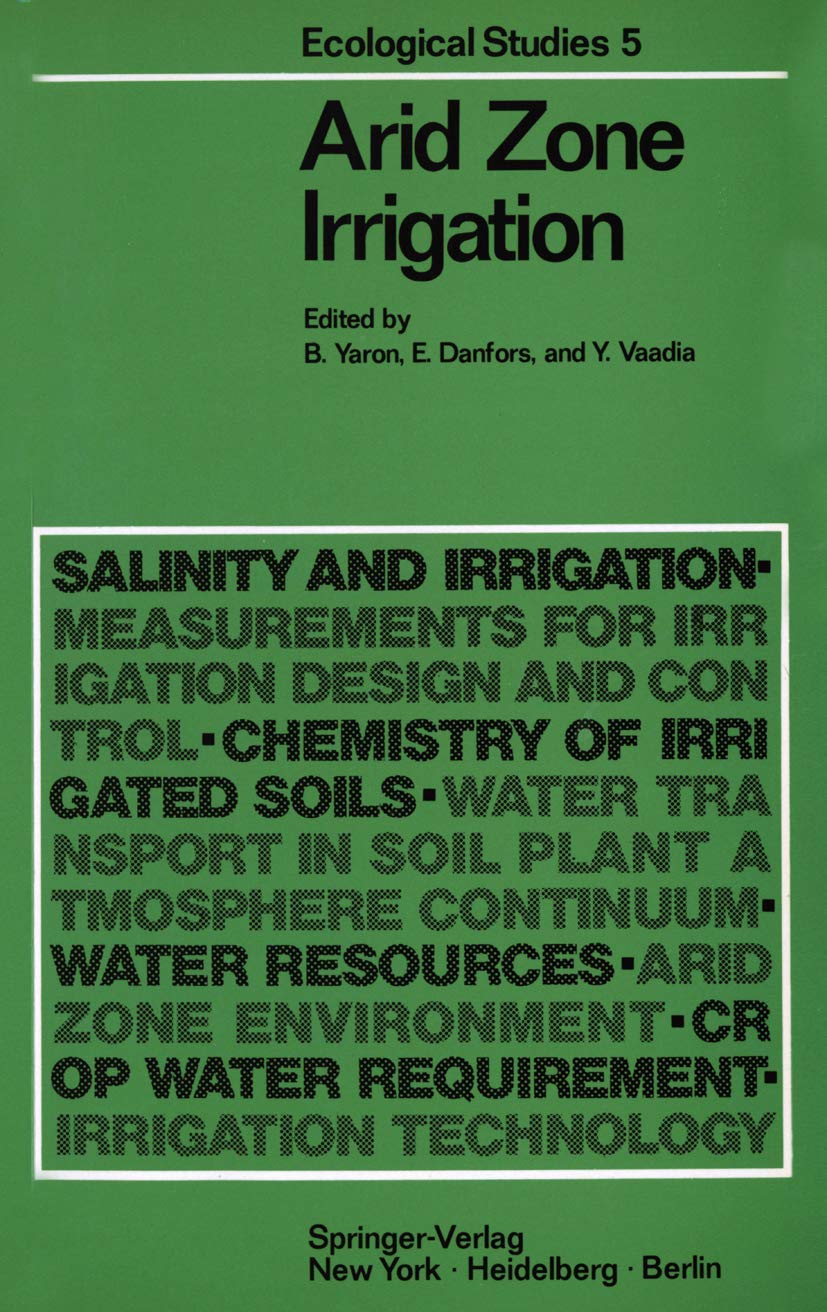
Title
Arid Zone Irrigation (Ecological Studies, 5),Used
Sold by Ergodebooks, an authorized reseller.
Returns accepted within 30 days | support@ergodebooks.com
Shipping Information
- Free Standard Shipping — United States only
- Processing Time: 3–5 business days
- Estimated Delivery: 6–10 business days after dispatch
- Double-boxed, fully insured & discreetly packaged
- Tracking number sent via email once dispatched
Returns & Refund
Returns accepted within 30 days of delivery.
Damaged or Defective Item
Free return shipping + replacement or full refund
Wrong Item Received
Free return shipping + replacement or full refund
Change of Mind
Return shipping at customer's expense · 25% restocking fee applies
Payment Option

A book previously published within the framework of the Ecological Studies Series, entitled "Physical Aspects of Soil Water and Salts in Ecosystems" included awidespectrum of research papers devoted to new findings in the field of soilplantwater relationships. "Arid Zone Irrigation" has been written specifically as a textbook for agronomists, soil scientists, agrometeorologists, water engineers and plant physiologists who want a clear presentation of irrigation fundamentals in arid and semiarid zones. It was our intention to provide an understanding of the basic principles governing irrigation technology and to help overcome the problem of water shortage in arid zone agriculture. This book, written by a large number of specialists and covering a broad spectrum of different disciplines, is based on general uptodate information, as well as on the results of the authors' own research. The idea of preparing such a textbook was conceived during a series of international advanced courses on irrigation held annually at the Institute of Soils and Water, Agricul tural Research Organization, Volcani Center, Bet Dagan, Israel. The final organization of the material has been influenced by discussions with colleagues from Sweden and Holland and the participants in our summer courses. Grateful acknowledgements are due to Professor CALVIN C. ROSE, CSIRO, Canberra, Australia, Professor DALE SWARTZENDRUBER, Purdue University, Lafayetta, U.S.A., and Dr. SHLOMO P. NEUMAN, Agricultural Research Organization, Bet Dagan, Israel, for their many helpful suggestions during critical reading of the manuscript. We thank also Mrs.
⚠️ WARNING (California Proposition 65):
This product may contain chemicals known to the State of California to cause cancer, birth defects, or other reproductive harm.
For more information, please visit www.P65Warnings.ca.gov.