
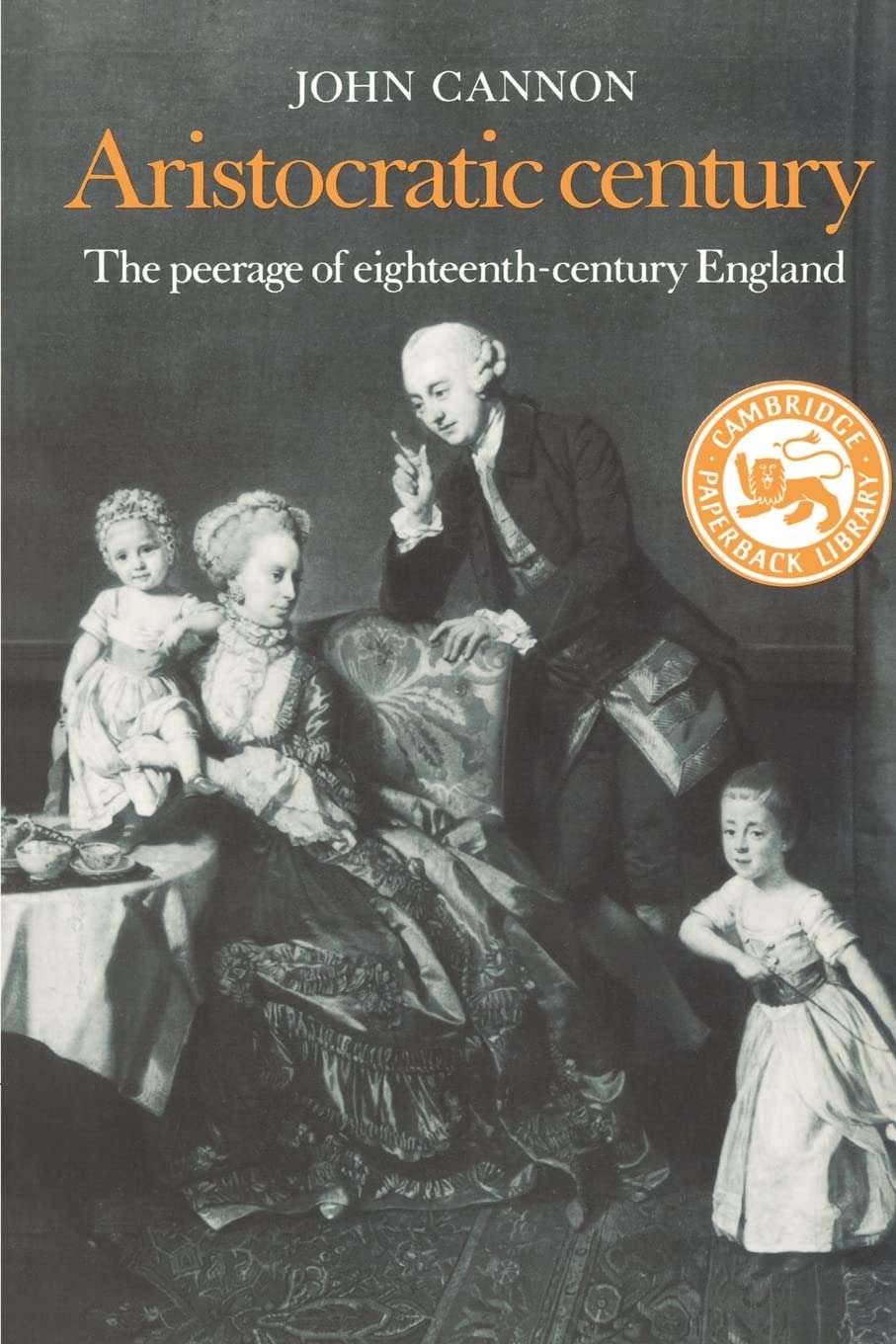
Title
Aristocratic Century: The Peerage of EighteenthCentury England (The Wiles Lectures),New
Sold by Ergodebooks, an authorized reseller.
Returns accepted within 30 days | support@ergodebooks.com
Shipping Information
- Free Standard Shipping — United States only
- Processing Time: 3–5 business days
- Estimated Delivery: 6–10 business days after dispatch
- Double-boxed, fully insured & discreetly packaged
- Tracking number sent via email once dispatched
Returns & Refund
Returns accepted within 30 days of delivery.
Damaged or Defective Item
Free return shipping + replacement or full refund
Wrong Item Received
Free return shipping + replacement or full refund
Change of Mind
Return shipping at customer's expense · 25% restocking fee applies
Payment Option

Since the work of Butterfield and Namier in the 1930s, it has commonly been said that eighteenthcentury England appears atomised, left with no overall interpretation. Subsequent work on religious differences and on party strife served to reinforce the image of a divided society, and in the last ten years historians of the poor and unprivileged have suggested that beneath the surface lurked substantial popular discontent. Professor Cannon uses his 1982 Wiles Lecture to offer a different interpretation that the widespread acceptance of aristocratic values and aristocratic leadership gave a remarkable intellectual, political and social coherence to the century. He traces the recovery made by the aristocracy from its decade in 1649 when the House of Lords was abolished as useless and dangerous. After the Glorious Revolution of 1688, the peerage reestablished its hold on government and society. Professor Cannon is forced to challenge some of the most cherished beliefs of English historiography that Hanoverian society, at its top level, was an open elite, continually replenished by vigorous recruits from other groups and classes. He suggests that, on the contrary, in some respects the English peerage was more exclusive than many of its continental counterparts and that the openness was a myth which itself served a potent political purpose. Of the prospering burgeoisie, he argues that the remarkable thing was not their assertiveness but their long acquiescence in patrician rule, and he poses the paradox of a country increasingly dominated by a landed aristocracy giving birth to the first industrial revolution. His final chapter discusses the ideological underpinning which made aristocratic supremacy acceptable for so long, and the emergence of those forces and ideals which were ultimately to replace it.
⚠️ WARNING (California Proposition 65):
This product may contain chemicals known to the State of California to cause cancer, birth defects, or other reproductive harm.
For more information, please visit www.P65Warnings.ca.gov.
- Q: How many pages does the book have? A: This book contains two hundred four pages. It provides a comprehensive examination of the peerage in eighteenth-century England.
- Q: What is the binding type of this book? A: The book is available in paperback binding. This makes it lightweight and easy to carry.
- Q: What are the dimensions of the book? A: The book measures six inches in length, zero point five one inches in width, and nine point zero two inches in height. These dimensions make it a convenient size for reading.
- Q: Who is the author of this book? A: The author of this book is John Cannon. He delivers a nuanced perspective on the social dynamics of eighteenth-century England.
- Q: What is the main theme of the book? A: The main theme revolves around the aristocracy's influence on eighteenth-century England. It challenges established beliefs about societal structures and aristocratic values.
- Q: Is this book suitable for academic study? A: Yes, this book is suitable for academic study. It offers detailed insights and interpretations valuable for historians and students alike.
- Q: How should I store this book? A: Store the book in a cool, dry place, upright on a shelf. This will help preserve its binding and pages.
- Q: Can this book be read by beginners? A: Yes, beginners can read this book. However, some prior knowledge of English history may enhance understanding of the content.
- Q: Is there a recommended reading age for this book? A: This book is generally suitable for readers aged eighteen and older. It contains complex themes relevant to adult audiences.
- Q: How do I care for this paperback book? A: To care for this paperback book, avoid exposure to moisture and direct sunlight. Handle it gently to maintain its condition.
- Q: What if the book arrives damaged? A: If the book arrives damaged, contact the seller for a return or replacement. Most sellers provide a return policy for such issues.
- Q: Is this book available in other formats? A: No, this book is currently only available in paperback format. Digital or hardcover versions may not be offered.
- Q: What is the significance of the author's research? A: The author's research offers a fresh perspective on aristocratic influence in history. It challenges traditional views and presents new interpretations.
- Q: Are there any illustrations in the book? A: No, this book does not contain illustrations. It focuses solely on text and scholarly analysis.
- Q: Is this book part of a series? A: No, this book is not part of a series. It stands alone in its exploration of eighteenth-century England.
- Q: Does the book include a bibliography? A: Yes, the book includes a bibliography. This provides readers with sources for further research on the topic.