
Title
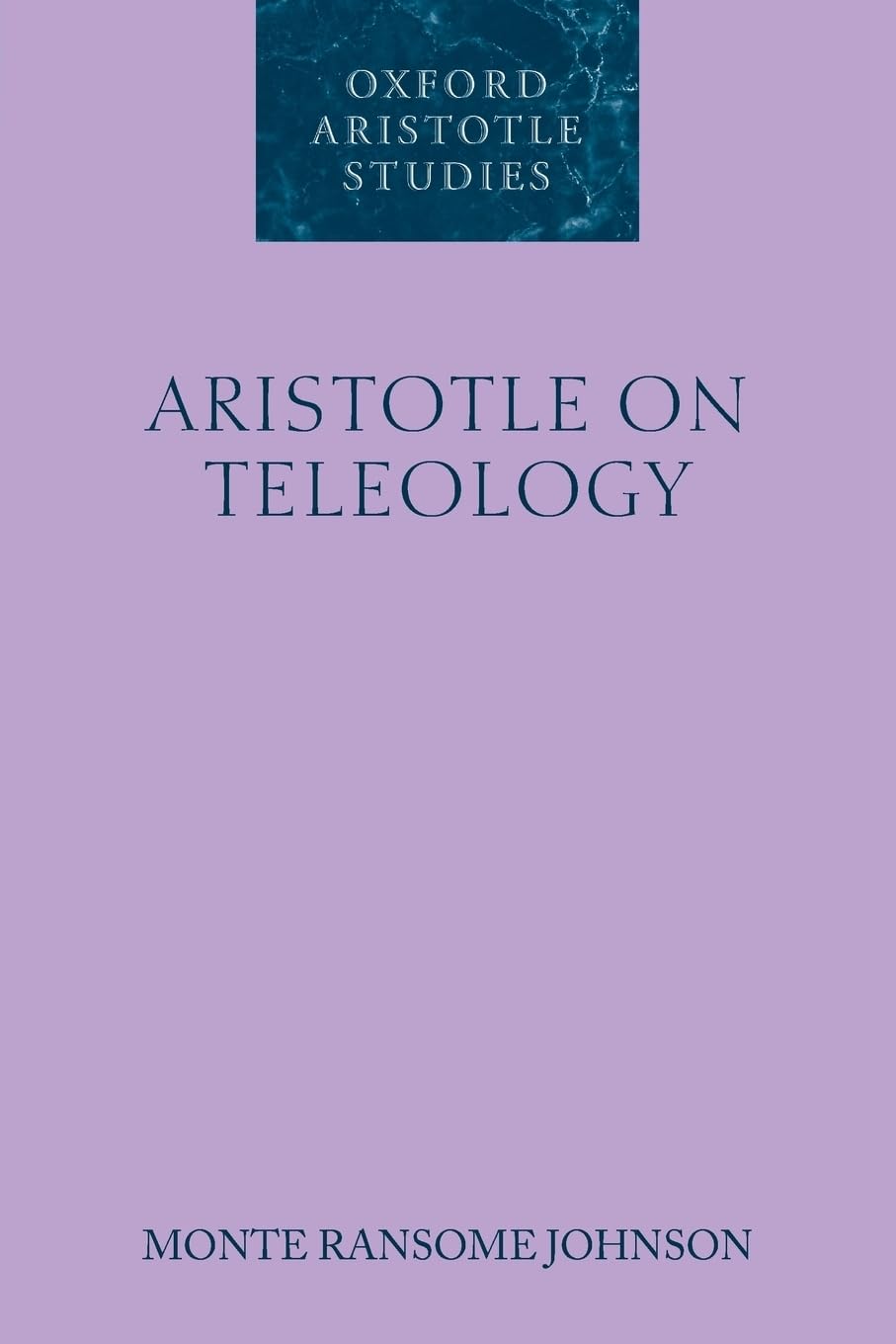
Aristotle On Teleology (Oxford Aristotle Studies Series)
Sold by Ergodebooks, an authorized reseller.
Returns accepted within 30 days | support@ergodebooks.com
Shipping Information
- Free Standard Shipping — United States only
- Processing Time: 3–5 business days
- Estimated Delivery: 6–10 business days after dispatch
- Double-boxed, fully insured & discreetly packaged
- Tracking number sent via email once dispatched
Returns & Refund
Returns accepted within 30 days of delivery.
Damaged or Defective Item
Free return shipping + replacement or full refund
Wrong Item Received
Free return shipping + replacement or full refund
Change of Mind
Return shipping at customer's expense · 25% restocking fee applies
Payment Option

Monte Johnson examines the most controversial aspects of Aristiotle's natural philosophy: his teleology. Is teleology about causation or explanation? Does it exclude or obviate mechanism, determinism, or materialism? Is it focused on the good of individual organisms, or is god or man the ultimate end of all processes and entities? Is teleology restricted to living things, or does it apply to the cosmos as a whole? Does it identify objectively existent causes in the world, or is it merely a heuristic for our understanding of other causal processes? Johnson argues that Aristotle's aporetic approach drives a middle course between these traditional oppositions, and avoids the dilemma, frequently urged against teleology, between backwards causation and anthropomorphism. Although these issues have been debated with extraordinary depth by Aristotle scholars, and touched upon by many in the wider philosophical and scientific community as well, there is no comprehensive historical treatment of the issue.Aristotle is commonly considered the inventor of teleology, although the precise term originated in the eighteenth century. If teleology means the use of ends and goals in natural science, then Aristotle was rather a critical innovator of teleological explanation. Teleological notions were widespread among his predecessors, but Aristotle rejected their conception of extrinsic causes such as mind or god as the primary causes for natural things. Aristotle's radical alternative was to assert nature itself as an internal principle of change and an end, and his teleological explanations focus on the intrinsic ends of natural substances those ends that benefit the natural thing itself.Aristotle's use of ends was subsequently conflated with incompatible 'teleological' notions, including proofs for the existence of a providential or designer god, vitalism and animism, opposition to mechanism and nonteleological causation, and anthropocentrism. Johnson addresses these misconceptions through an elaboration of Aristotle's methodological statements, as well as an examination of the explanations actually offered in the scientific works.
⚠️ WARNING (California Proposition 65):
This product may contain chemicals known to the State of California to cause cancer, birth defects, or other reproductive harm.
For more information, please visit www.P65Warnings.ca.gov.