
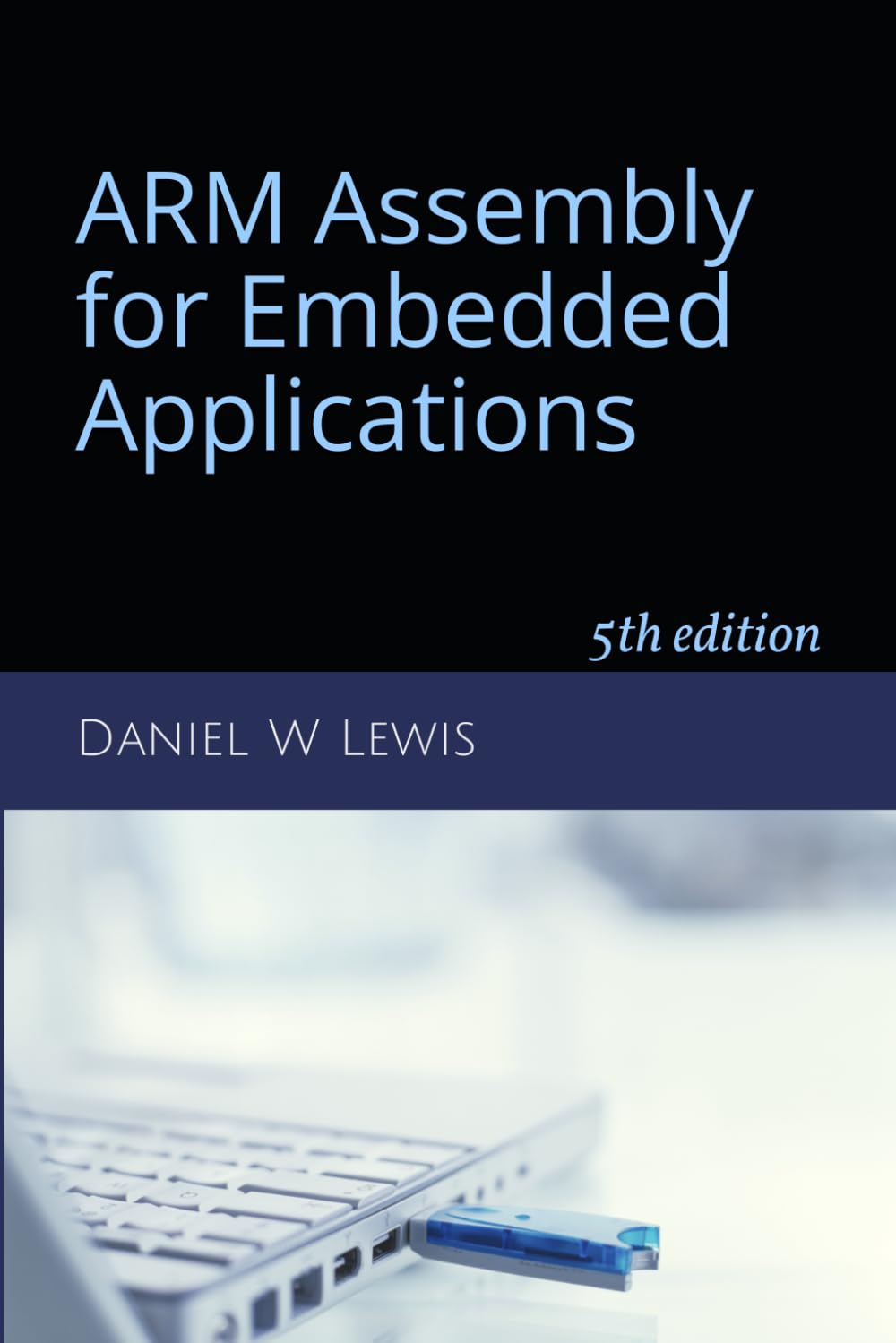
Title
ARM Assembly for Embedded Applications: 5th edition,Used
Sold by Ergodebooks, an authorized reseller.
Returns accepted within 30 days | support@ergodebooks.com
Shipping Information
- Free Standard Shipping — United States only
- Processing Time: 3–5 business days
- Estimated Delivery: 6–10 business days after dispatch
- Double-boxed, fully insured & discreetly packaged
- Tracking number sent via email once dispatched
Returns & Refund
Returns accepted within 30 days of delivery.
Damaged or Defective Item
Free return shipping + replacement or full refund
Wrong Item Received
Free return shipping + replacement or full refund
Change of Mind
Return shipping at customer's expense · 25% restocking fee applies
Payment Option

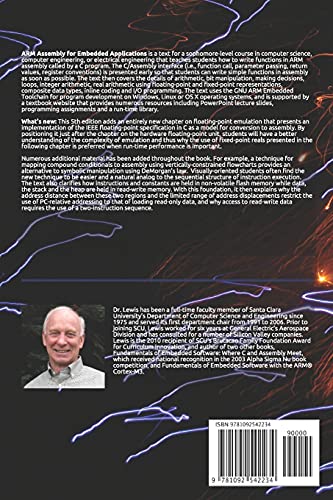
This text uses the GNU ARM Embedded Toolchain for program development on Windows, Linux or OS X operating systems, and is supported by a textbook website (http://www.engr.scu.edu/~dlewis/book3/) that provides numerous resources including PowerPoint lecture slides, programming assignments and a runtime library. ARM Assembly for Embedded Applications is a text for a sophomorelevel course in computer science, computer engineering, or electrical engineering that teaches students how to write functions in ARM assembly called by a C program. The C/Assembly interface (i.e., function call, parameter passing, return values, register conventions) is presented early so that students can write simple functions in assembly as soon as possible. The text then covers the details of arithmetic, bit manipulation, making decisions, loops, integer arithmetic, real arithmetic using floatingpoint and fixedpoint representations, composite data types, inline coding and I/O programming. Whats new: This 5th edition adds an entirely new chapter on floatingpoint emulation that presents an implementation of the IEEE floatingpoint specification in C as a model for conversion to assembly. By positioning it just after the chapter on the hardware floatingpoint unit, students will have a better understanding of the complexity of emulation and thus why the use of fixedpoint reals presented in the following chapter is preferred when runtime performance is important. Numerous additional material has been added throughout the book. For example, a technique for mapping compound conditionals to assembly using verticallyconstrained flowcharts provides an alternative to symbolic manipulation using DeMorgans law. Visuallyoriented students often find the new technique to be easier and a natural analog to the sequential structure of instruction execution. The text also clarifies how instructions and constants are held in nonvolatile flash memory while data, the stack and the heap are held in readwrite memory. With this foundation, it then explains why the address distance between these two regions and the limited range of address displacements restrict the use of PCrelative addressing to that of loading readonly data, and why access to readwrite data requires the use of a twoinstruction sequence.
⚠️ WARNING (California Proposition 65):
This product may contain chemicals known to the State of California to cause cancer, birth defects, or other reproductive harm.
For more information, please visit www.P65Warnings.ca.gov.