
Title
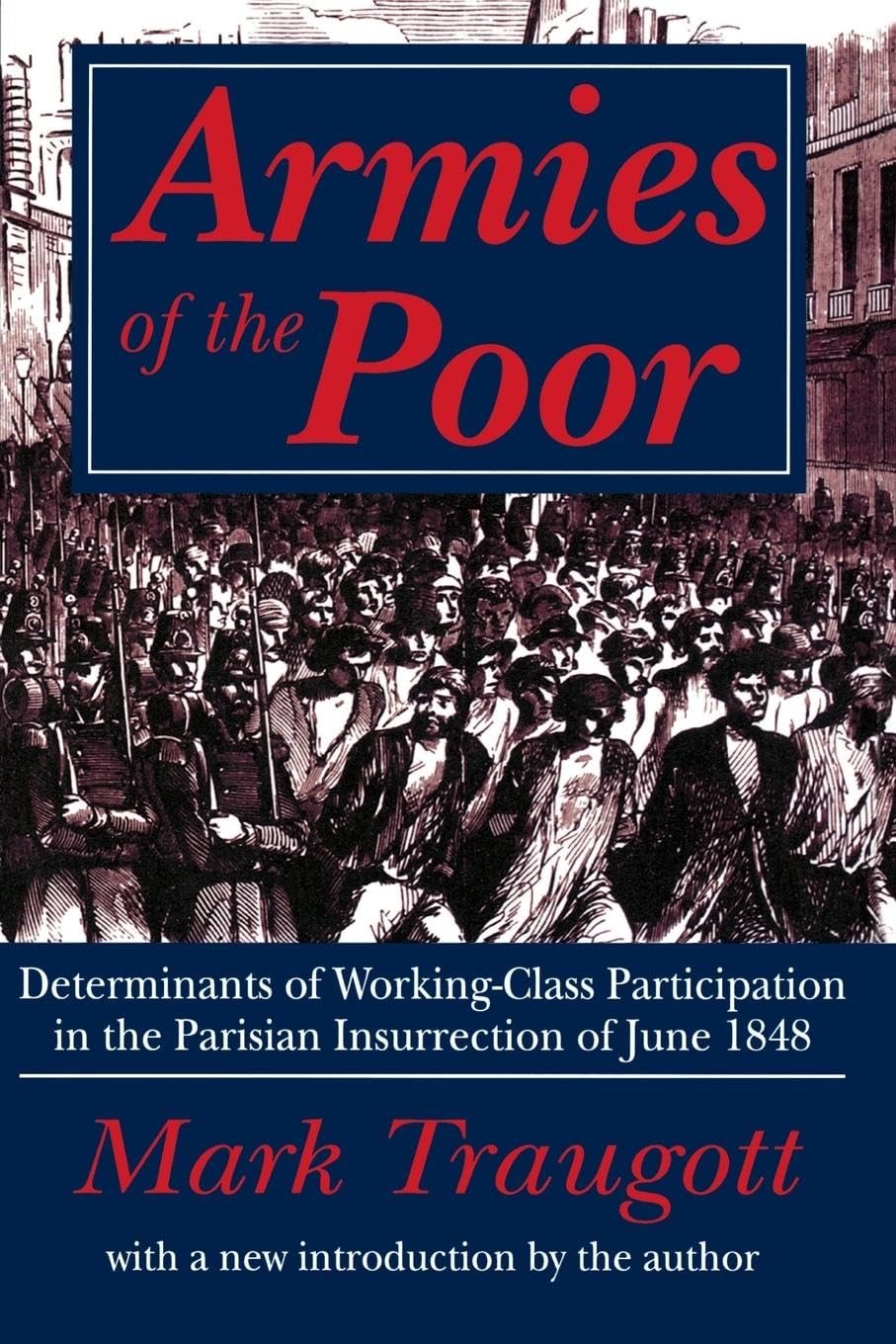
Armies of the Poor: Determinants of Workingclass Participation in in the Parisian Insurrection of June 1848,New
Sold by Ergodebooks, an authorized reseller.
Returns accepted within 30 days | support@ergodebooks.com
Shipping Information
- Free Standard Shipping — United States only
- Processing Time: 3–5 business days
- Estimated Delivery: 6–10 business days after dispatch
- Double-boxed, fully insured & discreetly packaged
- Tracking number sent via email once dispatched
Returns & Refund
Returns accepted within 30 days of delivery.
Damaged or Defective Item
Free return shipping + replacement or full refund
Wrong Item Received
Free return shipping + replacement or full refund
Change of Mind
Return shipping at customer's expense · 25% restocking fee applies
Payment Option

In June 1848, two irregular armies of the urban poor fought a fourday battle in the streets of Paris that decided the fate of the French Second Republic. The Parisian National Workshops and the Parisian Mobile Guardorganizations newly created at the time of the February Revolutionprovided the bulk of the June combatants associated with the insurrection and repression, respectively. According to Marx's simple and compelling hypothesis, a nascent French proletariat unsuccessfully attempted to assert its political and social rights against a coalition of the bourgeoisie and lumpenproletariat, represented by the Parisian Mobile Guard. Through a detailed study of archival sources, Mark Traugott challenges this interpretation of these events and proposes an organizational explanation.Research has consistently shown that skilled artisans and not unskilled proletarians stood at the forefront of the revolutionary struggles of the nineteenth century. Traugott compares the social identities of the main participants on opposite sides of the conflict and sorts out the reasons for the political alignments observed. Drawing on work by Charles Tilly and Lynn Lees, Traugott demonstrates that the insurgents were not highly proletarianized workers, but rather members of the highly skilled trades predominant in the Parisian economy. Meanwhile, those who spearheaded the repression were little different in occupational status, though they tended to be significantly younger. Traugott's 'organizational hypothesis' makes sense of the observed configuration of forces. He accounts for the age differential as a byproduct of the recruitment criteria that Mobile Guard volunteers were required to meet. Finally, he explains why class position creates no more than a diffuse political predisposition that remains subject to the influence of situationspecific factors such as organizational affiliations. Armies of the Poor helps clarify our understanding of the dynamic at work in the insurrectionary turmoil of 1848 in particular and in the great waves of early industrial revolutionism in general. It now is a standard interpretation for subsequent research on the French Revolution of 1848. Armies of the Poor will be of interest to historians seeking a reinterpretation of a major revolutionary episode and social scientists considering a reexamination of Marx and Engels' hypotheses of the roots of political mobilization and protest.
⚠️ WARNING (California Proposition 65):
This product may contain chemicals known to the State of California to cause cancer, birth defects, or other reproductive harm.
For more information, please visit www.P65Warnings.ca.gov.