
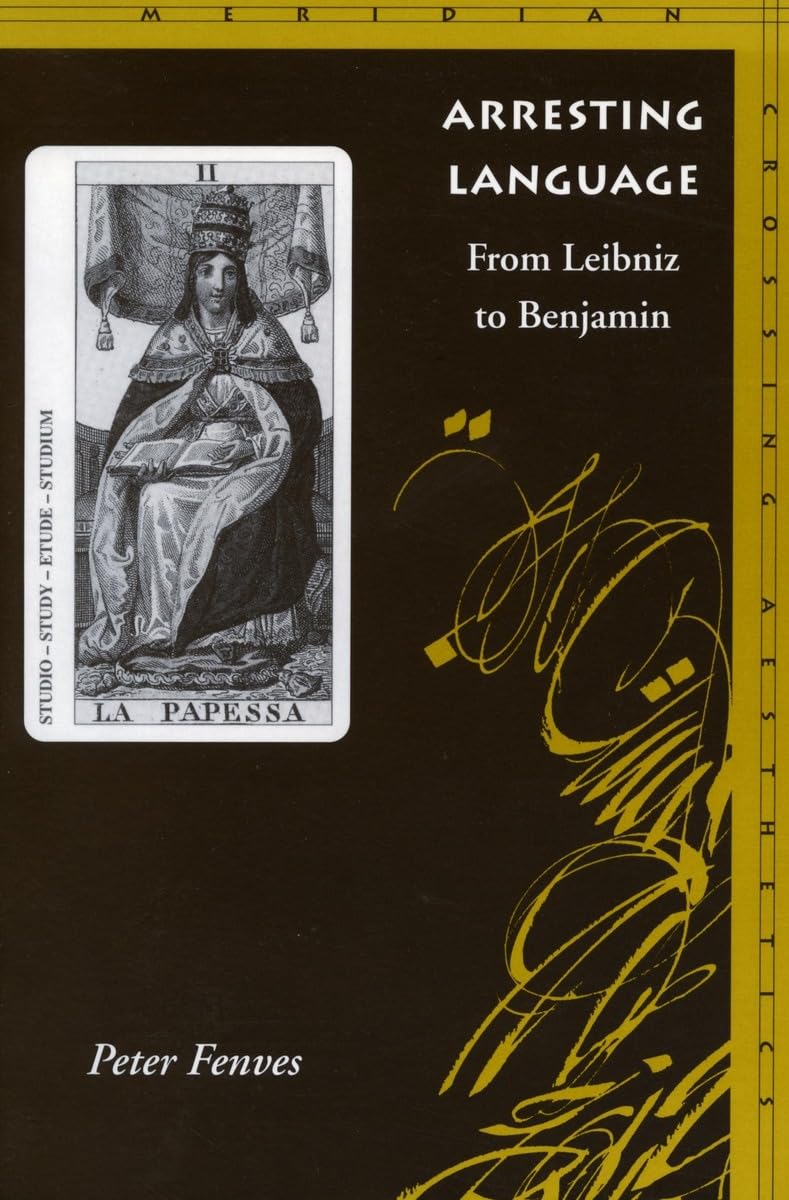
Title
Arresting Language: From Leibniz to Benjamin,Used
Sold by Ergodebooks, an authorized reseller.
Returns accepted within 30 days | support@ergodebooks.com
Shipping Information
- Free Standard Shipping — United States only
- Processing Time: 3–5 business days
- Estimated Delivery: 6–10 business days after dispatch
- Double-boxed, fully insured & discreetly packaged
- Tracking number sent via email once dispatched
Returns & Refund
Returns accepted within 30 days of delivery.
Damaged or Defective Item
Free return shipping + replacement or full refund
Wrong Item Received
Free return shipping + replacement or full refund
Change of Mind
Return shipping at customer's expense · 25% restocking fee applies
Payment Option

Speech act theory has taught us 'how to do things with words.' Arresting Language turns its attention in the opposite directiontoward the surprising things that language can undo and leave undone. In the eight essays of this volume, arresting language is seen as language at rest, words no longer in service to the project of establishing conventions or instituting legal regimes. Concentrating on both widely known and seldomread texts from a variety of philosophers, writers, and criticsfrom Leibniz and Mendelssohn, through Kleist and Hebel, to Benjamin and Irigaraythe book analyzes the genesis and structure of interruption, a topic of growing interest to contemporary literary studies, continental philosophy, legal studies, and theological reflection. Beginning with an exposition of Hlderlin's rigorous account of interruption in terms of the 'pure word,' in which the event of representation alone appears, Arresting Language identifies critical moments in philosophical and literary texts during which language itselfwithout any identifiable speakerarrests otherwise continuous processes and procedures, including the process of representation and the procedures for its legitimization. The book then investigates a series of pure words: the fatal verdict (arrt) of divine wisdom in Leibniz, the performance of Jewish ceremonial practices in Mendelssohn, the issuing of unauthorized arrest warrants in Kleist, fraudulent acts of storytelling in Hebel, the eruption of tragic silence and the 'mass strike' in Benjamin, and the recurrence of angelic intervention in Irigaray. At the center of this volume is a detailed explication of Benjamin's effort to transform Husserl's program for a phenomenological epoche into a paradoxically nonprogrammatic, paradisal epoche, by means of which the structure of paradise can be exactly outlined and the Messianic momentas the ultimate event of arresting languagecan at last appear to enter into its own.
⚠️ WARNING (California Proposition 65):
This product may contain chemicals known to the State of California to cause cancer, birth defects, or other reproductive harm.
For more information, please visit www.P65Warnings.ca.gov.