If you have any questions, you are always welcome to contact us. We'll get back to you as soon as possible, withing 24 hours on weekdays.
Customer service
All questions about your order, return and delivery must be sent to our customer service team by e-mail at yourstore@yourdomain.com
Sale & Press
If you are interested in selling our products, need more information about our brand or wish to make a collaboration, please contact us at press@yourdomain.com
Help
If you have any questions, you are always welcome to contact us. We'll get back to you as soon as possible, withing 24 hours on weekdays.
Customer service
All questions about your order, return and delivery must be sent to our customer service team by e-mail at yourstore@yourdomain.com
Sale & Press
If you are interested in selling our products, need more information about our brand or wish to make a collaboration, please contact us at press@yourdomain.com
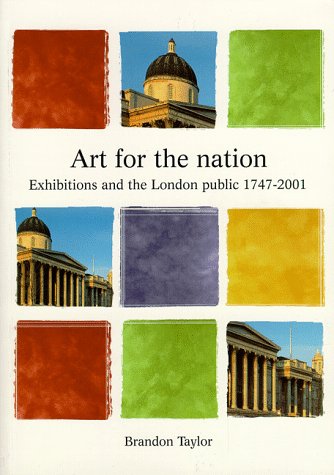
In the first half of the eighteenth century the only galleries in which to view art were the homes of the upper classes. That art had a highly exclusive audience. How did the exhibition of art in England evolve from the private to the public? What were the debates? Who assumed responsibility for allowing the general public into once private spaces? How did the press cover the crowds who came to view the art? How were patrons found for new institutions and how were they convinced to fund them? In short, how did art institutions expand from the birth of the Royal Academy of Arts in 1768 to the series of major collections housed at the National Gallery, the South Kensington Museum (later the Victoria and Albert), the Tate Gallery, the Arts Council of Great Britain, the Hayward Gallery, and more? How did the exhibition of art become big business? In Art for the nation, Brandon Taylor gives us a fascinating glimpse at the development of museums as institutions. He provides an absorbing account of the growth of public culture as he analyzes the politics, geography, and social life of metropolitan and visual culture. He also provides an eyeopening social history of the relationship between the classes and the entre of many Jewish patrons into a world from which they might otherwise have been excluded. At a time when museums are constantly in the newsas one of the fastest growing businesses in both England and the United States, as tourist attractions and gift shops, as malls of art, and as educational centersthis book is indispensable reading.
⚠️ WARNING (California Proposition 65):
This product may contain chemicals known to the State of California to cause cancer,
birth defects, or other reproductive harm.
For MAP (Minimum Advertised Price) violations and Intellectual Property (IP) or Trademark concerns, please contact:
support@ergodebooks.com
⚠️ California Proposition 65 Warning: Some products sold on this website may expose you to chemicals known to the State of California to cause cancer, birth defects, or other reproductive harm. For more information, visit www.P65Warnings.ca.gov.