
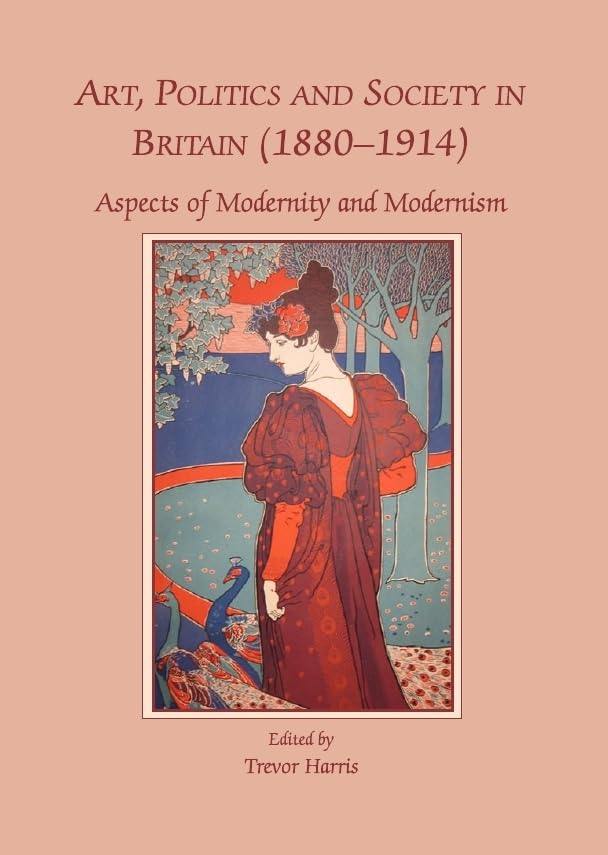
Title
Art, Politics and Society in Britain (18801914): Aspects of Modernity and Modernism,Used
Sold by Ergodebooks, an authorized reseller.
Returns accepted within 30 days | support@ergodebooks.com
Shipping Information
- Free Standard Shipping — United States only
- Processing Time: 3–5 business days
- Estimated Delivery: 6–10 business days after dispatch
- Double-boxed, fully insured & discreetly packaged
- Tracking number sent via email once dispatched
Returns & Refund
Returns accepted within 30 days of delivery.
Damaged or Defective Item
Free return shipping + replacement or full refund
Wrong Item Received
Free return shipping + replacement or full refund
Change of Mind
Return shipping at customer's expense · 25% restocking fee applies
Payment Option

Product Description The oldest word in politics is 'new'. The oldest word in the writing of history may well be 'modern': it is, without doubt, one of the most overworked adjectives in the English language. But the indeterminacy is perhaps just another way of saying that the difficulties raised are of a kind which simply will not go away...This collection of eight essays on aspects of modernity and modernism takes up the challenge of examining the complex, but fascinating convergence of aesthetics, politics and a quasispiritual dimension which is perhaps typical of British modernist thinking about modernity. This may have produced figures whom we now dismiss as eccentrics or 'aesthetes', it none the less produced figures whom many still think of as in some sense embodying the national identity: what, after all, could be more 'English' than a William Morris wallpaper design? Rather than towards socialism in any of its 'scientific' guises, what the British modernist approach to modernity may have been pushing at was yet another mutation of liberalism: a libertarianhumanitarian hybrid in which indigenous radical and Evangelical legacies keep scientific socialism in check, where fellowship and domesticity edge out a largerscale, more abstract 'fraternity', and where citoyennete or civisme give way to what George Orwell was later to define simply as 'decency'. About the Author Trevor Harris is Professor of British Civilisation in the Department of English Studies at the Universit FranoisRabelais, Tours, France. He has worked extensively on the intellectual history of Britain in the nineteenth and twentieth centuries, and on British foreign policy. His most recent book is Une Certaine ide de l Angleterre in the collection 'L Histoire au prsent' (Paris: Armand Colin, 2006).
⚠️ WARNING (California Proposition 65):
This product may contain chemicals known to the State of California to cause cancer, birth defects, or other reproductive harm.
For more information, please visit www.P65Warnings.ca.gov.