
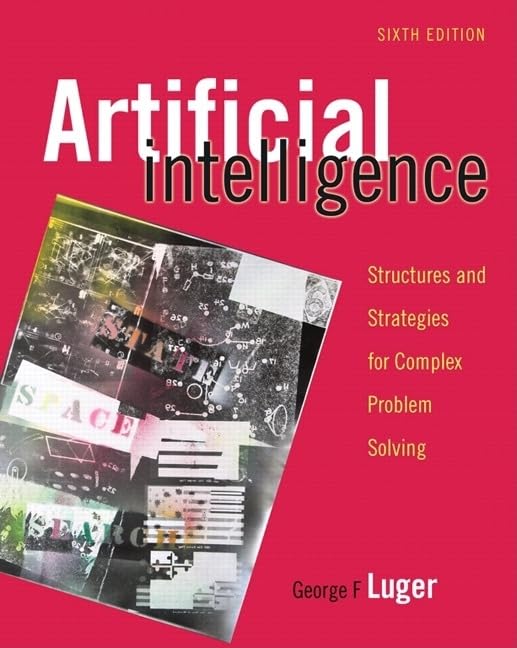
Title
Artificial Intelligence: Structures and Strategies for Complex Problem Solving,Used
Sold by Ergodebooks, an authorized reseller.
Returns accepted within 30 days | support@ergodebooks.com
Shipping Information
- Free Standard Shipping — United States only
- Processing Time: 3–5 business days
- Estimated Delivery: 6–10 business days after dispatch
- Double-boxed, fully insured & discreetly packaged
- Tracking number sent via email once dispatched
Returns & Refund
Returns accepted within 30 days of delivery.
Damaged or Defective Item
Free return shipping + replacement or full refund
Wrong Item Received
Free return shipping + replacement or full refund
Change of Mind
Return shipping at customer's expense · 25% restocking fee applies
Payment Option

Artificial Intelligence: Structures and Strategies for Complex Problem Solving is ideal for a one or twosemester undergraduate course on AI.In this accessible, comprehensive text, George Luger captures the essence of artificial intelligencesolving the complex problems that arise wherever computer technology is applied. Ideal for an undergraduate course in AI, the Sixth Edition presents the fundamental concepts of the discipline first then goes into detail with the practical information necessary to implement the algorithms and strategies discussed. Readers learn how to use a number of different software tools and techniques to address the many challenges faced by todays computer scientists.
⚠️ WARNING (California Proposition 65):
This product may contain chemicals known to the State of California to cause cancer, birth defects, or other reproductive harm.
For more information, please visit www.P65Warnings.ca.gov.
- Q: How many pages does this book have? A: This book has seven hundred eighty-four pages. It provides comprehensive coverage of artificial intelligence concepts.
- Q: What is the binding type of this book? A: The binding type is hardcover. This ensures durability and longevity for frequent use.
- Q: What are the dimensions of this book? A: The dimensions are seven point six inches by one point seven inches by nine point three inches. These measurements make it a standard size for textbooks.
- Q: What programming languages are used in this book? A: The book includes examples in Prolog, Lisp, and Java. These languages are essential for implementing AI algorithms.
- Q: Who is the author of this book? A: The author is George Luger. He is well-known for his contributions to the field of artificial intelligence.
- Q: Is this book suitable for beginners? A: Yes, this book is suitable for beginners. It presents fundamental AI concepts in an accessible manner.
- Q: What level of education is this book designed for? A: This book is designed for undergraduate courses. It's perfect for students studying artificial intelligence.
- Q: Can this book be used for a one-semester course? A: Yes, it can be used for a one-semester course. The content is structured to cover essential topics efficiently.
- Q: How can I use the programming examples in this book? A: You can use the programming examples by implementing them in the respective languages. This will help you understand AI algorithms practically.
- Q: What is the best way to care for this hardcover book? A: To care for this hardcover book, store it in a dry place and avoid exposure to direct sunlight. This helps preserve its condition.
- Q: Is there a warranty or return policy for this book? A: Typically, books do not come with a warranty. However, return policies may vary by retailer.
- Q: What if the book arrives damaged? A: If the book arrives damaged, contact the retailer for a return or exchange. Most retailers have policies for damaged items.
- Q: How do I store this book to prevent damage? A: Store this book upright on a shelf or flat to prevent bending. Ensure it’s in a cool, dry environment.
- Q: Does this book include references and citations? A: Yes, the book includes updated references and citations. This enhances its credibility and academic value.
- Q: What topics are covered in the new chapters of this edition? A: New chapters cover topics like probabilistically based machine learning and stochastic methods. These are crucial for advanced AI studies.