If you have any questions, you are always welcome to contact us. We'll get back to you as soon as possible, withing 24 hours on weekdays.
Customer service
All questions about your order, return and delivery must be sent to our customer service team by e-mail at yourstore@yourdomain.com
Sale & Press
If you are interested in selling our products, need more information about our brand or wish to make a collaboration, please contact us at press@yourdomain.com
Help
If you have any questions, you are always welcome to contact us. We'll get back to you as soon as possible, withing 24 hours on weekdays.
Customer service
All questions about your order, return and delivery must be sent to our customer service team by e-mail at yourstore@yourdomain.com
Sale & Press
If you are interested in selling our products, need more information about our brand or wish to make a collaboration, please contact us at press@yourdomain.com
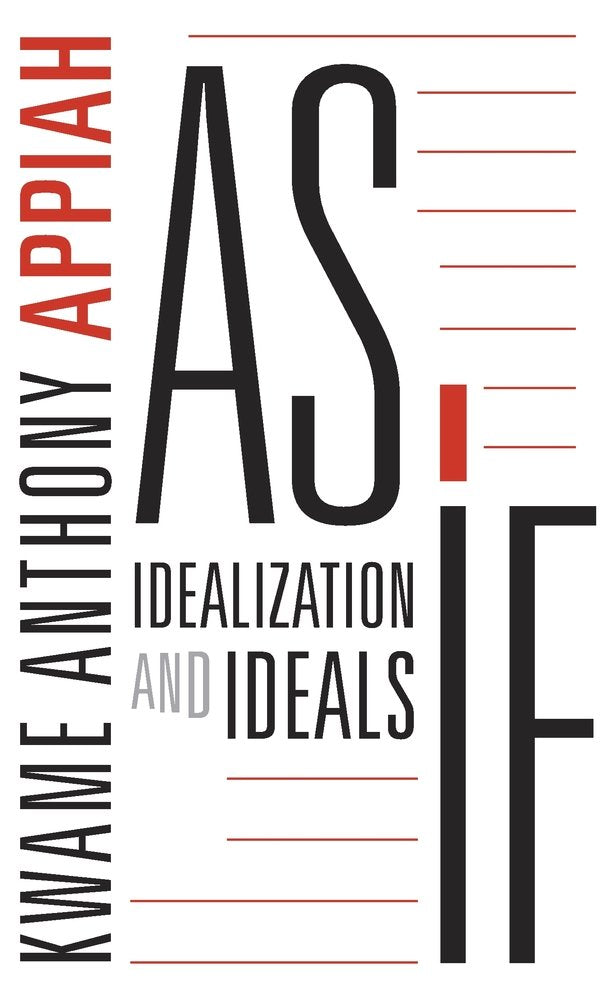
Idealization is a fundamental feature of human thought. We build simplified models in our scientific research and utopias in our political imaginations. Concepts like belief, desire, reason, and justice are bound up with idealizations and ideals. Life is a constant adjustment between the models we make and the realities we encounter. In idealizing, we proceed as if our representations were true, while knowing they are not. This is not a dangerous or distracting occupation, Kwame Anthony Appiah shows. Our best chance of understanding nature, society, and ourselves is to open our minds to a plurality of imperfect depictions that together allow us to manage and interpret our world.The philosopher Hans Vaihinger first delineated the as if impulse at the turn of the twentieth century, drawing on Kant, who argued that rational agency required us to act as if we were free. Appiah extends this strategy to examples across philosophy and the human and natural sciences. In a broad range of activities, we have some notion of the truth yet continue with theories that we recognize are, strictly speaking, false. From this vantage point, Appiah demonstrates that a picture one knows to be unreal can be a vehicle for accessing reality.As If explores how strategic untruth plays a critical role in farflung areas of inquiry: decision theory, psychology, natural science, and political philosophy. A polymath who writes with mainstream clarity, Appiah defends the centrality of the imagination not just in the arts but in science, morality, and everyday life.
⚠️ WARNING (California Proposition 65):
This product may contain chemicals known to the State of California to cause cancer,
birth defects, or other reproductive harm.
For MAP (Minimum Advertised Price) violations and Intellectual Property (IP) or Trademark concerns, please contact:
support@ergodebooks.com
⚠️ California Proposition 65 Warning: Some products sold on this website may expose you to chemicals known to the State of California to cause cancer, birth defects, or other reproductive harm. For more information, visit www.P65Warnings.ca.gov.