If you have any questions, you are always welcome to contact us. We'll get back to you as soon as possible, withing 24 hours on weekdays.
Customer service
All questions about your order, return and delivery must be sent to our customer service team by e-mail at yourstore@yourdomain.com
Sale & Press
If you are interested in selling our products, need more information about our brand or wish to make a collaboration, please contact us at press@yourdomain.com
Help
If you have any questions, you are always welcome to contact us. We'll get back to you as soon as possible, withing 24 hours on weekdays.
Customer service
All questions about your order, return and delivery must be sent to our customer service team by e-mail at yourstore@yourdomain.com
Sale & Press
If you are interested in selling our products, need more information about our brand or wish to make a collaboration, please contact us at press@yourdomain.com
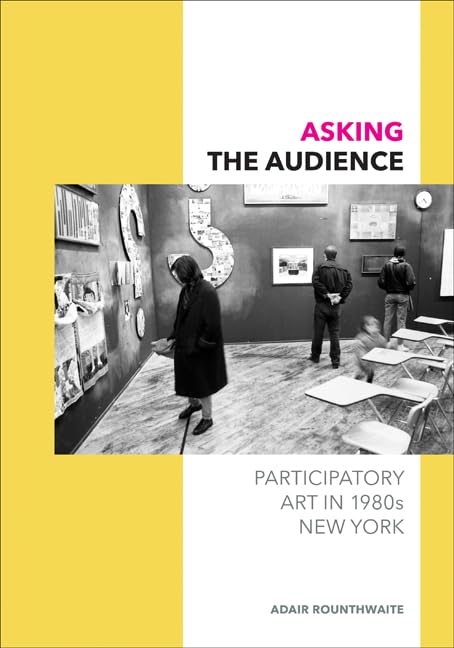
The 1980s was a critical decade in shaping todays art production. While newly visible work concerned with power and identity hinted at a shift toward multiculturalism, the 80s were also a time of social conservatism that resulted in substantial changes in arts funding. In Asking the Audience, Adair Rounthwaite uses this context to analyze the rising popularity of audience participation in American art during this important decade.Rounthwaite explores two seminal and interrelated art projects sponsored by the Dia Art Foundation in New York: Group Materials Democracy and Martha Roslers If You Lived Here. These projects married issues of social activismsuch as homelessness and the AIDS crisiswith various forms of public participation, setting the precedent for the highprofile participatory practices currently dominating global contemporary art. Rounthwaite draws on diverse archival images, audio recordings, and more than thirty new interviews to analyze the live affective dynamics to which the projects gave rise. Seeking to foreground the audience experience in understanding the social context of participatory art, she argues that affect is key to the audiences ability to exercise agency within the participatory artwork.From artists and audiences to institutions, funders, and critics, Asking the Audience traces the networks that participatory art creates between various agents, demonstrating how, since the 1980s, leftist political engagement has become a cornerstone of the institutionalized consumption of contemporary art.
⚠️ WARNING (California Proposition 65):
This product may contain chemicals known to the State of California to cause cancer,
birth defects, or other reproductive harm.
For MAP (Minimum Advertised Price) violations and Intellectual Property (IP) or Trademark concerns, please contact:
support@ergodebooks.com
⚠️ California Proposition 65 Warning: Some products sold on this website may expose you to chemicals known to the State of California to cause cancer, birth defects, or other reproductive harm. For more information, visit www.P65Warnings.ca.gov.