
Title
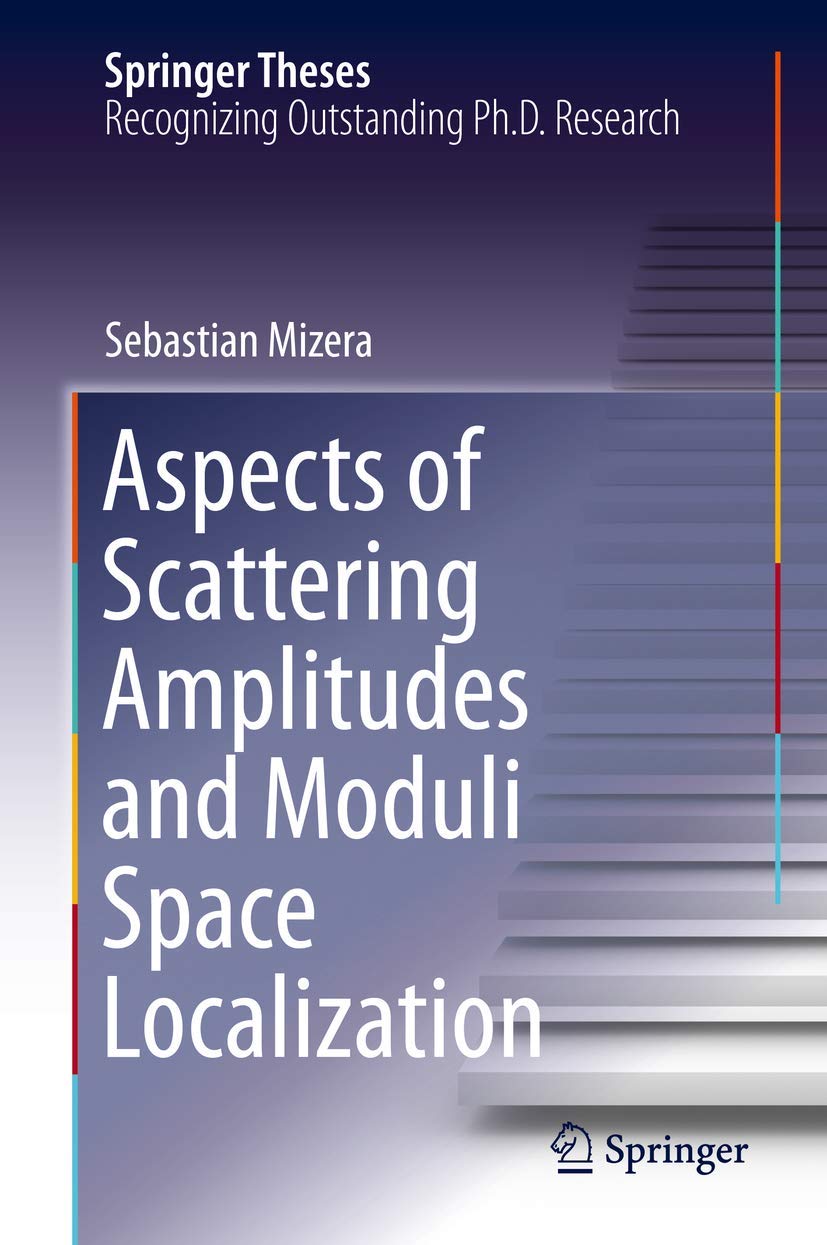
Aspects of Scattering Amplitudes and Moduli Space Localization (Springer Theses),Used
Sold by Ergodebooks, an authorized reseller.
Returns accepted within 30 days | support@ergodebooks.com
Shipping Information
- Free Standard Shipping — United States only
- Processing Time: 3–5 business days
- Estimated Delivery: 6–10 business days after dispatch
- Double-boxed, fully insured & discreetly packaged
- Tracking number sent via email once dispatched
Returns & Refund
Returns accepted within 30 days of delivery.
Damaged or Defective Item
Free return shipping + replacement or full refund
Wrong Item Received
Free return shipping + replacement or full refund
Change of Mind
Return shipping at customer's expense · 25% restocking fee applies
Payment Option

This thesis proposes a new perspective on scattering amplitudes in quantum field theories. Their standard formulation in terms of sums over Feynman diagrams is replaced by a computation of geometric invariants, called intersection numbers, on moduli spaces of Riemann surfaces. It therefore gives a physical interpretation of intersection numbers, which have been extensively studied in the mathematics literature in the context of generalized hypergeometric functions. This book explores physical consequences of this formulation, such as recursion relations, connections to geometry and string theory, as well as a phenomenon called moduli space localization.After reviewing necessary mathematical background, including topology of moduli spaces of Riemann spheres with punctures and its fundamental group, the definition and properties of intersection numbers are presented. A comprehensive list of applications and relations to other objects is given, including those toscattering amplitudes in open and closedstring theories. The highlights of the thesis are the results regarding localization properties of intersection numbers in two opposite limits: in the low and the highenergy expansion.In order to facilitate efficient computations of intersection numbers the author introduces recursion relations that exploit fibration properties of the moduli space. These are formulated in terms of socalled braid matrices that encode the information of how points braid around each other on the corresponding Riemann surface. Numerous application of this approach are presented for computation of scattering amplitudes in various gauge and gravity theories. This book comes with an extensive appendix that gives a pedagogical introduction to the topic of homologies with coefficients in a local system.
⚠️ WARNING (California Proposition 65):
This product may contain chemicals known to the State of California to cause cancer, birth defects, or other reproductive harm.
For more information, please visit www.P65Warnings.ca.gov.