
Title
Assembling Women: The Feminization of Global Manufacturing,Used
Sold by Ergodebooks, an authorized reseller.
Returns accepted within 30 days | support@ergodebooks.com
Shipping Information
- Free Standard Shipping — United States only
- Processing Time: 3–5 business days
- Estimated Delivery: 6–10 business days after dispatch
- Double-boxed, fully insured & discreetly packaged
- Tracking number sent via email once dispatched
Returns & Refund
Returns accepted within 30 days of delivery.
Damaged or Defective Item
Free return shipping + replacement or full refund
Wrong Item Received
Free return shipping + replacement or full refund
Change of Mind
Return shipping at customer's expense · 25% restocking fee applies
Payment Option

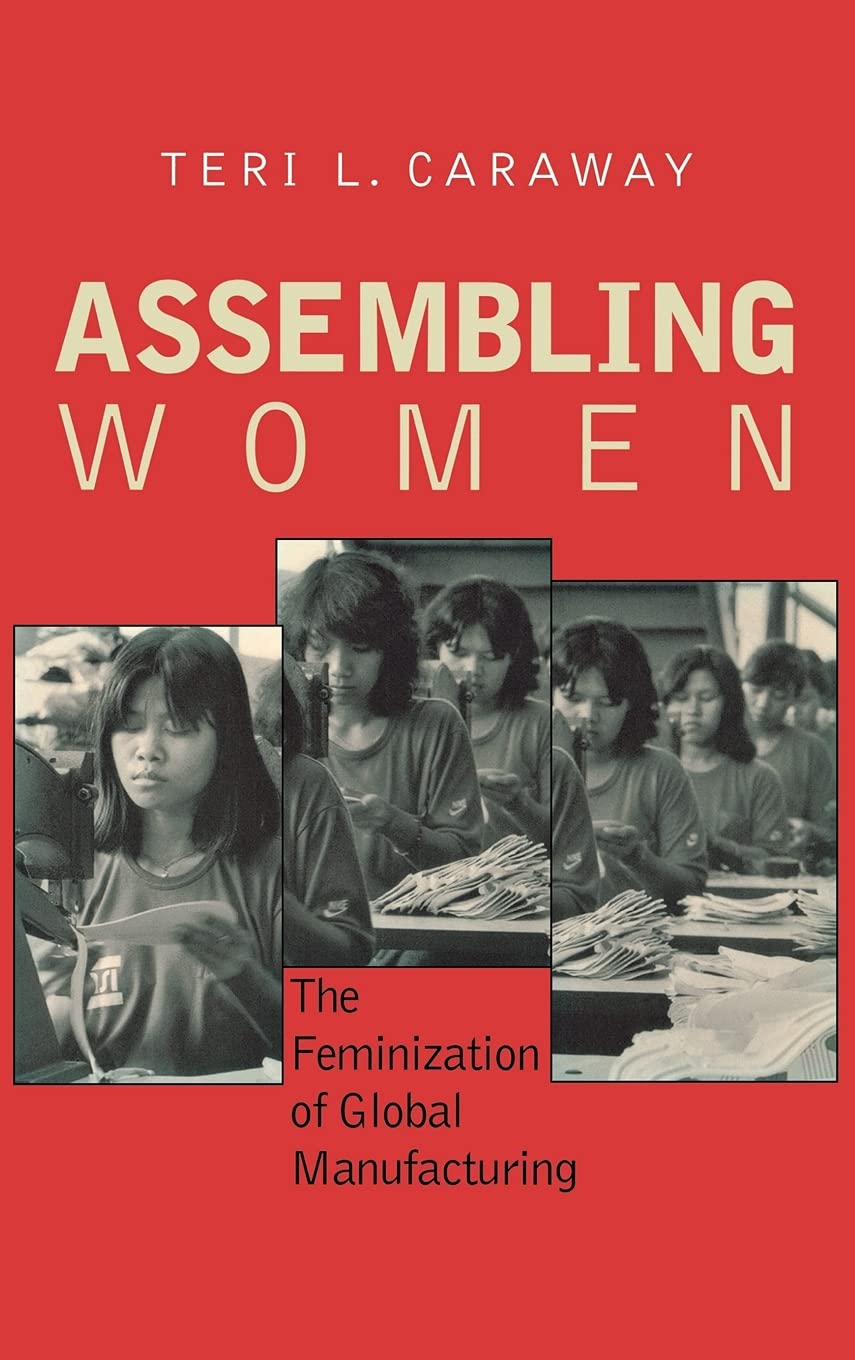
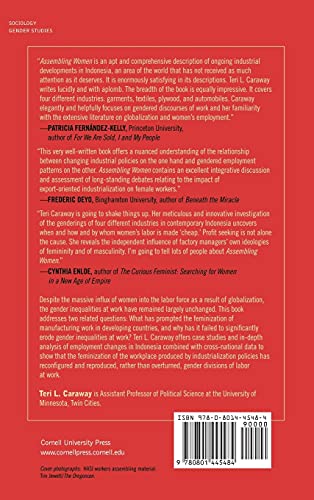
Despite the massive influx of women into the labor force as a result of globalization, the gender inqualities at work have remained largely unchanged. This book addresses two related questions: What has prompted the feminization of manufacturing work in developing countries, and why has it failed to significantly erode gender inequalities at work? Teri L. Caraway offers case studies and indepth analysis of employment changes in Indonesia combined with crossnational data to show that the feminization of the workplace produced by industrialization policies has reconfigured and reproduced, rather than overturned, gender divisions of labor at work.Caraway challenges the conventional wisdom that exportoriented industrialization and women's cheap labor are the driving forces behind feminization. Instead, she argues, the answers can be found in weak unions and current social practice. Caraway employs information about a wide range of industriescapitalintensive, maledominated, nonexport firms as well as femaledominated, laborintensive, exportoriented industriesin arriving at her conclusions. Her findings will prove discouraging to anyone who hopes that globalization has become a positive force in improving the lives of women workers.Caraway's multilevel methodology for analyzing changes in gendered patterns of employment and her introduction of "gendered discourses of work" as a major explanatory variable will make Assembling Women a valuable resource for women's studies scholars, development economists, political scientists, and sociologists as well as all with an interest in Southeast Asian Studies and labor and industrial relations.
⚠️ WARNING (California Proposition 65):
This product may contain chemicals known to the State of California to cause cancer, birth defects, or other reproductive harm.
For more information, please visit www.P65Warnings.ca.gov.
- Q: What is the main focus of 'Assembling Women'? A: 'Assembling Women' primarily examines the feminization of global manufacturing and explores the factors that have led to increased female participation in the workforce, particularly in developing countries.
- Q: Who is the author of the book? A: The author of 'Assembling Women' is Teri L. Caraway, who provides in-depth analysis and case studies in the book.
- Q: What are the key themes discussed in the book? A: Key themes include the persistence of gender inequalities in the workplace, the impact of globalization on women's labor, and the role of weak unions and social practices in shaping employment outcomes.
- Q: What type of methodology does Teri L. Caraway use in her analysis? A: Caraway employs a multilevel methodology that includes case studies and cross-national data to analyze gendered patterns of employment.
- Q: How does the book challenge conventional views on women's labor? A: 'Assembling Women' challenges the notion that export-oriented industrialization and women's cheap labor are the main drivers of workplace feminization, arguing instead that other factors play significant roles.
- Q: Is this book suitable for students and researchers? A: Yes, 'Assembling Women' is a valuable resource for students and researchers in women's studies, development economics, political science, sociology, and those interested in labor and industrial relations.
- Q: What is the publication date of 'Assembling Women'? A: 'Assembling Women' was published on March 13, 2007.
- Q: How many pages does the book contain? A: 'Assembling Women' contains a total of 224 pages.
- Q: What is the binding type of the book? A: The book is available in hardcover binding.
- Q: Does the book include case studies? A: Yes, the book includes case studies, particularly focused on employment changes in Indonesia, to support its analysis.