
Title
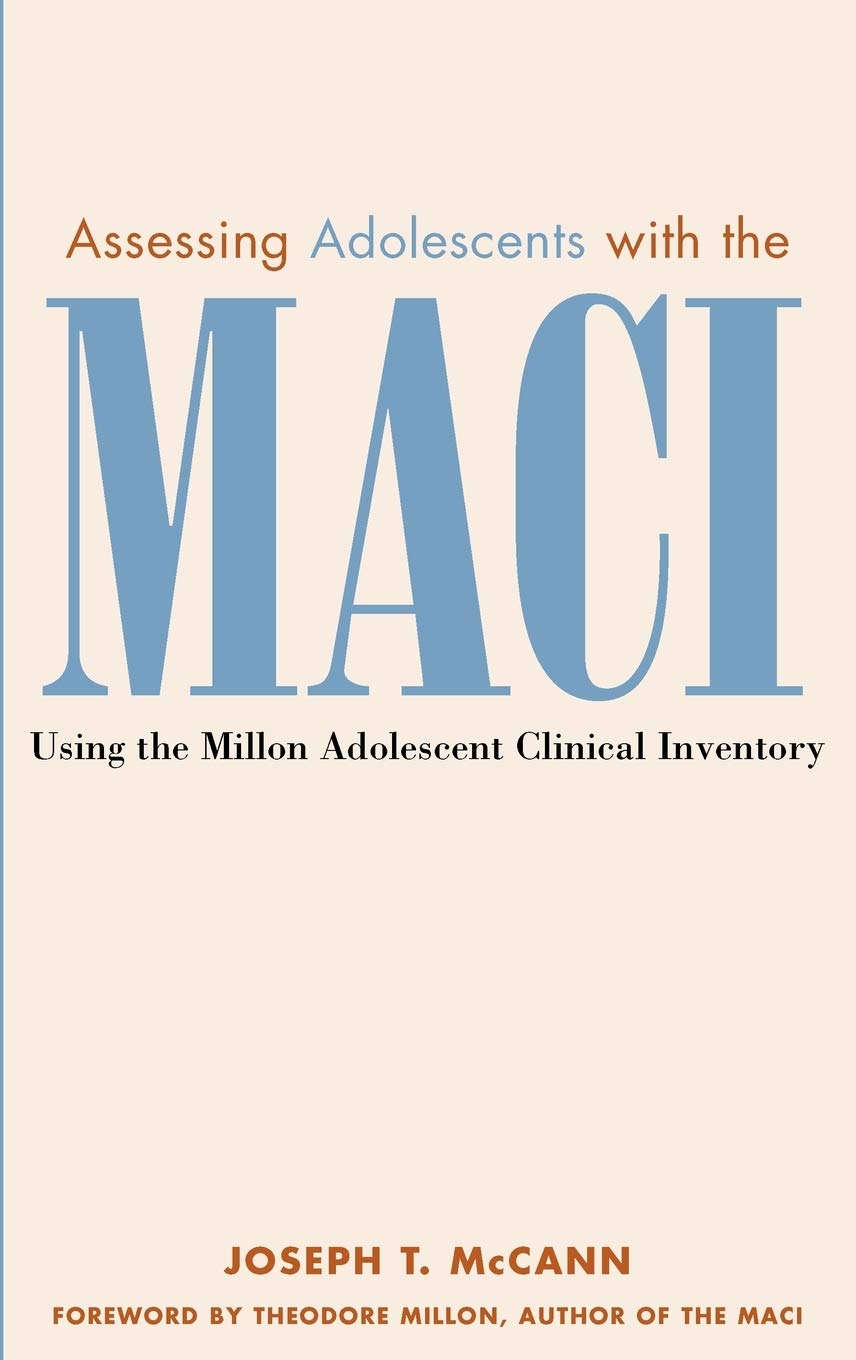
Assessing Adolescents with the MACI: Using the Millon Adolescent Clinical Inventory,Used
Sold by Ergodebooks, an authorized reseller.
Returns accepted within 30 days | support@ergodebooks.com
Shipping Information
- Free Standard Shipping — United States only
- Processing Time: 3–5 business days
- Estimated Delivery: 6–10 business days after dispatch
- Double-boxed, fully insured & discreetly packaged
- Tracking number sent via email once dispatched
Returns & Refund
Returns accepted within 30 days of delivery.
Damaged or Defective Item
Free return shipping + replacement or full refund
Wrong Item Received
Free return shipping + replacement or full refund
Change of Mind
Return shipping at customer's expense · 25% restocking fee applies
Payment Option

Assessing Adolescents with the MACI is an interpretive guide forusing the Millon Adolescent Clinical Inventorythe most widelyused personality assessment test for adolescents. The first bookdevoted exclusively to the MACI, this resource will prove a helpfulguide for understanding the test, interpreting the results inclinical evaluation, and making appropriate recommendations fortreatment and care management.Unlike other assessment tests developed for adults and adapted foradolescents, the MACI was created to address the unique concerns,pressures, and situations of adolescents. The MACI is alsoconstructed using an underlying theory of personality andpsychopathology. The MACI is a 160item, 31scale self reportinventory that was designed to assess personality styles,significant problems or concerns, and clinical symptoms inadolescents. Using a true false format, the MACI surveys a widerange of personality characteristics and clinical symptoms thattend to be a focus in psychological evaluations of teenagers thateither have or are suspected of having emotional or behavioraldifficulties.While multiscale personality inventories such as the MACI areuseful for improving the clinician's understanding of anadolescent's personality and clinical symptoms, there are otherreasons for using such instruments. The MACI can be used toformulate diagnostic hypotheses, confirm clinical diagnoses,formulate treatment plans, or assist in decision making surroundingcase management and disposition planning. The MACI can be used asan outcome measure to evaluate changes in an adolescent'sfunctioning as a result of treatment and intervention. Of course,the MACI can also be used in research studies to investigate arange of issues that pertain to adolescent psychopathology,personality, and treatment response.Drawing on a broad range of sources, including data in the MACImanual, published research studies, unpublished research,theoretical literature, and his own experience with the test,Joseph McCann lays the groundwork for the basis of the test andthen offers an exhaustive exploration of all facets of the test.Recognizing both the strengths and weaknesses of the MACI, McCannoffers a balanced and comprehensive resource on this vitalassessment tool.'This book fills an important gap in the clinical literature . . .Joseph McCann, author of this first full text on the MACI, is thebest known workshop presenter on the topic. Assessment with theMACI will enable the student and the clinician to develop asophisticated basis for disentangling the many variations amongyoungsters, to assess both their assets and liabilities, todetermine the presence of clinical disorders, and, mostimportantly, to provide a full picture that can serve as the basisfor making decisions regarding each adolescent's welfare, that is,to be able to outline a logical course of treatment which may provemore optimally efficacious. It will guide the reader to transformthe raw MACI test data, coordinate these data with the history ofthe youngster's experience, as well as with observational andinterview information, facilitating interpretive syntheses andproviding thereby a basis to help link assessment to psychotherapy.This text is insightful and comprehensive, a work of inestimablevalue to both practicing clinicians and students.' TheodoreMillon, from the Foreword.
⚠️ WARNING (California Proposition 65):
This product may contain chemicals known to the State of California to cause cancer, birth defects, or other reproductive harm.
For more information, please visit www.P65Warnings.ca.gov.