
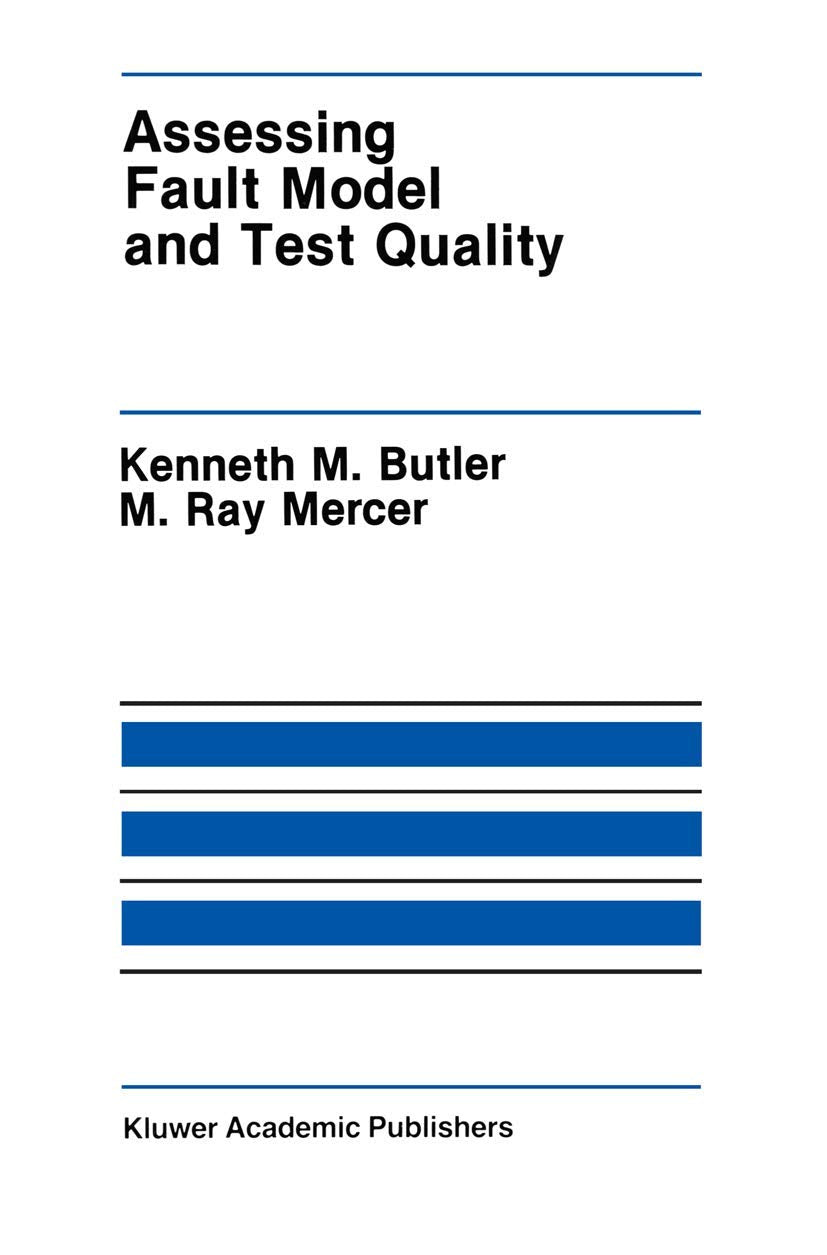
Title
Assessing Fault Model and Test Quality (The Springer International Series in Engineering and Computer Science, 157),Used
Sold by Ergodebooks, an authorized reseller.
Returns accepted within 30 days | support@ergodebooks.com
Shipping Information
- Free Standard Shipping — United States only
- Processing Time: 3–5 business days
- Estimated Delivery: 6–10 business days after dispatch
- Double-boxed, fully insured & discreetly packaged
- Tracking number sent via email once dispatched
Returns & Refund
Returns accepted within 30 days of delivery.
Damaged or Defective Item
Free return shipping + replacement or full refund
Wrong Item Received
Free return shipping + replacement or full refund
Change of Mind
Return shipping at customer's expense · 25% restocking fee applies
Payment Option

For many years, the dominant fault model in automatic test pattern gen eration (ATPG) for digital integrated circuits has been the stuckat fault model. The static nature of stuckat fault testing when compared to the extremely dynamic nature of integrated circuit (IC) technology has caused many to question whether or not stuckat fault based testing is still viable. Attempts at answering this question have not been wholly satisfying due to a lack of true quantification, statistical significance, and/or high computational expense. In this monograph we introduce a methodology to address the ques tion in a manner which circumvents the drawbacks of previous approaches. The method is based on symbolic Boolean functional analyses using Or dered Binary Decision Diagrams (OBDDs). OBDDs have been conjectured to be an attractive representation form for Boolean functions, although cases ex ist for which their complexity is guaranteed to grow exponentially with input cardinality. Classes of Boolean functions which exploit the efficiencies inherent in OBDDs to a very great extent are examined in Chapter 7. Exact equa tions giving their OBDD sizes are derived, whereas until very recently only size bounds have been available. These size equations suggest that straight forward applications of OBDDs to design and test related problems may not prove as fruitful as was once thought.
⚠️ WARNING (California Proposition 65):
This product may contain chemicals known to the State of California to cause cancer, birth defects, or other reproductive harm.
For more information, please visit www.P65Warnings.ca.gov.